Bill Clinton
From Wikipedia, the free encyclopedia
"William Clinton" redirects here. For other uses, see William Clinton (disambiguation).

| Bill Clinton | |
|---|---|
 |
|
| 42nd President of the United States | |
| In office January 20, 1993 – January 20, 2001 |
|
| Vice President | Al Gore |
| Preceded by | George H. W. Bush |
| Succeeded by | George W. Bush |
| 40th & 42nd Governor of Arkansas | |
| In office January 11, 1983 – December 12, 1992 |
|
| Lieutenant | Winston Bryant Jim Tucker |
| Preceded by | Frank D. White |
| Succeeded by | Jim Guy Tucker |
| In office January 9, 1979 – January 19, 1981 |
|
| Lieutenant | Joe Purcell |
| Preceded by | Joe Purcell (Acting) |
| Succeeded by | Frank White |
| 50th Attorney General of Arkansas | |
| In office January 3, 1977 – January 9, 1979 |
|
| Governor | David Pryor Joe Purcell (Acting) |
| Preceded by | Jim Guy Tucker |
| Succeeded by | Steve Clark |
| Personal details | |
| Born | William Jefferson Blythe III August 19, 1946 Hope, Arkansas, U.S. |
| Political party | Democratic |
| Spouse(s) | Hillary Rodham (m. 1975) |
| Relations | Roger Clinton, Jr. (half-brother) |
| Children | Chelsea Clinton (b.1980) |
| Parents | William Jefferson Blythe, Jr. Virginia Clinton Kelley |
| Alma mater | Georgetown University (B.S.) University College, Oxford Yale University (J.D.) |
| Profession | Lawyer Politician |
| Religion | Baptist (formerly Southern Baptist)[1] |
| Signature |  |
| Website | Clinton Presidential Library |
Born and raised in Arkansas, Clinton became both a student leader and a skilled musician. He is an alumnus of Georgetown University, where he was a member of Kappa Kappa Psi and Phi Beta Kappa and earned a Rhodes Scholarship to attend the University of Oxford. He is married to Hillary Rodham Clinton, who served as United States Secretary of State from 2009 to 2013 and who was a Senator from New York from 2001 to 2009. Both Clintons earned law degrees from Yale Law School, where they met and began dating. As Governor of Arkansas, Clinton overhauled the state's education system, and served as Chair of the National Governors Association.
Clinton was elected president in 1992, defeating incumbent George H. W. Bush. Clinton presided over the longest period of peacetime economic expansion in American history, and signed into law the North American Free Trade Agreement. After failing to pass national health care reform, the Democratic House was ousted when the Republican Party won control of the Congress in 1994 for the first time in 40 years. Two years later, Clinton became the first Democrat since Franklin D. Roosevelt to be elected president twice. He passed welfare reform and the State Children's Health Insurance Program, providing health coverage for millions of children. In 1998, he was impeached for perjury before a grand jury and obstruction of justice during a lawsuit against him, both related to a scandal involving a White House intern. He was acquitted by the U.S. Senate and served his complete term of office. The Congressional Budget Office reported a budget surplus between the years 1998 and 2000, the last three years of Clinton's presidency.
Clinton left office with the highest end-of-office approval rating of any U.S. president since World War II. Since then, he has been involved in public speaking and humanitarian work. Clinton created the William J. Clinton Foundation to address international causes such as the prevention of AIDS and global warming. In 2004, he published his autobiography My Life. He has remained active in politics by campaigning for Democratic candidates, most notably for his wife's campaign for the 2008 Democratic presidential nomination, and then Barack Obama's presidential campaigns in 2008 and 2012. In 2009, he was named United Nations Special Envoy to Haiti, and after the 2010 Haiti earthquake he teamed with George W. Bush to form the Clinton Bush Haiti Fund. Since leaving office, Clinton has been rated highly in public opinion polls of U.S. presidents.
Contents
Early life and career


In Hot Springs, Bill attended St. John's Catholic Elementary School, Ramble Elementary School, and Hot Springs High School – where he was an active student leader, avid reader, and musician.[3] Clinton was in the chorus and played the tenor saxophone, winning first chair in the state band's saxophone section. He briefly considered dedicating his life to music, but as he noted in his autobiography My Life:
"Sometime in my sixteenth year, I decided I wanted to be in public life as an elected official. I loved music and thought I could be very good, but I knew I would never be John Coltrane or Stan Getz. I was interested in medicine and thought I could be a fine doctor, but I knew I would never be Michael DeBakey. But I knew I could be great in public service."[3]Clinton's interest in law also began in Hot Springs High, when in his Latin class he took up the challenge to argue the defense of the ancient Roman Senator Catiline in a mock trial.[7] After a vigorous defense that made use of his "budding rhetorical and political skills", he told the Latin teacher Mrs. Elizabeth Buck that it "made him realize that someday he would study law."[8]
Clinton has named two influential moments in his life that contributed to his decision to become a public figure, both occurring in 1963. One was his visit as a Boys Nation senator to the White House to meet President John F. Kennedy.[3][6] The other was listening to Martin Luther King, Jr.'s 1963 I Have a Dream speech, which impressed him enough that he later memorized it.[9]
College and law school years
Georgetown University

Rhodes Scholar
Upon graduation, he won a Rhodes Scholarship to University College, Oxford where he studied Philosophy, Politics and Economics, though because he had switched programs and had left early for Yale University, he did not receive a degree there.[6][14][15] He developed an interest in rugby union, playing at Oxford[16] and later for the Little Rock Rugby club in Arkansas.Vietnam War opposition and draft controversy
While at Oxford he also participated in Vietnam War protests and organized an October 1969 Moratorium to End the War in Vietnam event.[3]Clinton received Vietnam War draft deferments during 1968 and 1969 while he was in England.[17] Planning to attend law school in the U.S, and aware that he might lose his draft deferment, he tried unsuccessfully to obtain positions in the National Guard or Air Force, and then made arrangements to join the Reserve Officers' Training Corps program at the University of Arkansas.[18]
He subsequently decided not to join the ROTC, saying in a letter to the officer in charge of the program he had planned to join that he opposed the war, but didn't think it was honorable to use ROTC or Reserve service to avoid serving. He further stated that because he opposed the war, he wouldn't volunteer to serve in uniform, but would subject himself to the draft and serve if called only "to maintain my political viability within the system."[19] Clinton registered for the draft and received a high number (311), meaning that those whose birthdays had been drawn as numbers 1 to 310 would have to be drafted before him, which was unlikely. Clinton's political opponents charge that he used Fulbright's influence to avoid military service.[20] Colonel Eugene Holmes, the Army officer who had been involved with Clinton's ROTC application, suspected that Clinton attempted to manipulate the situation into a way to avoid the draft and avoid serving in uniform. He issued a notarized statement during the 1992 presidential campaign: "I was informed by the draft board that it was of interest to Senator Fulbright's office that Bill Clinton, a Rhodes Scholar, should be admitted to the ROTC program ... I believe that he purposely deceived me, using the possibility of joining the ROTC as a ploy to work with the draft board to delay his induction and get a new draft classification."[21]
During the 1992 campaign it was revealed that Clinton's uncle had also attempted to secure him a position in the Navy Reserve, which would have kept him from going to Vietnam. This effort was unsuccessful and Clinton said in 1992 that he had been unaware of it until then.[22] Although legal, Clinton's actions with respect to the draft and deciding whether to serve in the military were criticized by conservatives and some Vietnam veterans during his first presidential campaign.[23] On the other hand, Clinton's 1992 campaign manager, James Carville, successfully argued that Clinton's letter in which he declined to join the ROTC should be made public, insisting that voters, many of whom had also opposed the Vietnam War, would understand and appreciate his position.[24]
Law school
After Oxford, Clinton attended Yale Law School and earned a Juris Doctor (J.D.) degree in 1973.[6] In a Yale library in 1971 he met fellow law student Hillary Rodham, who was a year ahead of him.[25] They began dating and soon were inseparable. After only about a month, Clinton postponed his plans to be a coordinator for the George McGovern campaign for the 1972 United States presidential election in order to move in with her in California.[26] They married on October 11, 1975, and their only child, Chelsea, was born on February 27, 1980.[25]Clinton did eventually move to Texas with Rodham to take a job leading George McGovern's effort there in 1972. He spent considerable time in Dallas, at the campaign's local headquarters on Lemmon Avenue, where he had an office. Clinton worked with future two-term mayor of Dallas, Ron Kirk, future governor of Texas, Ann Richards, and then unknown television director (and future filmmaker) Steven Spielberg.
Political career 1978–1992
Further information: Electoral history of Bill Clinton
Governor of Arkansas
Further information: Arkansas gubernatorial election, 1978, Arkansas gubernatorial election, 1980 and Arkansas gubernatorial election, 1982
After graduating from Yale Law School, Clinton returned to Arkansas and became a law professor at the University of Arkansas. In 1974 he ran for the House of Representatives. Running in a conservative district against incumbent Republican John Paul Hammerschmidt, Clinton's campaign was bolstered by the anti-Republican and anti-incumbent mood resulting from the Watergate scandal.
Hammerschmidt, who had received 77 percent of the vote in 1972,
defeated Clinton by only a 52 percent to 48 percent margin. In 1976
Clinton ran for Arkansas Attorney General. With only minor opposition in the primary and no opposition at all in the general election,[27] Clinton was elected.[6]
Clinton joined friend Bruce Lindsey's Little Rock law firm of Wright, Lindsey and Jennings.[31] In 1982, he was again elected governor and kept the office for ten years.[27] Beginning with the 1986 election, Arkansas had changed its gubernatorial term of office from 2 to 4 years. During his term he helped transform Arkansas's economy and significantly improve the state's educational system.[citation needed] He became a leading figure among the New Democrats.[32][33] The New Democrats, organized as the Democratic Leadership Council (DLC), called for welfare reform, smaller government, and other policies not supported by traditional liberals, arguing that the path to the party's electoral success at the national level following the landslide victories of Ronald Reagan involved attracting the support of voters in the political middle, who would vote Republican unless the Democrats became more centrist. He gave the Democratic response to President Reagan's 1985 State of the Union Address and served as Chair of the National Governors Association from 1986 to 1987, bringing him to an audience beyond Arkansas.[6] Clinton made economic growth, job creation and educational improvement high priorities. For senior citizens, he removed the sales tax from medications and increased the home property-tax exemption.[32]
In the early 1980s, Clinton made reform of the Arkansas education system a top priority. The Arkansas Education Standards Committee, chaired by Clinton's wife, attorney and Legal Services Corporation chair Hillary Rodham Clinton, succeeded in reforming the education system, transforming it from the worst in the nation into one of the best. Many have considered this the greatest achievement of the Clinton governorship. Clinton and the committee were responsible for state educational improvement programs, notably more spending for schools, rising opportunities for gifted children, an increase in vocational education, raising of teachers' salaries, inclusion of a wider variety of courses, and compulsory teacher testing for aspiring educators.[6][32] He defeated four Republican candidates for governor: Lowe (1978), White (1982 and 1986), and businessmen Woody Freeman of Jonesboro, (1984) and Sheffield Nelson of Little Rock (1990).[27]
The Clintons' personal and business affairs during the 1980s included transactions that became the basis of the Whitewater controversy investigation that later dogged his presidential administration.[34] After extensive investigation over several years, no indictments were made against the Clintons related to the years in Arkansas.[6][35]
According to some sources, Clinton was in his early years a death penalty opponent who switched positions.[36][37] During Clinton's term, Arkansas performed its first executions since 1964 (the death penalty had been re-enacted on March 23, 1973).[38] As Governor, he oversaw four executions: one by electric chair and three by lethal injection. Later, as president, Clinton was the first President to pardon a death-row inmate since the federal death penalty was reintroduced in 1988.[39]
Democratic presidential primaries of 1988

Presidential campaign 1992
Further information: Democratic Party (United States) presidential primaries, 1992, United States presidential election, 1992 and Bill Clinton presidential campaign, 1992
In the first primary contest, the Iowa caucus, Clinton finished a distant third to Iowa Senator Tom Harkin. During the campaign for the New Hampshire primary, reports of an extramarital affair with Gennifer Flowers surfaced. As Clinton fell far behind former Massachusetts Senator Paul Tsongas in the New Hampshire polls,[6] following Super Bowl XXVI, Clinton and his wife Hillary went on 60 Minutes
to rebuff the charges. Their television appearance was a calculated
risk, but Clinton regained several delegates. He finished second to
Tsongas in the New Hampshire primary,
but after trailing badly in the polls and coming within single digits
of winning, the media viewed it as a victory. News outlets labeled him
"The Comeback Kid" for earning a firm second-place finish.[44]Winning the big prizes of Florida and Texas and many of the Southern primaries on Super Tuesday gave Clinton a sizable delegate lead. However, former California Governor Jerry Brown was scoring victories and Clinton had yet to win a significant contest outside his native South.[6][43] With no major Southern state remaining, Clinton targeted New York, which had many delegates. He scored a resounding victory in New York City, shedding his image as a regional candidate.[43] Having been transformed into the consensus candidate, he secured the Democratic Party nomination, finishing with a victory in Jerry Brown's home state of California.[6]

While campaigning for U.S. President, the then Governor Clinton returned to Arkansas to see that Ricky Ray Rector would be executed. After killing a police officer and a civilian, Rector shot himself in the head, leading to what his lawyers said was a state where he could still talk but did not understand the idea of death. According to Arkansas state and Federal law, a seriously mentally impaired inmate cannot be executed. The courts disagreed with the allegation of grave mental impairment and allowed the execution. Clinton's return to Arkansas for the execution was framed in a The New York Times article as a possible political move to counter "soft on crime" accusations.[36][47]
Because Bush's approval ratings were around 80 percent during the Gulf War, he was described as unbeatable. However, when Bush compromised with Democrats to try to lower Federal deficits, he reneged on his promise not to raise taxes, hurting his approval rating. Clinton repeatedly condemned Bush for making a promise he failed to keep.[43] By election time, the economy was souring and Bush saw his approval rating plummet to just slightly over 40 percent.[43][48] Finally, conservatives were previously united by anti-communism, but with the end of the Cold War, the party lacked a uniting issue. When Pat Buchanan and Pat Robertson addressed Christian themes at the Republican National Convention – with Bush criticizing Democrats for omitting God from their platform – many moderates were alienated.[49] Clinton then pointed to his moderate, "New Democrat" record as governor of Arkansas, though some on the more liberal side of the party remained suspicious.[50] Many Democrats who had supported Ronald Reagan and Bush in previous elections switched their support to Clinton.[51] Clinton and his running mate, Al Gore, toured the country during the final weeks of the campaign, shoring up support and pledging a "new beginning".[51]
Clinton won the 1992 presidential election (43.0 percent of the vote) against Republican incumbent George H. W. Bush (37.4 percent of the vote) and billionaire populist Ross Perot, who ran as an independent (18.9 percent of the vote) on a platform focusing on domestic issues; a significant part of Clinton's success was Bush's steep decline in public approval.[51] Clinton's election ended twelve years of Republican rule of the White House and twenty of the previous twenty-four years. The election gave Democrats full control of the United States Congress,[4] the first time one party controlled both the executive and legislative branches since Democrats held the 95th United States Congress during the Jimmy Carter presidency in the late 1970s.[52][53]
Presidency, 1993–2001
Main article: Presidency of Bill Clinton

First term, 1993–1997

|
Video of the First inauguration of Bill Clinton.
|
| Problems playing these files? See media help. | |
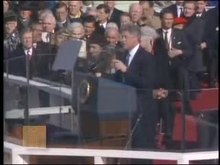

On February 15, 1993, Clinton made his first address to the nation, announcing his plan to raise taxes to cap the budget deficit.[65] Two days later, in a nationally televised address to a joint session of Congress, Clinton unveiled his economic plan. The plan focused on reducing the deficit rather than on cutting taxes for the middle class, which had been high on his campaign agenda.[66] Clinton's advisers pressured him to raise taxes on the theory that a smaller federal budget deficit would reduce bond interest rates.[67]
On May 19, 1993, Clinton fired seven employees of the White House Travel Office, causing the White House travel office controversy even though the Travel Office staff served at the pleasure of the President, who could dismiss them without cause. The White House responded to the controversy by claiming the firings were done because of financial improprieties that had been revealed by a brief FBI investigation.[68] Critics contended the firings had been done to allow friends of the Clintons to take over the travel business and that the involvement of the FBI was unwarranted.[69]
"Our democracy must be not only the envy of the world but the engine
of our own renewal. There is nothing wrong with America that cannot be
cured by what is right with America."
Inaugural address, January 20, 1993.[70]

In November 1993, David Hale, the source of criminal allegations against Bill Clinton in the Whitewater controversy, alleged that Clinton, while governor of Arkansas, pressured him to provide an illegal $300,000 loan to Susan McDougal, the partner of the Clintons in the Whitewater land deal.[73] A U.S. Securities and Exchange Commission investigation did result in convictions against the McDougals for their role in the Whitewater project, but the Clintons themselves were never charged, and Clinton maintains innocence in the affair.
Clinton signed the Brady Bill into law on November 30, 1993, which imposed a five-day waiting period on handgun purchases. He also expanded the Earned Income Tax Credit, a subsidy for low-income workers.[35]
In December of that year, allegations by Arkansas state troopers Larry Patterson and Roger Perry were first reported by David Brock in the American Spectator. Later known as Troopergate, the allegations by these men were that they arranged sexual liaisons for Bill Clinton back when he was governor of Arkansas. The story mentioned a woman named Paula, a reference to Paula Jones. Brock later apologized to Clinton, saying the article was politically motivated "bad journalism" and that "the troopers were greedy and had slimy motives."[74]
|
Clinton's December 8, 1993 remarks on the signing of the North American Free Trade Agreement
|
|
| Problems playing these files? See media help. | |

On January 1, 1994, Clinton signed the North American Free Trade Agreement into law.[80] Throughout his first year in office, Clinton consistently supported ratification of the treaty by the U.S. Senate. Clinton and most of his allies in the Democratic Leadership Committee strongly supported free trade measures; there remained, however, strong disagreement within the party. Opposition came chiefly from anti-trade Republicans, protectionist Democrats and supporters of Ross Perot. The bill passed the house with 234 votes against 200 opposed (132 Republicans and 102 Democrats voting in favor; 156 Democrats, 43 Republicans, and 1 independent against). The treaty was then ratified by the Senate and signed into law by the President.[80]
Clinton's 1994 Omnibus Crime Bill made many changes to U.S. law, including the expansion of the death penalty to include crimes not resulting in death, such as running a large-scale drug enterprise. During Clinton's re-election campaign he said, "My 1994 crime bill expanded the death penalty for drug kingpins, murderers of federal law enforcement officers, and nearly 60 additional categories of violent felons."[81]
"When I took office, only high energy physicists had ever heard of
what is called the Worldwide Web ... Now even my cat has its own page."
Bill Clinton's announcement of Next Generation Internet initiative, 1996.[82]
After two years of Democratic Party control, the Democrats lost control of Congress in the mid-term elections in 1994, for the first time in forty years.[88]

The White House FBI files controversy of June 1996 arose concerning improper access by the White House to FBI security-clearance documents. Craig Livingstone, head of the White House Office of Personnel Security, improperly requested, and received from the FBI, background report files without asking permission of the subject individuals; many of these were employees of former Republican administrations.[91] In March 2000, Independent Counsel Robert Ray determined that there was no credible evidence of any crime. Ray's report further stated, "there was no substantial and credible evidence that any senior White House official was involved" in seeking the files.[92]
On September 21, 1996, Clinton signed into law the Defense of Marriage Act (DOMA), which defines marriage for federal purposes as the legal union of one man and one woman, allowing individual states to refuse to recognize gay marriages performed in other states.[93] Paul Yandura, speaking for the White House gay and lesbian liaison office, said that Clinton's signing of DOMA "was a political decision that they made at the time of a re-election." In defense of his actions, Clinton has said that DOMA was an attempt to "head off an attempt to send a constitutional amendment banning gay marriage to the states", a possibility he described as highly likely in the context of a "very reactionary Congress."[94] Administration spokesman Richard Socarides said, "... the alternatives we knew were going to be far worse, and it was time to move on and get the president re-elected."[95] Others were more critical. The veteran gay rights and gay marriage activist Evan Wolfson has called these claims "historic revisionism".[95] In a July 2, 2011 editorial The New York Times opined, "The Defense of Marriage Act was enacted in 1996 as an election-year wedge issue, signed by President Bill Clinton in one of his worst policy moments."[96]
Despite DOMA, Clinton, who was the first President to select openly gay persons for Administration positions,[97] is generally credited as the first President to publicly champion gay rights.[98] During his Presidency, Clinton controversially issued two substantial executive orders on behalf of gay rights, the first lifting the ban on security clearances for LGBT federal employees[99] and the second outlawing discrimination based on sexual orientation in the federal civilian workforce.[100] Under President Clinton's leadership, federal funding for HIV/AIDS research, prevention and treatment more than doubled.[101] And Clinton also pushed for passing hate crimes laws for gays and for the private sector Employment Non-Discrimination Act, which, buoyed by his lobbying, failed to pass the Senate by a single vote in 1996.[102] Advocacy for these issues, paired with the politically unpopular nature of the gay rights movement at the time, led to enthusiastic support for Clinton's election and reelection by the Human Rights Campaign.[98] Clinton came out for gay marriage in July 2009[103] and urged the Supreme Court to overturn DOMA in 2013.[104] He was later honored by GLAAD for his prior pro-gay stances and his reversal on DOMA.[105]
As part of a 1996 initiative to curb illegal immigration, Clinton signed the Illegal Immigration Reform and Immigrant Responsibility Act (IIRIRA) on September 30, 1996. Appointed by Clinton,[106] the U.S. Commission on Immigration Reform recommended reducing legal immigration from about 800,000 people a year to about 550,000.[107][108]
The 1996 United States campaign finance controversy was an alleged effort by the People's Republic of China (PRC) to influence the domestic policies of the United States, before and during the Clinton administration, and involved the fundraising practices of the administration itself. The Chinese government denied all accusations.[109]
Second term, 1997–2001


Impeachment
In a lame-duck session of Congress after the 1998 elections, the House voted to impeach Clinton, based on alleged acts of perjury and obstruction of justice related to the Lewinsky scandal.[35] This made Clinton only the second U.S. president to be impeached (the first being Andrew Johnson). Impeachment proceedings were based on allegations that Clinton had illegally lied about and covered up his relationship with 22-year-old White House intern Monica Lewinsky.[112] After the Starr Report was submitted to the House providing what it termed "substantial and credible information that President Clinton Committed Acts that May Constitute Grounds for an Impeachment",[113] the House began impeachment hearings against Clinton before the mid-term elections. To hold impeachment proceedings, the Republican leadership called a lame-duck session in December 1998.
The Senate later voted to acquit Clinton on both charges.[115] The Senate refused to meet to hold an impeachment trial before the end of the old term, so the trial was held over until the next Congress. Clinton was represented by Washington law firm Williams & Connolly.[116] The Senate finished a twenty-one-day trial on February 12, 1999, with the vote of 55 Not Guilty/45 Guilty on the perjury charge[115] and 50 Not Guilty/50 Guilty on the obstruction of justice charge.[117] Both votes fell short of the Constitutional two-thirds majority requirement to convict and remove an officeholder. The final vote was generally along party lines, with no Democrats voting guilty, and only a handful of Republicans voting not guilty.[115]
Clinton controversially issued 141 pardons and 36 commutations on his last day in office on January 20, 2001.[35][118] Most of the controversy surrounded Marc Rich and allegations that Hillary Clinton's brother, Hugh Rodham, accepted payments in return for influencing the president's decision-making regarding the pardons.[119] Some of Clinton's pardons remain a point of controversy.[120]
Military and foreign events
Further information: Foreign policy of the Bill Clinton administration


In response to the 1998 Al-Qaeda bombings of U.S. embassies in East Africa that killed a dozen Americans and hundreds of Africans, Clinton ordered cruise missile strikes on terrorist targets in Afghanistan and Sudan. First was a Sudanese Pharmaceutical company suspected of assisting Osama Bin Laden in making chemical weapons. The second was Bin Laden's terrorist training camps in Afghanistan.[125] Clinton was subsequently criticized when it turned out that a pharmaceutical plant in Sudan (originally alleged to be a chemical warfare plant) had been destroyed.

In Clinton's 1998 State of the Union Address, he warned Congress of Iraqi dictator Saddam Hussein's possible pursuit of nuclear weapons:
Together we must also confront the new hazards of chemical and biological weapons, and the outlaw states, terrorists and organized criminals seeking to acquire them. Saddam Hussein has spent the better part of this decade, and much of his nation's wealth, not on providing for the Iraqi people, but on developing nuclear, chemical and biological weapons and the missiles to deliver them. The United Nations weapons inspectors have done a truly remarkable job, finding and destroying more of Iraq's arsenal than was destroyed during the entire gulf war. Now, Saddam Hussein wants to stop them from completing their mission. I know I speak for everyone in this chamber, Republicans and Democrats, when I say to Saddam Hussein, "You cannot defy the will of the world", and when I say to him, "You have used weapons of mass destruction before; we are determined to deny you the capacity to use them again.[136]

Clinton's November 2000 visit to Vietnam was the first by a U.S. President since the end of the Vietnam War.[142] Clinton remained popular with the public throughout his two terms as President, ending his presidential career with a 65 percent approval rating, the highest end-of-term approval rating of any President since Dwight D. Eisenhower.[143] On October 10, 2000, Clinton signed into law the U.S.–China Relations Act of 2000, which granted permanent normal trade relations (PNTR) trade status to People's Republic of China.[144] The president asserted that free trade would gradually open China to democratic reform.[145] Clinton also oversaw a boom of the U.S. economy. Under Clinton, the United States had a projected federal budget surplus for the first time since 1969.[146]
After initial successes such as the Oslo accords of the early 1990s, Clinton attempted to address the Arab–Israeli conflict. Clinton brought Israeli Prime Minister Ehud Barak and Palestinian Authority Chairman Yasser Arafat together at Camp David.[35] Following the peace talk failures, Clinton stated Arafat "missed the opportunity" to facilitate a "just and lasting peace." In his autobiography, Clinton blames Arafat for the collapse of the summit.[3][147] The situation broke down completely with the start of the Second Intifada.[35]
Judicial appointments
Main articles: Bill Clinton Supreme Court candidates and Bill Clinton judicial appointments
Clinton appointed the following justices to the Supreme Court:- Ruth Bader Ginsburg – 1993[148]
- Stephen Breyer – 1994[149]
Public opinion

As he was leaving office, a CNN/USA TODAY/Gallup poll revealed 45 percent said they would miss him. While 55 percent thought he "would have something worthwhile to contribute and should remain active in public life", 68 percent thought he would be remembered for his "involvement in personal scandal", and 58 percent answered "No" to the question "Do you generally think Bill Clinton is honest and trustworthy?" Forty-seven percent of the respondents identified themselves as being Clinton supporters. The same percentage said he would be remembered as either "outstanding" or "above average" as a president, while 22 percent said he would be remembered as "below average" or "poor".[154]
The Gallup Organization published a poll in February 2007, a correspondents to name the greatest president in U.S. history; Clinton came in fourth place, capturing 13 percent of the vote. In a 2006 Quinnipiac University Polling Institute poll asking respondents to name the best president since World War II, Clinton ranked number two behind Ronald Reagan. However, in the same poll, when respondents were asked to name the worst president since World War II, Clinton was placed number three behind Richard Nixon and George W. Bush.[155] In May 2006, a CNN poll comparing Clinton's job performance with that of his successor, George W. Bush, found that a strong majority of respondents said Clinton outperformed Bush in six different areas questioned.[156]
ABC News characterized public consensus on Clinton as, "You can't trust him, he's got weak morals and ethics – and he's done a heck of a good job."[143] After leaving office, Clinton's Gallup Poll rating of 66 percent was the highest approval rating of any postwar president, three points ahead of both Reagan and John F. Kennedy.[157]
In March 2010, a Newsmax/Zogby poll asking Americans which of the current living former presidents they think is best equipped to deal with the problems the country faces today, found that a wide margin of respondents would pick Bill Clinton. Clinton received 41 percent of the vote, while George W. Bush received 15 percent, George H. W. Bush received 7 percent, and Jimmy Carter received 5 percent.[158]
Public image
Main article: Public image of Bill Clinton

Clinton drew strong support from the African American community and made improving race relations a major theme of his presidency.[171] In 1998, Nobel laureate Toni Morrison called Clinton "the first Black president", saying, "Clinton displays almost every trope of blackness: single-parent household, born poor, working-class, saxophone-playing, McDonald's-and-junk-food-loving boy from Arkansas".[172] Noting that Clinton's sex life was scrutinized more than his career accomplishments, Morrison compared this to the stereotyping and double standards that blacks typically endure.[172]
Shortly after he took office, conservative newspaper owner Richard Mellon Scaife organized a fundraising campaign to smear Clinton's image in the media.[173] Leading the Arkansas Project, Scaife and other associates sought to find sources in Clinton's home state of Arkansas who would be willing to dish out negative allegations against the President.[173]

In 1992, Gennifer Flowers stated that she had a relationship with Clinton that began in 1980.[181] Flowers at first denied that she had an affair with Clinton, but later changed her story.[182][183] After Clinton at first denied having a relationship with Flowers on 60 Minutes, he later admitted that he had a sexual encounter with Flowers.[184]
In 1998, Kathleen Willey alleged that Clinton groped her in a hallway in 1993. An independent counsel determined Willey gave "false information" to the FBI, inconsistent with sworn testimony related to the Jones allegation.[185] On March 19, 1998, Julie Hiatt Steele, a friend of Willey, released an affidavit, accusing the former White House aide of asking her to lie to corroborate Ms. Willey's account of being sexually groped by President Clinton in the Oval Office.[186] An attempt by Kenneth Starr to prosecute Steele for making false statements and obstructing justice ended in a mistrial and Starr declined to seek a retrial after Steele sought an investigation against the former Independent Counsel for prosecutorial misconduct.[187] Linda Tripp's grand jury testimony also differed from Willey's claims regarding inappropriate sexual advances.[188]
Also in 1998, Juanita Broaddrick alleged Clinton had raped her though she did not remember the exact date, which may have been 1978.[189] In another 1998 event, Elizabeth Ward Gracen recanted a six-year-old denial and stated she had a one night stand with Clinton in 1982.[190] Gracen later apologized to Hillary Clinton.[191] Throughout the year, however, Gracen eluded a subpoena from Kenneth Starr to testify her claim in court.[192]
Post-presidential career
Main article: Post-presidency of Bill Clinton

Activities up until 2008 campaign
In 2002, Clinton warned that pre-emptive military action against Iraq would have unwelcome consequences,[194][195] and later claimed to have opposed the Iraq War from the start (though some dispute this).[196] In 2005, Clinton criticized the Bush administration for its handling of emissions control, while speaking at the United Nations Climate Change Conference in Montreal.[197]The William J. Clinton Presidential Center and Park in Little Rock, Arkansas was dedicated in 2004.[198] Clinton released a best-selling autobiography, My Life in 2004.[199] In 2007, he released Giving: How Each of Us Can Change the World, which also became a The New York Times Best Seller and garnered positive reviews.[200]


Presidential election 2008
During the 2008 Democratic presidential primary campaign, Clinton vigorously advocated on behalf of his wife, Hillary Clinton. Through speaking engagements and fundraisers, he was able to raise $10 million toward her campaign.[213] Some worried that as an ex-president, he was too active on the trail, too negative to Clinton rival Barack Obama, and alienating his supporters at home and abroad.[214] Many were especially critical of him following his remarks in the South Carolina primary, which Obama won. Later in the 2008 primaries, there was some infighting between Bill and Hillary's staffs, especially in Pennsylvania.[215] Considering Bill's remarks, many thought that he could not rally Hillary supporters behind Obama after Obama won the primary.[216] Such remarks lead to apprehension that the party would be split to the detriment of Obama's election. Fears were allayed August 27, 2008, when Clinton enthusiastically endorsed Obama at the 2008 Democratic National Convention, saying that all his experience as president assures him that Obama is "ready to lead".[217] After Hillary Clinton's presidential campaign was over, Bill Clinton continued to raise funds to help pay off her campaign debt.[218][219]After the 2008 election

Since then, Clinton has been assigned a number of other diplomatic missions. He was named United Nations Special Envoy to Haiti in 2009.[223] In response to the 2010 Haiti earthquake, U.S. President Barack Obama announced that Clinton and George W. Bush would coordinate efforts to raise funds for Haiti's recovery.[224] Clinton continues to visit Haiti to witness the inauguration of refugee villages, and to raise funds for victims of the earthquake.[225] In 2010, Clinton announced support of, and delivered the keynote address for, the inauguration of NTR, Ireland's first environmental foundation.[226][227] At the 2012 Democratic National Convention, Clinton gave a widely praised speech nominating Barack Obama.[228]
Post-presidential health concerns
In September 2004, Clinton received a quadruple bypass surgery.[229] In March 2005, he underwent surgery for a partially collapsed lung.[230] On February 11, 2010, he was rushed to Columbia Presbyterian Hospital in New York City after complaining of chest pains, and had two coronary stents implanted in his heart.[229][231] After this experience, Clinton adopted the plant-based whole foods (vegan) diet recommended by doctors Dean Ornish and Caldwell Esselstyn.[232]Clinton has reportedly begun practicing Buddhist meditation in order to help him relax and achieve a healthier lifestyle.[233]
Wealth
The Clintons have accrued several million dollars in legal bills during Bill Clinton's presidency.[234] They were eventually paid off 4 years after he left office.[235] Both Bill and Hillary Clinton have received millions of dollars in book authorship fees.[236] In July 2014, the Daily Mail reported that together, the couple "has earned more than $160 million in the decade after Bill's second presidential term came to an end."[237] Also in July 2014, the Wall Street Journal reported that at the end of 2012, the Clintons were worth between $5 million and $25.5 million, and that in 2012 (the last year they were required to disclose the information) the Clintons made between $16-17 million, mostly from speaking fees earned by the former president.[238] In June 2014, ABC News and The Washington Post reported that Bill Clinton has made more than $100 million giving paid speeches since leaving public office, and in 2008, the New York Times (NYT) reported that the Clintons' income tax returns[239] show they have made $109 million in the 8 years from Jan. 1, 2000 to Dec. 31, 2007, including almost $92 million from his speaking and book-writing.[236][240][241][242] Hillary Clinton said that she and Bill came out of the White House financially "broke" and in debt, especially due to large legal fees incurred during their years in the White House. "We had no money when we got there, and we struggled to, you know, piece together the resources for mortgages, for houses, for Chelsea's education." She added, "Bill has worked really hard ... we had to pay off all our debts ... he had to make double the money because of, obviously, taxes; and then pay off the debts, and get us houses, and take care of family members."[241]Honors and accolades
Main article: List of honors and awards earned by Bill Clinton


He has been honored in various other ways, in countries that include the Czech Republic,[258] Papua New Guinea,[259] Germany,[260] and Kosovo.[249] The Republic of Kosovo, in gratitude for his help during the Kosovo War, renamed a major street in the capital city of Pristina as Bill Clinton Boulevard and added a monumental Clinton statue.[261][262][263]
In 1992, Clinton was selected as Time's "Man of the Year",[264] and again in 1998, along with Ken Starr.[265] From a poll conducted of the American people in December 1999, Clinton was among eighteen included in Gallup's List of Widely Admired People of the 20th century.[266] He was honored with a Grammy Award for Best Spoken Word Album for Children, a J. William Fulbright Prize for International Understanding,[267] a TED Prize (named for the confluence of technology, entertainment and design),[268] and was named as an Honorary GLAAD Media Award recipient for his work as an advocate for the LGBT community.[269] U.S. President Barack Obama awarded Clinton the Presidential Medal of Freedom on November 20, 2013.[270]
Authored books
- Between Hope and History. New York: Times Books. 1996. ISBN 978-0-8129-2913-3.
- My Life (1st ed.). New York: Vintage Books. 2004. ISBN 978-1-4000-3003-3.
- Giving: How Each of Us Can Change the World (1st ed.). New York: Knopf. 2007. ISBN 0-307-26674-5.
- Back to Work: Why We Need Smart Government for a Strong Economy. Knopf. 2011. ISBN 978-0-307-95975-1.


No comments:
Post a Comment
Please leave a comment-- or suggestions, particularly of topics and places you'd like to see covered