Astronomy Picture of the Day
Discover the cosmos!
Each day a different image or photograph of our fascinating universe is
featured, along with a brief explanation written by a professional astronomer.
2014 August 24
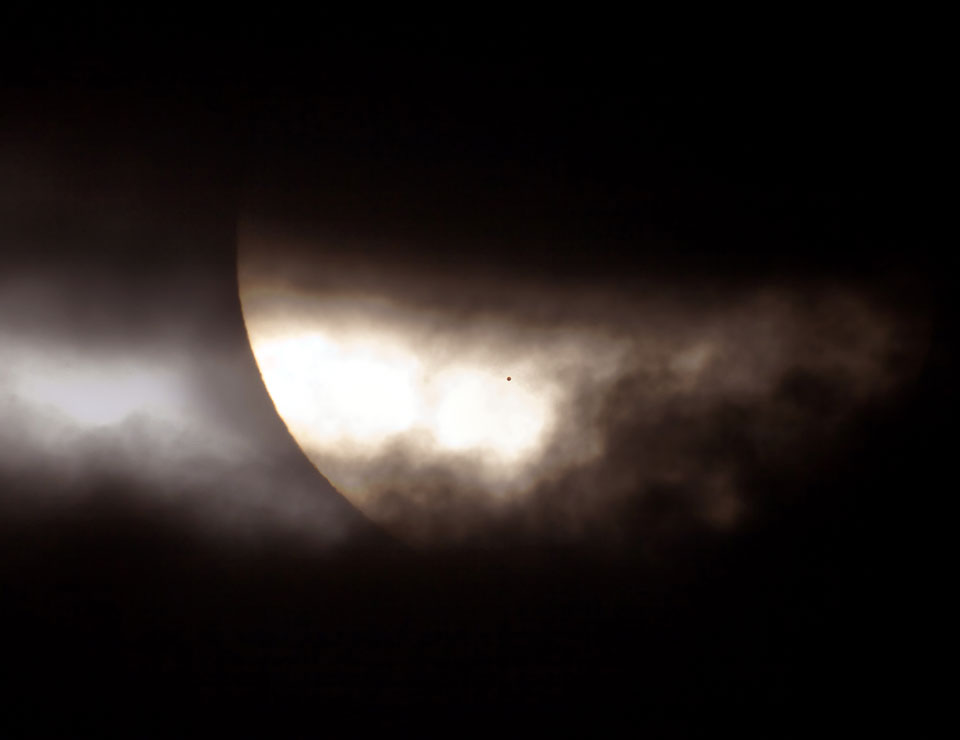 Mercury's Transit: An Unusual Spot on the Sun
Image Credit & Copyright:
David Cortner
Explanation:
What's that dot on the Sun?
If you look closely, it is almost perfectly round.
The dot is the result of an unusual type of
solar eclipse that occurred in 2006.
Usually it is the
Earth's Moon that eclipses the Sun.
This time, the planet
Mercury
took a turn.
Like the approach to New Moon before a
solar eclipse,
the phase of Mercury became a continually thinner
crescent as the planet
progressed toward an alignment with the Sun.
Eventually the phase of
Mercury dropped to zero and
the dark spot of Mercury crossed our parent star.
The situation could technically be labeled a Mercurian
annular
eclipse with an extraordinarily large
ring of fire.
From above the
cratered planes
of the night side of Mercury, the Earth appeared in its fullest phase.
Hours later, as Mercury continued in its orbit, a slight
crescent phase appeared again.
The
next Mercurian solar eclipse
will occur in 2016.
Tomorrow's picture: long tail
<
|
Archive
|
Index
|
Search
|
Calendar
|
RSS
|
Education
|
About APOD
|
Discuss
|
>
Authors & editors:
Robert Nemiroff
(
MTU) &
Jerry Bonnell (
UMCP)
NASA Official: Phillip Newman
Specific rights apply.
NASA Web
Privacy Policy and Important Notices
A service of:
ASD at
NASA /
GSFC
& Michigan Tech. U.


No comments:
Post a Comment
Please leave a comment-- or suggestions, particularly of topics and places you'd like to see covered