Astronomy Picture of the Day
Discover the cosmos!
Each day a different image or photograph of our fascinating universe is
featured, along with a brief explanation written by a professional astronomer.
2014 September 14
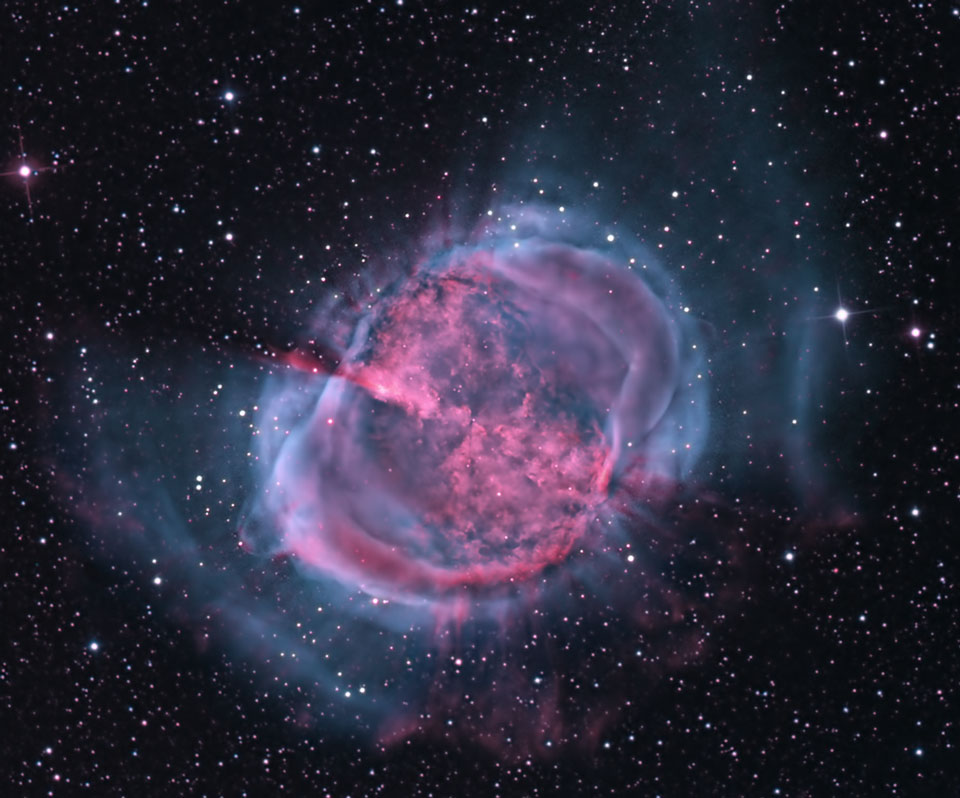 M27: The Dumbbell Nebula
Image Credit & Copyright:
Bill Snyder
(Bill
Snyder Photography)
Explanation:
The first hint of what will become of our
Sun
was discovered inadvertently in
1764.
At that time,
Charles Messier was compiling a list
of diffuse objects not to be confused with comets.
The 27th object on
Messier's list, now known as
M27 or the Dumbbell Nebula, is a
planetary nebula,
the type of nebula our
Sun will produce when
nuclear fusion stops in its core.
M27 is one of the brightest
planetary nebulae on the sky,
and can be seen toward the
constellation of the Fox (
Vulpecula) with binoculars.
It takes light about 1000 years to reach us from M27,
shown above in colors emitted by
hydrogen and
oxygen.
Understanding the physics and significance of
M27
was well beyond 18th century science.
Even today, many things remain mysterious about
bipolar planetary nebula like
M27, including the physical mechanism that expels a
low-mass star's gaseous outer-envelope, leaving an
X-ray hot
white dwarf.
Tomorrow's picture: dark comet
<
|
Archive
|
Index
|
Search
|
Calendar
|
RSS
|
Education
|
About APOD
|
Discuss
|
>
Authors & editors:
Robert Nemiroff
(
MTU) &
Jerry Bonnell (
UMCP)
NASA Official: Phillip Newman
Specific rights apply.
NASA Web
Privacy Policy and Important Notices


No comments:
Post a Comment
Please leave a comment-- or suggestions, particularly of topics and places you'd like to see covered