
Subscribe for ad free access & additional features for teachers. Authors: 267, Books: 3,607, Poems & Short Stories: 4,435, Forum Members: 71,154, Forum Posts: 1,238,602, Quizzes: 344
Alexandre Dumas pere
Search
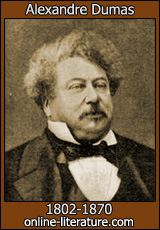
Alexandre Dumas, père, (1802-1870), prolific French playwright, historian, and author is best known today for his novel (first serialised in the magazine Le Siècle), The Three Musketeers (1844);
It is by his courage, please observe, by his courage alone, that a gentleman can make his way nowadays. Whoever hesitates for a second perhaps allows the bait to escape which during that exact second fortune held out to him. You are young. You ought to be brave for two reasons: the first is that you are a Gascon, and the second is that you are my son. Never fear quarrels, but seek adventures. I have taught you how to handle a sword; you have thews of iron, a wrist of steel. Fight on all occasions.--Ch. 1
This is the counsel young D'Artagnan's father gives him as he sets off to Paris to become a musketeer. He becomes fast friends with Athos, Porthos, and Aramis and embraces their motto "One for all, and all for one", exemplifying the major theme in Dumas' works of loyalty and honour among men. Like Honore de Balzac (1799-1850) Dumas père also wrote several roman feuilleton or serial works; Twenty Years After (1845) and The Vicomte de Bragelonne (1847), including Louise de la Valliere, Ten Years Later, and The Man in the Iron Maskconcludes his d'Artagnan Romances.
The Count of Monte Cristo (1844), first serialised in the weekly Journal des débats was also a huge literary and financial success for Dumas père. Through protagonist Edmond Dantès the reader is taken along his journey of a wrongful trial, his search for justice, revenge, and ultimately riches, forgiveness, and love. Mirroring Dumas père's own life of high adventure and decadence, he based many of his protagonists on historical figures, as is apparent in his Celebrated Crimes series (written between 1839 and 1841) which includes essays on The Borgias, Ali Pacha, Mary Stuart, and La Constantin. Although the issue of his part-African ancestry was not one that Dumas père wrote about often Georges: The Planter of the Isle of France (1843) particularly deals with the theme of mixed-race and white colonialism. Dumas père collaborated with French historian and author Auguste Maquet (1813-1886) on some of his more famous works; many of them are still in print today and have inspired other author's works and numerous adaptations to the stage and screen.
Alexandre Dumas père was born on 24 July 1802 in the village of Villers-Cotterêts, just outside of Paris, France, the third child born to Marie Louise Labouret, daughter of an inn keeper, and Thomas Alexandre Davy de la Pailleterie (1762-1806) a military General under Napoléon. Alexandres' grandfather, the Marquis Alexandre Davy de La Pailleterie (1710-1786) married a slave he fell in love with in San Domingo (now Haiti) named Marie Louise Césette Dumas (d.1772). Thomas took her last name when he himself enlisted with the French army. After a falling out with Napoléon due to his criticism of the Egypt campaign, and a long imprisonment which left him in poor health, Thomas returned returned home a broken man with no pension. After his death the family was left in dire financial straits. Alexandre's mother set her best efforts to providing an education for her son although he proved to be less than enthusiastic about it. He attended Abbé Grégoire's school before finding employment with a local notary to help support the family.
In 1822 Dumas père set off for Paris and was soon immersed in literary life. He worked as a scribe for the duc d'Orléans, later to be King Louis Philippe when the 1830 revolution which Dumas père participated in ousted King Charles X. He met noted playwrights and collaborated with them before making his own entrance to the stage at the Comédie française with his plays Henry III and His Court (1829), The Tower of Nesle (1832), Kean (1836), and his Byronic Antony(first performed in 1831) inspired by the works of Lord George Gordon Byron. An avid reader of William Shakespeare and Sir Walter Scott, his dramas were immensely popular, being among the first of the Romantic movement along with friend and sometimes rival Victor Hugo's (1802-1885). They were a decided change from the Neoclassic style that dominated Parisian stages at the time. During this period Dumas père had a son, Alexandre fils (1824-1895) with his lover Marie Laure Catherine Labay (1794-1868) who also became a noted author and playwright, being admitted to the Académie française in 1874. Although Dumas père kept up his womanising ways, in 1840 he married actress Ida Ferrier (1811-1859) and had an illegitimate daughter, Marie Alexandrine (b.1831) with Belle Kreilssamner (1803-1875).
After a short but terrifying bout of cholera during the epidemic of 1832, Dumas père was ordered by his physician--"when they have nothing more to say" [from The Glacier Land (1852)]--to take a tour of Europe; on 21 July 1832 he left Paris and embarked on his first of many travels which took him to such countries as Austria, the Netherlands, Spain, England, Germany, and North Africa. As was his wont, he kept remarkable records of his adventures included in Travel Impressions: In Switzerland (1834), A Year in Florence (1841), From Paris to Cadiz(1847), The Caucasus (1859), and Travel Impressions: In Russia (1860).
Dumas père continued his prodigious output of essays, short stories, and novels. With the success of The Count of Monte Cristo and The Three Musketeers he sought a place of refuge to concentrate on further writings. He bought land and built the Château de Monte Cristo (nicknamed Château d'If) in Port Marly, Yvelines, France, now a museum. There he worked when not lavishly entertaining guests, but it was not long before he had to sell it when his debts grew too much. In 1851 he fled to Brussels, Belgium to avoid creditors. Further titles published during this time were his Valois Romances including Queen Margot(1845), The Lady of Monsoreau (a.ka. Chicot the Jester (1845), and The Forty-Five Guardsmen (1847); and The Regent's Daughter (1845), The Two Dianas(1846), The Black Tulip (1850), The Wolf Leader (1857), The Companions of Jehu(1857), and his autobiography Mes Mémoires (written between 1852-55).
Alexandre Dumas père died on 5 December 1870 at his son's villa in Puys, near Dieppe, France. He was buried in the cemetery of Villers-Cotterêts, but as of the year 2002 he now rests in the Panthéon in Paris, among other such notable French literary giants as Émile Zola, Victor Hugo, Jean Jacques Rousseau, and Francois-Marie Arouet Voltaire.
Tell the angel who will watch over your future destiny, Morrel, to pray sometimes for a man, who like Satan thought himself for an instant equal to God, but who now acknowledges with Christian humility that God alone possesses supreme power and infinite wisdom. .... There is neither happiness nor misery in the world; there is only the comparison of one state with another, nothing more. He who has felt the deepest grief is best able to experience supreme happiness. We must have felt what it is to die, Morrel, that we may appreciate the enjoyments of living."Live, then, and be happy, beloved children of my heart, and never forget that until the day when God shall deign to reveal the future to man, all human wisdom is summed up in these two words,--"Wait and hope."--Ch. 117, The Count of Monte Cristo
Biography written by C. D. Merriman for Jalic Inc. Copyright Jalic Inc. 2008. All Rights Reserved.
The above biography is copyrighted. Do not republish it without permission.
Forum Discussions on Alexandre Dumas pereRecent Forum Posts on Alexandre Dumas pere
Fiction
Non-Fiction
Short Stories
Essays
Quizzes on Alexandre Dumas pere
Related links for Alexandre Dumas pere
Here is where you find links to related content on this site or other sites, possibly including full books or essays about Alexandre Dumas pere written by other authors featured on this site.


Der schwarze Teufal
Finally starting the Marie Antoinette series
Attention Dumas lovers!
French actor Pardieu to play A. Dumas pere ....
Good News Dumas fans
Advice on reading Dumas
Sylvandire
Hi, new to the forums, and I need a suggestion.
Any Dumas fans out there?
English Translations?
Dumas Biography: Any suggestions?
Advice Needed on Similiar Book Plots