
In Venezuela, An iPhone 6 May Cost You $47,678
The IPhone 6 can cost up to $47,678 in Venezuela, the country with the world's highest inflation rate.
Venezuela is facing harsh economic times, and though the number of mobile users has shrunk by almost half since 2012, Bloomberg reports that those who want one have to go through the government-run phone provider amid a dollar shortage and a lack of inventory, making the cost very expensive.
A new-model Apple iPhone 6 is about 300,000 bolivars or $47,678 at Mercado Libre, a local e-commerce site. This is about 41 times the country's minimum wage.
Though the country recently raised its minimum wage by 30 percent, it is still about $30 a month at black market prices. A 3G Samsung Galaxy Fame cost more than two months pay for those making minimum wage.
Venezuela has seen its wealth shrink sharply as oil prices have fallen by a third; Venezuela is one of the world's oil suppliers. The country's reserves of international currencies are at their lowest level in 12 years, and there are widespread shortages of food and other supplies.
Despite the tough economic situation, those who can afford newer cell phone models face another issue - theft.
"You never know how you're going to react in a situation like that," Maria Veronica Fernandez, who was robbed of her phone at gunpoint told Bloomberg. "In the end, all you can do is settle, and it really sucks."
Voices: Yes, I Speak Spanish and Proper English
Speaking Spanish and "proper" English are not mutually exclusive.
A few weeks ago, I struck up a conversation with someone at an airport. After a couple of hours of chatting, my phone rang and it was my father. I have always spoken to my dad in Spanish, so I switched and spoke away in fast Spanish. When I hung up, the person was in awe and said to me "Is Spanish your first language? I would've never guessed... You don't have an accent at all when you speak."
Really? Many people think these two actions (speaking Spanish and English without an accent) are mutually exclusive. These conversations happen daily; so many people have stories like these. Gemarla Babilonia-Gaskin, a Puerto Rican blogger living in Long Island, New York, says people are amazed when she speaks Spanish. They say, "OMG you have no accent!" coupled by "the look" - people looking at her quizzically, not quite "getting" who she is.
These experiences, along with so many other anecdotes friends have shared with me, made me realize there are many misconceptions about Hispanics and language. Not all Latinos have accents and not all Hispanics are bilingual. Our community is not homogeneous.
"I CAN'T HELP BUT WONDER WHAT ASSUMPTIONS ARE MADE ABOUT ME BECAUSE I SPEAK SPANISH."
There are millions of people who are fully bilingual, educated, US citizens and speak flawless English. There are also millions of people who are U.S. citizens and whose first language is Spanish, since it's the prevalent language in Puerto Rico, which is a U.S. commonwealth.
I can't help but wonder what assumptions are made about me because I speak Spanish. Did the woman at the airport wonder if I was documented, or if I had gone to college? I wish we could have spoken further so I could have told her that yes, I went to college, and as a matter of fact I will soon have two graduate degrees. I would have also explained to her that I also speak French, and that I'm raising my son to be multilingual.
In fact, I wonder, if she had heard me speaking in French, would she have asked the same question, "Is French your first language? I would've never guessed?" I wonder if that assumption only occurs with Spanish speakers.
So let's talk about accents. Why are some accents, like French, considered better, connoting more education or even sexiness, while others are considered less desirable? Even more importantly, since when is it bad to have an accent? Last time I checked having an accent in another language meant that you actually took the time to go to another place and learn another language. This shows courage, strength and determination to get ahead in a place that is foreign to you. So there should be no shame in an accent.
When does a person develop an accent when learning another language? There is actually no consensus among the linguistic community, according to linguist and researcher Francois Grosjean. While some have proposed that you can have an "accentless" second language if you learn it before age 6 and some have extended it to the age of 12, "I have met bilinguals who acquired their second or third language even later who do not have an accent in it," stated Grosjean.
Luckily, today, speaking more than one language is seen as a plus. Dual language programs are popular and adults who may not speak Spanish are going back to school to learn their heritage language, even if it means speaking with an accent.
Accents are also not static. One's accent changes depending on the situation, the people you are speaking to and the place. I know that my Spanish changes depending on who I am speaking to and where I am. Somehow, the Spanish that comes out of my mouth in Mexico does not sound the same as the one that comes out of my mouth when I speak to my parents, or when I am talking to another Latina.
Just to put it in context, a majority of Hispanics (65 percent) in the US are born here and the majority of us are bilingual, 59 percent to be exact, according to the Pew Research Center. In fact, there are Latinos whose families have been here for generations and they don't speak any Spanish, yet they are still Latino.
That is exactly Melanie Mendez-Gonzales' case. The blogger behind Qué Means What is a Texas native and her first language is not Spanish; she learned it later on as an adult. When she speaks it, she feels very self-conscious doing so. "I have a Texan accent and it really is noticeable when I speak Spanish," Melanie says. Sometimes, she gets corrected for her misuse of words. She finds herself explaining that she is Latina even though she speaks Spanish with an accent. So among U.S. Hispanics, you have it all - from mostly Spanish or mostly English speakers to fully bilingual.
I hope that as our country becomes increasingly diverse, we don't make assumptions about a person's educational attainment, background or immigration status based on how a person speaks English or another language. People with accents have been part of the American mosaic since its inception. The diversity, hard work and strength of many immigrant people is what has made America the place it is today.
Diana Limongi is a freelance writer and blogger. She has an MPA in Nonprofit Management and an MA in Migration Studies, and lives in New York City with her family. Follow her on Twitter @dianalimongi
Miles Morales Replaces Peter Parker As Spider-Man
Spider-Man comics just got a new leading man, thanks to popular demand.
Marvel Comics announced this week that Miles Morales, a half Latino, half African-American character who was Spider-Man in the alternate universe version of the comic is now Spider-Man.
"When we first peeled back Spider-Man's iconic mask to reveal a new face — that of African-American/Hispanic Miles Morales — we didn't dare dream that he'd connect the way he has with so many fans of all creeds and colors," said Marvel Editor-In-Chief Axel Alonso to NBC News via e-mail. "That speaks volumes about the growing comic book audience and the universality of Miles' story."
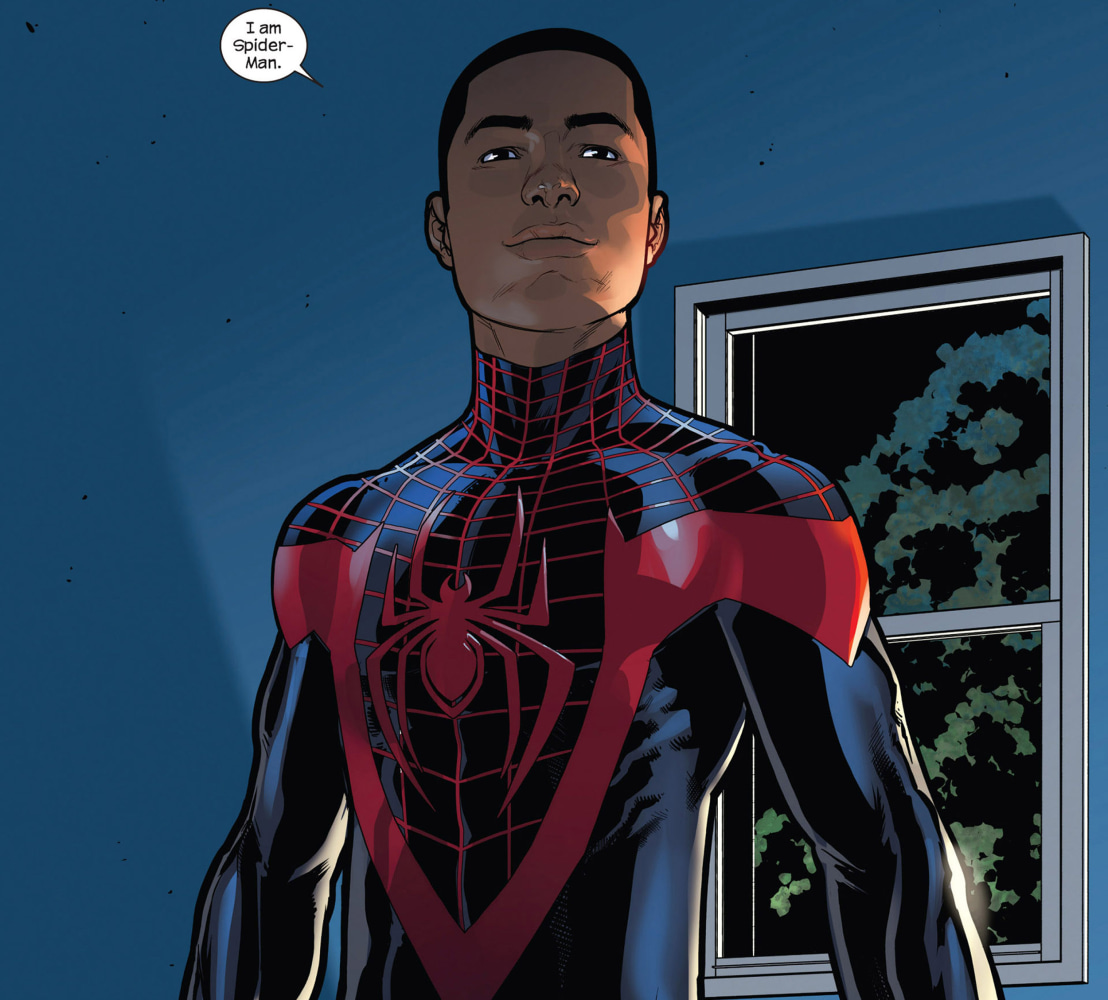
The storyline of teen Miles Morales, son of an African American father and Puerto Rican mother, was first introduced in 2011. He played a version of Spider-Man in Marvel's offshoot "Ultimate" comic books, replacing the murdered Peter Parker. In the new version coming out in the fall, Peter Parker still will be part of the series, but as a mentor to Morales.
The comic book giant has been trying to create new heroes after years of fans asking for a more diverse lineup. Marvel has already come out with a new female Thor, a black Captain America last year and its first Muslim superhero, Ms Marvel.
Fans online heralded the company for its choice but the celebration was short lived. When Sony and Marvel announced they were going to make a new Spider-Man movie for the screen, fans all over clamored to cast a diverse Spider-Man and make him biracial Miles Morales. But today Marvel and Sony Pictures announced actor Tom Holland will take over the role of Peter Parker in the upcoming film. Twitter reacted swiftly.
While seeing Miles Morales in the big screen might be years away, Latino and African American kids will be able to pick up the new Spider-Man series and see the possibility of someone who looks like them saving the world.

Juanes to Perform for Pope Francis During U.S. Visit
Juanes will perform for Pope Francis in September as a part of the World Meeting of Families, it was announced Tuesday.
The Colombian superstar was named as one of the first performers and will be alongside Andrea Bocelli and The Philadelphia Orchestra on September 26th in Philadelphia.
The event is expected to draw thousands during the Pope's visit to Philadelphia and millions will be watching the event live around the world. Pope Francis will also be going to New York and Washington, D.C.
"I am profoundly honored for the invitation to sing for the Pope Francisco. #ADiosLePido," Juanes tweeted out earlier today following the announcement.
Juanes will perform for the Pope after his summer tour dates across Europe and the United States for his Loco De Amor Tour.


No comments:
Post a Comment
Please leave a comment-- or suggestions, particularly of topics and places you'd like to see covered