
Breaking News
- 12 June 2015 in News: The origins of an emerging bipolar planetary nebula revealed
- 12 June 2015 in News: Helium-shrouded planets may be common in our Galaxy
- 15 June 2015 in News: See Earth-crossing asteroid Icarus in closest approach for 75 years
- 14 June 2015 in News: Europe’s Philae comet lander phones home
- 13 June 2015 in News: Hubble detects ‘sunscreen’ layer on distant exoplanet
See Earth-crossing asteroid Icarus in closest approach for 75 years
By Ade Ashford
Posted on 15 June 2015 by Ade Ashford
At 4:39 pm BST on 16th June, a historically interesting near-Earth asteroid named Icarus will dash by our planet at a distance of just five million miles, or 21 times the Earth-Moon distance. Discovered on 27th June 1949 by Walter Baade at Palomar Observatory, just a few months after the legendary 200-inch Hale Telescope saw first light, this one-kilometre-wide space rock received the provisional designation 1949 MA. Once the particulars of its 409-day orbit had been determined, astronomers quickly realised that it was an unusual object.
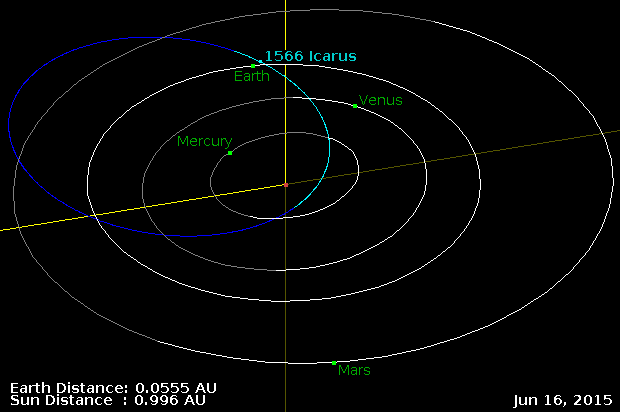
Earth-crossing asteroid 1566 Icarus (1949 MA) will miss our planet by a safe five million miles, or 21 lunar distances, at 4:39 pm BST on 16th June 2015 — the closest it will approach Earth until 2090. Click the graphic to open an interactive Java applet. Image credit: NASA JPL Small-Body Database Browser/Osamu Ajiki/Ron Baalke/Ade Ashford.
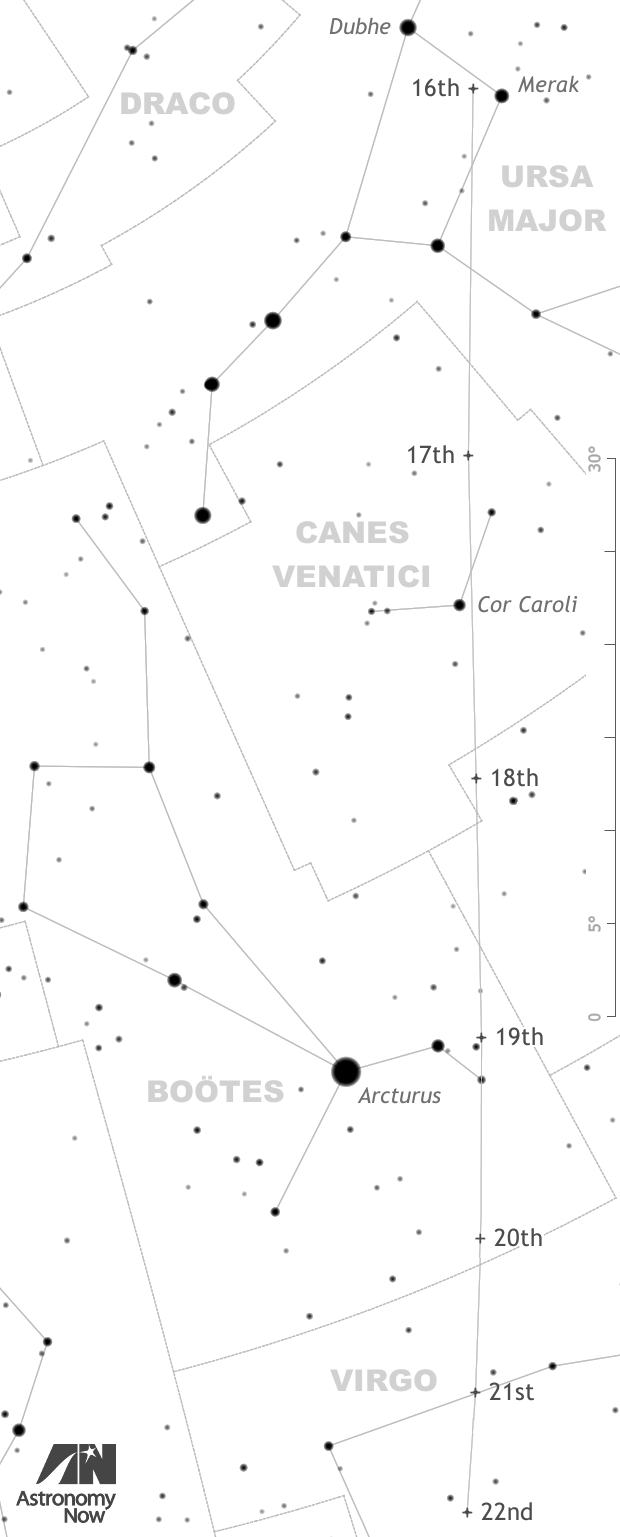
Mile-wide asteroid 1566 Icarus’ encounter with Earth during June 2015 is the nearest it gets to our planet until 2090, but there is no fear of a collision. Icarus makes its closest approach to us at 4:39 pm BST on 16th June at a distance of five million miles (eight million kilometres), or 21 times the Earth-Moon distance. The viewing window for UK-based observers is ~16th—22nd June when the asteroid is moving at a average speed of ½°/hour against the background stars. Icarus reaches a maximum brightness of magnitude +13.5 on the 19th when it will be in the constellation of Boötes near Arcturus, the brightest star in the northern celestial hemisphere. The tick marks show the position of Icarus at 12 am BST on the dates shown. Click on the chart for a printable full-size version. AN illustration by Ade Ashford.
When to observe 1566 Icarus
Weather permitting, this fascinating asteroid will be bright enough to be observable from the British Isles from 16th—22nd June and we will not have to contend with moonlight. However, twilight around the Summer Solstice will be an issue — particularly for those in the north of England and Scotland. Generally speaking, the window of opportunity is between midnight and 2 am when the sky will be dark enough over the UK, but try to view as close to 1 am as you can (all times quoted in this article are British Summer Time, BST).
Weather permitting, this fascinating asteroid will be bright enough to be observable from the British Isles from 16th—22nd June and we will not have to contend with moonlight. However, twilight around the Summer Solstice will be an issue — particularly for those in the north of England and Scotland. Generally speaking, the window of opportunity is between midnight and 2 am when the sky will be dark enough over the UK, but try to view as close to 1 am as you can (all times quoted in this article are British Summer Time, BST).
The phase angle, illumination and distance of Icarus will change rapidly over the week that it is observable, hence its visual magnitude will vary from approximately +14.8 on 16th June, to a peak of +13.5 on the 19th, back to around +14.1 on the 22nd. From 18th—20th June, users of 8-inch and larger telescopes can see Icarus moving against the background stars, something that you will perceive in real time as the asteroid averages 0.5°/hour during the period in question. Owners of smaller telescopes on accurately driven mounts may wish to photograph it or use astrovideo methods to capture it.
First night: June 16th, 12 am—2 am
Icarus will be faint tonight at magnitude +14.8 and only seen visually in 12-inch telescopes and larger, but very easy to locate as it traverses the bowl of the Big Dipper in Ursa Major, passing just 1.4° north-northeast of β Ursae Majoris, or Merak — the lower of the two pointer stars to the Pole Star, Polaris — around 12:20 am BST.
Icarus will be faint tonight at magnitude +14.8 and only seen visually in 12-inch telescopes and larger, but very easy to locate as it traverses the bowl of the Big Dipper in Ursa Major, passing just 1.4° north-northeast of β Ursae Majoris, or Merak — the lower of the two pointer stars to the Pole Star, Polaris — around 12:20 am BST.
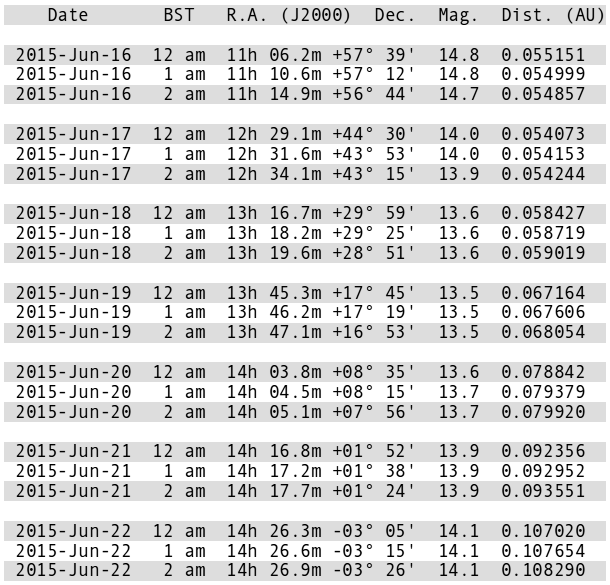
Over the following week we will provide a nightly guide to what to expect, but for those with computerised GoTo telescope mounts or instruments equipped with digital setting circles, the following table gives astrometric Epoch 2000.0 coordinates computed for an observer located in the centre of the British Isles. Parallax will be therefore be negligible for the whole of the UK.

Inside the magazine
You can find out more about observing the Solar System in the June edition of Astronomy Nowin addition to a full observing guide to the night sky.
Never miss an issue by subscribing to the UK’s biggest astronomy magazine. Also available for iPad/iPhone and Android devices.
Related Articles

Asteroid to fly close by Earth safely on 26th January
NASA Jet Propulsion Laboratory Press Release
Dawn spacecraft prepares to image dwarf planet Ceres in detail
NASA's Jet Propulsion Laboratory Press Release

NASA’s Dawn spacecraft becomes the first to orbit a dwarf planet
NASA's Jet Propulsion Laboratory Press Release
© 2015 Pole Star Publications Ltd


No comments:
Post a Comment
Please leave a comment-- or suggestions, particularly of topics and places you'd like to see covered