The Good Friday Agreement and today
The Good Friday Agreement is the cornerstone of our commitment to peace and stability on this island. It was agreed on 10 April 1998 and overwhelmingly approved in 2 referendums in both parts of Ireland in May 1998.
Constitutional status
The Good Friday Agreement gives prominence to the ‘principle of consent’ which affirms the legitimacy of the aspiration to a United Ireland while recognising the current wish of the majority in Northern Ireland to remain part of the United Kingdom.
It goes on to state that...
“it is for the people of Ireland alone, by agreement between the two parts respectively and without external impediment, to exercise their right of self-determination on the basis of consent, freely and concurrently given, North and South, to bring about a United Ireland, accepting that this right must be achieved and exercised with and subject to the agreement and consent of a majority of the people of Northern Ireland”.
Political institutions
The Agreement put in place a framework to establish a number of political institutions. This framework is made up of three strands, together representing the relationships that exist within and between the islands of Britain and Ireland.
Strand One
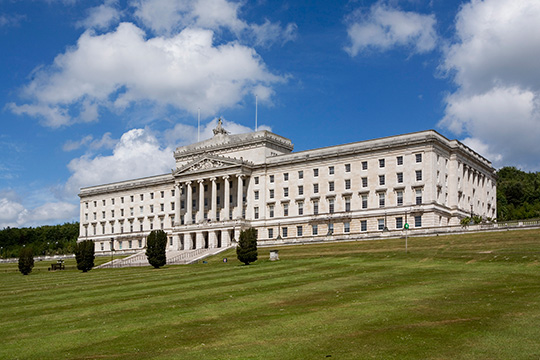
The Northern Ireland Assembly and Executive were set up so that the elected political parties could share power. The Assembly is located at Stormont, just outside Belfast.
Strand Two
The North South Ministerial Council was set up to develop co-operation between both parts of Ireland.
Strand Three
The British-Irish Council was set up to promote the relationship between Ireland and Britain.
These devolved institutions only operated intermittently in the years immediately following the Good Friday Agreement, and the Irish and British Governments continued to work with the parties to build trust and confidence.
Policing and justice
In 2005, the Independent Decommissioning Body confirmed that IRA decommissioning had taken place.
In 2006, the St. Andrew's Agreement was published, which set out a path to full devolution of policing and justice and a stable power-sharing arrangement.
In 2010, the signing of the Hillsborough Agreement allowed for the devolution of policing and justice powers to the Northern Ireland Assembly, which then began later that year.
It also included an agreement on controversial parades which had caused ongoing conflict between communities.
Building a Brighter Future
In 2014, the Irish and British Governments together with the Northern Ireland Executive parties took part in eleven weeks of political talks, resulting in the Stormont House Agreement of 23 December 2014. The Stormont House Agreement covers a broad range of political, social and economic issues and has the potential to advance significantly its twin aims of reconciliation and economic renewal in Northern Ireland. To this end, the Government also undertook a number of financial commitments, as did the UK Government. In the period ahead, the Government will work to ensure the effective and expeditious implementation of the Stormont House Agreement.


No comments:
Post a Comment
Please leave a comment-- or suggestions, particularly of topics and places you'd like to see covered