|
Organized fire fighting began in New York in 1648 when the first Fire
Ordinance was adopted by the Dutch Settlement of New Amsterdam. Fines
levied for dirty chimneys provided funds for the maintenance of buckets, hooks
and ladders. It also established a fire watch of eight Wardens and required
that each male citizen stand his turn on watch.
After the first Wardens were appointed, an organization known as the Prowlers was
formed and furnished with buckets, hooks and ladders. Often called the rattle
watch , they patrolled the streets on the lookout for fire from nine o'clock
at night until dawn.
When the colonists were organized in 1658, bucket brigades were formed and
equipped with 250 leather buckets made by Dutch shoemakers of the colony. Thus,
our first inauspicious beginning was made. Seven years later, in 1664, the colony
became a British settlement and was renamed New York.
It was not until 74 years later, in 1731, that fire brigades were put into
service. Two hand-drawn pumpers, brought from distant London were the first
fire engines to be used in the colony. They were designated as Engine Company
1 and Engine Company 2. All able bodied citizens were required to respond to
alarms and perform duty under the supervision of the Aldermen.
Faced with the problem of a fast growing colony, the General Assembly established
the volunteer Fire Department of the City of New York, in December of 1737.
Able, discreet and sober men were appointed as firemen to be ready for service
by night and day and be diligent, industrious and vigilant.
Following the Revolutionary War, the Department was reorganized and incorporated
as the Fire Department of the City of New York.
The volunteer Fire Department continued to protect the lives and property
of the citizens of the city until after the close of the Civil War when, in
1865, they were superseded by the paid Metropolitan Fire Department. The change
created resentment and bitter actions were taken by some who opposed the elimination
of the volunteers. This resulted in rough and tumble battles fought on both
personal and political levels.
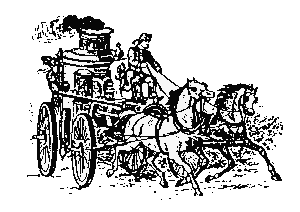
The introduction of the steam engine spelled the final doom of the volunteer
department in New York. The steam apparatus eliminated the need for men to pump
the water, and the horses ended the problem of hauling engines by hand.
At the beginning, the paid fire service extended only to certain parts of
New York City (Manhattan). The Act of 1865 united Brooklyn and New York (cities)
to form a Metropolitan District. By the end of 1865 the department consisted
of 13 Chief Officers and 552 Company Officers and firemen. They worked a continuous
tour of duty, with 3 hours a day for meals and one day off a month. They were
paid salaries according to their rank or grade. The first regulations were also
formulated and they were fairly strict and straightlaced.
The volunteers, despite their disappointment, accepted the decision and publicly
declared that they would continue to function and serve until properly relieved
by paid units.
The Act provided that members of the volunteers were to be given preference
over all others in filling the rolls of the paid department.
Due to major fires, which resulted in excessive fire losses and a rise in
insurance rates, the department was reorganized in 1866 under the command of
General Alexander Schaler. Under military discipline, the department began to
realize its full potential and fire losses began to generally reduce.
The merit system of promotion in the Fire Department was instituted in 1870.
In 1874 Westchester County (later called the Bronx) was annexed and gradually
volunteers there were replaced by companies of the paid department, until the
last volunteer unit was disbanded in 1928.
A further consolidation occurred in 1887 covering what we now know as the
Borough of Queens. Again volunteer units were gradually replaced by paid companies
until, by 1929, this Borough was protected by the paid department of the City
of New York.
Richmond became a part of the greater City of New York in 1898. No change
in the volunteer status took place, except for nominal supervision, until 1905
when the first group of volunteers was disbanded and replaced by paid units.
More paid companies were installed in 1915, 1928, 1932 and 1937, when all but
two volunteer companies were disbanded. These two were the only legal volunteer
companies still active in the City of New York.
New Year's day 1898 heralded the consolidation of the different areas of the
city and the beginning of a new era for the Fire Department. All fire forces
in the various sections were brought under the unified command of the first
Commissioner of the Fire Department.
Following this amalgamation many changes took place involving many aspects
of the job including installation of the high pressure systems, motorization
of fire apparatus, creation of a Marine fleet, adoption of vastly improved working
conditions and the utilization of perfected radio communications.
Today the Fire Department protects more than 8,000,000 residents in an area
of 320 square miles. The department is administered by the Fire Commissioner
appointed by and responsible to the Mayor. The uniformed force is under the
command of the Chief of Department and consists of more than 11,400 Fire Officers
and fire fighters. In addition, the Department includes 2,800 Emergency Medical
Technicians, Paramedics and Supervisors assigned to the Bureau of Emergency
Medical Service (EMS), as well as 1200 civilian employees. |
|



No comments:
Post a Comment
Please leave a comment-- or suggestions, particularly of topics and places you'd like to see covered