NASA tech finds disaster survivors
 |
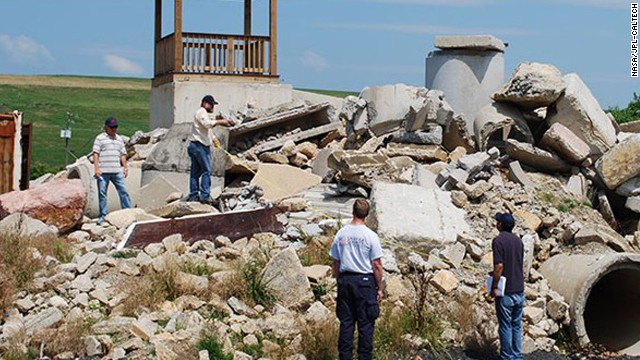
FEMA personnel test the FINDER, which can detect human heartbeats up to 40 feet into a pile of rubble.
STORY HIGHLIGHTS
- A new device can detect heartbeats of disaster survivors under 40 feet of rubble
- Called FINDER, It was created by researchers at NASA's Jet Propulsion Laboratory
- The device could be used in earthquakes, avalanches and tornadoes
The vibrations are small, invisible to the human eye, and might just save your life after a major disaster.
Researchers at NASA have
developed a device that picks up these subtle movements through up to 40
feet of debris. Called FINDER (Finding Individuals for Disaster and
Emergency Response), the tool was developed at NASA's Jet Propulsion
Laboratory to help rescue crews find survivors quickly in a major
disaster.
"I spend half my time
doing space exploration and half building boxes that can search for
people in a disaster," said James Lux, who created FINDER at the JPL.
NASA develops technology for space but frequently finds additional uses for its discoveries here on Earth.
After the devastating 2010 earthquake in Haiti, the Department of Homeland Security's
science and technology directorate wanted technology they could use in
similar situations. They reached out to Lux. He had previously worked on
a similar device for the U.S. military, which could tell if a solider
downed on the battlefield was dead or alive.
After a disaster, there's
a limited window of time to find trapped survivors. FINDER makes the
process more efficient. It uses a low power radio signal to detect
motion. Each movement caused by a heartbeat is like a "twinkle"
reflecting back to the radar. What makes the system especially smart is
software that can cut through all other movements and pinpoint which
vibrations are signs of life. The system looks just for the signals that
match human heartbeats, filtering out slower movements like tree
branches in the wind, and faster ones like the heartbeat of a rat.
It takes about five
minutes to learn how to use FINDER and just a few minutes to set up. The
device fits into a case small enough to carry on a plane. Hit the
"Search" button and 30 seconds later a Web page appears on the FINDER
laptop, which shows how many heartbeats it's found in a 100 foot radius.
In the U.S.,
infrastructure is solid enough that earthquakes don't result in the same
type of devastation that hit Haiti. Tornadoes are a bigger problem,
like those that flattened parts of Moore, Oklahoma, and Joplin,
Missouri.
"In both cases, they had a
wide area with a lot of rubble and no good way to figure out where
people were trapped," said Lux. "It would have been nice to have one of
these there -- people were in storm shelters under the pile of a
neighbors house."
It could also work in
avalanches and hurricanes. After Katrina, many people climbed into their
attics to escape the rising water and ended up trapped. FINDER would be
able to detect heartbeats in similar situations, which could help
dictate rescue efforts.
Because disasters rarely
announce themselves ahead of time, and only a handful of prototypes are
available, FINDER hasn't been used in a real emergency. It has been
tested by FEMA task forces and at a training site in Virginia that is
set up to mimic the scene of a natural disaster.
NASA frequently develops
cutting-edge technology, but it doesn't mass produce or sell it. To get
these devices into the hands of more emergency response crews, a
separate company needs to license the technology and manufacture and
sell the gadgets, which would probably sell for about $10,000, said Lux.
"What it's really
waiting for is somebody to manufacture it, we can't force anybody to
make it," said Lux, who thinks the devices will be used in the next year
or two.
Until then, Lux is
working to shrink the FINDER hardware and mount it on a drone or
helicopter. Then crews could fly the device further into disaster areas
that are difficult to reach on foot. His team is also working on a
variation that could help firefighters determine where people are in a
burning building before rushing in.
"It's not often you get to use tech developed for deep space and to go out and save lives," said Lux.


No comments:
Post a Comment
Please leave a comment-- or suggestions, particularly of topics and places you'd like to see covered