
Breaking News
- 8 May 2015 in News: Lopsided star explosion holds the key to other supernova mysteries
- 7 May 2015 in News: Hubble finds giant halo around the Andromeda Galaxy
- 7 May 2015 in News: Geochemical process on Saturn’s moon Enceladus linked to life’s origin
- 7 May 2015 in News: Exo-asteroid debris shows how water reached Earth
- 9 May 2015 in News: MESSENGER found evidence of Mercury’s ancient magnetic field
MESSENGER found evidence of Mercury’s ancient magnetic field
The Planetary Science Institute Press Release
Posted on 9 May 2015 by Astronomy Now
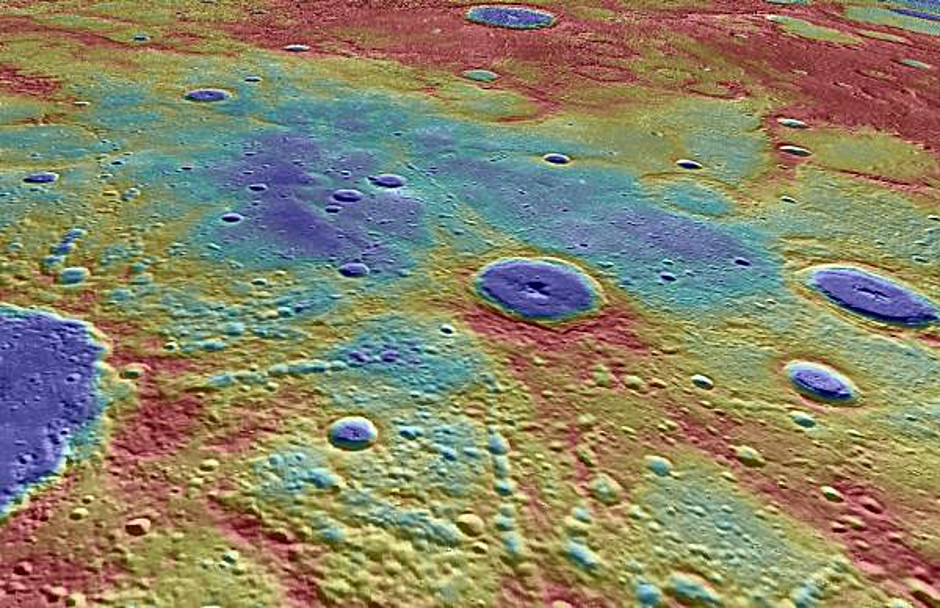
In this perspective view, we look west across Suisei Planitia (blue colours), the site of some of the crustal magnetic signals. The plains are comprised of volcanic lava flows that erupted and solidified several billion years ago, filling the low areas between the higher topography (red colours). The impact crater Kosho, 65 kilometres in diameter, is seen in the centre of the image (deep blue floor), and part of the crater Strindberg, 190 kilometres in diameter, is seen in the lower left at the edge of the image. The background image is Mercury Dual Imaging System global mosaic, coloured by surface elevation measured by the Mercury Laser Altimeter (MLA), both draped over a digital elevation model derived from MLA data. Image credit: NASA/Johns Hopkins University Applied Physics Laboratory/Carnegie Institution of Washington.
About 4 billion years ago, Mercury’s magnetic field could have been much stronger than today, as indicated by low-altitude observations made by NASA’s MESSENGER spacecraft that revealed evidence of magnetisation of ancient crustal rocks on Mercury.
The MESSENGER spacecraft crashed onto Mercury on 30th April after running out of fuel, but the mission provided a trove of new information on the planet closest to the Sun.
“From MESSENGER and Mariner 10 observations we already knew that Mercury has had a global magnetic field today and 40 years ago,” said Johnson, a senior scientist at the Planetary Science Institute and lead author of “Low-Altitude Magnetic Field Measurements by MESSENGER Reveal Mercury’s Ancient Crustal Field,” published May 7th in the journal Science.
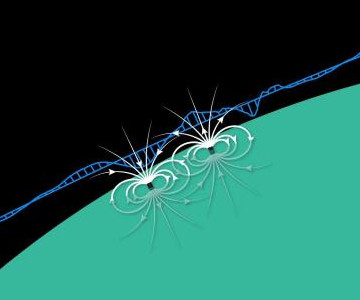
In this cartoon of field lines and observed signal, the white lines show schematic magnetic field lines above the surface of Mercury from magnetised crustal rocks. The MESSENGER spacecraft passed over a region of crustal magnetisation and the Magnetometer instrument measured small variations in the magnetic field (illustrated by the blue wiggly line). Because the signals are small they were only observed when MESSENGER was very close to the planet. Image credit: NASA/Johns Hopkins University Applied Physics Laboratory/Carnegie Institution of Washington.
Mercury is the only inner Solar System body other than Earth that currently possesses a global magnetic field generated by a dynamo in a fluid metallic outer core. In Mercury, as in Earth, the outer core is molten iron.
“Magnetised rocks record the history of the magnetic field of a planet, a key ingredient in understanding its evolution,” Johnson said. “We already know that around 3.7 to 3.9 billion years ago Mercury was volcanically and tectonically active. We now know that it had a magnetic field at around that time.”
“If we didn’t have the recent very low-altitude observations, we would never have been able to discover these signals,” said Johnson. “Mercury has just been waiting to tell us its story.”
Related Articles


Planet Mercury blackened by billions of years of comet dust
Brown University Press Release
Wind-distorted wave creates huge Y-shaped features in Venusian clouds
Instituto de Astrofísica de Andalucía Press Release
Hubble views of Ganymede’s aurorae suggest a vast salty subsurface ocean
NASA / Space Telescope Science Institute Press Release
© 2015 Pole Star Publications Ltd


No comments:
Post a Comment
Please leave a comment-- or suggestions, particularly of topics and places you'd like to see covered