Advertisement
Cold War
1954Eisenhower gives famous “domino theory” speech
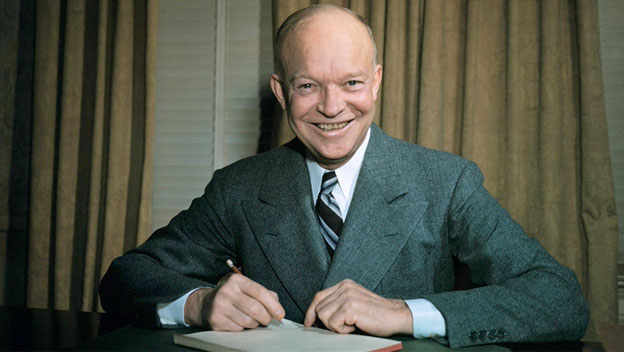
President Dwight D. Eisenhower coins one of the most famous Cold War phrases when he suggests the fall of French Indochina to the communists could create a “domino” effect in Southeast Asia. The so-called “domino theory” dominated U.S. thinking about Vietnam for the next decade.
By early 1954, it was clear to many U.S. policymakers that the French were failing in their attempt to re-establish colonial control in Indochina (Vietnam), which they lost during World War II when the Japanese took control of the area. The Vietnamese nationalists, led by the communist Ho Chi Minh, were on the verge of winning a stunning victory against French forces at the battle of Dien Bien Phu. In just a few weeks, representatives from the world’s powers were scheduled to meet in Geneva to discuss a political settlement of the Vietnamese conflict. U.S. officials were concerned that a victory by Ho’s forces and/or an agreement in Geneva might leave a communist regime in control of all or part of Vietnam. In an attempt to rally congressional and public support for increased U.S. aid to the French, President Eisenhower gave an historic press conference on April 7, 1954.
He spent much of the speech explaining the significance of Vietnam to the United States. First was its economic importance, “the specific value of a locality in its production of materials that the world needs” (materials such as rubber, jute, and sulphur). There was also the “possibility that many human beings pass under a dictatorship that is inimical to the free world.” Finally, the president noted, “You have broader considerations that might follow what you would call the ‘falling domino’ principle.” Eisenhower expanded on this thought, explaining, “You have a row of dominoes set up, you knock over the first one, and what will happen to the last one is a certainty that it will go over very quickly.” This would lead to disintegration in Southeast Asia, with the “loss of Indochina, of Burma, of Thailand, of the Peninsula, and Indonesia following.” Eisenhower suggested that even Japan, which needed Southeast Asia for trade, would be in danger.
Eisenhower’s words had little direct immediate impact–a month later, Dien Bien Phu fell to the communists, and an agreement was reached at the Geneva Conference that left Ho’s forces in control of northern Vietnam. In the long run, however, Eisenhower’s announcement of the “domino theory” laid the foundation for U.S. involvement in Vietnam. John F. Kennedy and Lyndon B. Johnson both used the theory to justify their calls for increased U.S. economic and military assistance to non-communist South Vietnam and, eventually, the commitment of U.S. armed forces in 1965.
RELATED VIDEOS
 VIDEOPlay video1950s
 VIDEOPlay videoThe U2 Program
 VIDEOPlay videoD-Day Battle Gear
 VIDEOPlay videoD-Day Invasion
 VIDEOPlay videoEisenhower's State of the Union Address
 VIDEOPlay videoA Key to Victory
 VIDEOPlay videoD-Day Invasion of Normandy
 VIDEOPlay videoCampaign Spot: Ike For President (1952)
 VIDEOPlay videoD-Day
 VIDEOPlay videoThe Fall of the Soviet Union
 VIDEOPlay videoD-Day: The Lost Evidence - In the Heat of Battle
 VIDEOPlay videoRichard Nixon's Checkers Speech
 TOPICEisenhower Doctrine
 AUDIOPlay videoDwight D. Eisenhower on the Middle East
 TOPICThe 1950s
 AUDIOPlay videoEisenhower's Farewell Address
 TOPICU-2 Spy Incident
 TOPICDomino Theory
 TOPICJohn Foster Dulles
 AUDIOPlay videoEisenhower's 3 Imperatives for World Peace
 AUDIOPlay videoEisenhower on the Second Berlin Crisis
 AUDIOPlay videoThe Eisenhower Doctrine
 AUDIOPlay videoEisenhower Weighs Chance for Peace in the Cold War
 AUDIOPlay videoEisenhower Welcomes Khrushchev to the U.S.
ALSO ON THIS DAY
Lead Story
1994
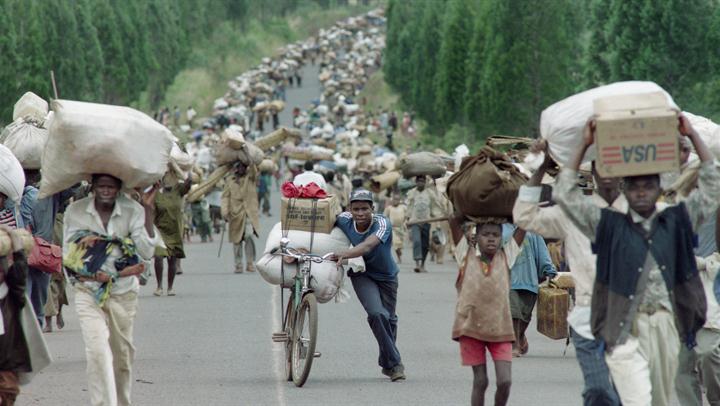
On this day in 1994, Rwandan armed forces kill 10 Belgian peacekeeping officers in a successful effort to discourage international intervention in the genocide that had begun only hours earlier. In approximately three months, the Hutu extremists who controlled Rwanda brutally murdered an estimated 500,000 to 1 million innocent civilian...
American Revolution
1776
On this day in 1776, Navy Captain John Barry, commander of the American warship Lexington, makes the first American naval capture of a British vessel when he takes command of the British warship HMS Edward off the coast of Virginia. The capture of the Edward and its cargo turned...
Automotive
1947
On this day in 1947, Henry Ford, the founder of Ford Motor Company, which developed the first affordable, mass-produced car–the Model T–and also helped pioneer assembly-line manufacturing, dies at his estate in Dearborn, Michigan, at the age of 83. Ford was born July 30, 1863, on a farm located in present-day...
Civil War
1862
Two days of heavy fighting conclude near Pittsburgh Landing in western Tennessee. The Battle of Shiloh became a Union victory after the Confederate attack stalled on April 6, and fresh Yankee troops drove the Confederates from the field on April 7. Shiloh began when Union General Ulysses S. Grant brought his...
Crime
1994
Rwandan armed forces kill 10 Belgian peacekeeping officers in a successful effort to discourage international intervention in their genocide that had begun only hours earlier. In less than three months, Hutu extremists who controlled Rwanda murdered an estimated 800,000 innocent civilian Tutsis in the worst episode of genocide since World...
Advertisement
Disaster
1990
In a tragic coincidence, two separate ferry accidents in different areas of the world take the lives of a reported 325 people on this day in 1990. The first took place in Myanmar (formerly Burma) on the Gyaing River. Later in the day, Scandinavia was also rocked by...
General Interest
1953
By a vote of 57 to 1, Dag Hammarskjold is elected secretary-general of the United Nations.The son of Hjalmar Hammarskjold, a former prime minister of Sweden, Dag joined Sweden’s foreign ministry in 1947, and in 1951 formally entered the cabinet as deputy foreign minister. The same year, he traveled to...
1963
On April 7, 1963, a new Yugoslav constitution proclaims Tito the president for life of the newly named Socialist Federal Republic of Yugoslavia.Formerly known as Josip Broz, Tito was born to a large peasant family in Croatia in 1892. At that time, Croatia was part of the Austro-Hungarian Empire, and...
2012
On this day in 2012, broadcast journalist Mike Wallace, a full-time correspondent for the pioneering TV newsmagazine “60 Minutes” from its debut in 1968 until 2006, dies at age 93 in New Canaan, Connecticut. During his career, Wallace interviewed everyone from world leaders to Hollywood celebrities to scam artists, and...
Hollywood
1970
On this day in 1970, the legendary actor John Wayne wins his first–and only–acting Academy Award, for his star turn in the director Henry Hathaway’s Western True Grit. Wayne appeared in some 150 movies over the course of his long and storied career. He established his tough, rugged, uniquely American screen...
Advertisement
Literary
1770
William Wordsworth, one of the founders of the Romantic school of poetry, is born. Born near England’s Lake District in 1770, Wordsworth lost his mother when he was eight and his father five years later. He attended Cambridge, then traveled in Europe, taking long walking tours with friends through the...
Music
1920
“East is East, and West is West, and never the twain shall meet,” goes the famous Rudyard Kipling quotation. It’s a statement that certainly applied in the world of pop music prior to the 1960s, when a handful of influential British groups brought the sound of Indian classical music into...
Old West
1805
After a long winter, the Lewis and Clark expedition departs its camp among the Mandan Indians and resumes its journey West along the Missouri River. The Corps of Discovery had begun its voyage the previous spring, and it arrived at the large Mandan and Minnetaree villages along the upper Missouri River...
Presidential
1961
On this day in 1961, President John F. Kennedy sends a letter to Congress in which he recommends the U.S. participate in an international campaign to preserve ancient temples and historic monuments in the Nile Valley of Egypt. The campaign, initiated by UNESCO, was designed to save sites threatened by...
Sports
1873
On April 7, 1873, John McGraw, one of the winningest managers in Major League Baseball history, is born in Truxton, New York. McGraw’s career total of 2,763 wins ranks second only to Connie Mack. McGraw played for St. Bonaventure University and in 1891 joined the Baltimore Orioles, where he spent the...
Advertisement
Vietnam War
1975
North Vietnamese forces prepare to launch the “Ho Chi Minh Campaign,” designed to set the conditions for a final communist victory in South Vietnam. By this time, well over two-thirds of South Vietnam was under communist control as South Vietnamese forces had fallen back in panic when the North Vietnamese...
World War I
1918
One month after Russia signed the Treaty of Brest-Litovsk, formally ending its participation in World War I, Winston Churchill secretly proposes to the British War Cabinet a method by which Britain’s former ally could be persuaded to reenter the war. Russia’s withdrawal from the war was a direct result of the...
World War II
1939
On this day in 1939, in an effort to mimic Hitler’s conquest of Prague, Benito Mussolini’s troops, though badly organized, invade and occupy Albania. Although the invasion of Albania was intended as but a prelude to greater conquests in the Balkans, it proved a costly enterprise for Il Duce. Albania was...
1945
On this day in 1945, the Japanese battleship Yamato, ostensibly the greatest battleship in the world, is sunk in Japan’s first major counteroffensive in the struggle for Okinawa. Weighing 72,800 tons and outfitted with nine 18.1-inch guns, the battleship Yamato was Japan’s only hope of destroying the Allied fleet off the...
You May Like
Advertisement
ALSO ON THIS DAY
Lead Story
- 1994 Civil war erupts in Rwanda
American Revolution
- 1776 U.S. Navy captures first British warship
Automotive
- 1947 Auto pioneer Henry Ford dies
Civil War
- 1862 Battle of Shiloh concludes
Cold War
- 1954 Eisenhower gives famous “domino theory” speech
Crime
- 1994 The Rwandan genocide
Disaster
- 1990 Twin ferry accidents on opposite ends of world
General Interest
- 1953 Hammarskjold elected U.N. head
- 1963 Tito is made president for life
- 2012 Longtime “60 Minutes” journalist Mike Wallace dies
Hollywood
- 1970 John Wayne wins Best Actor Oscar
Literary
- 1770 William Wordsworth is born
Music
- 1920 Indian sitar legend Ravi Shankar is born
Old West
- 1805 Lewis and Clark depart Fort Mandan
Presidential
- 1961 JFK lobbies Congress to help save historic sites in Egypt
Sports
- 1873 John McGraw, second all-time winningest baseball manager, is born
Vietnam War
- 1975 North Vietnamese forces begin preparations for final offensive
World War I
- 1918 Winston Churchill urges talks with Russia
World War II
- 1939 Italy invades Albania
- 1945 Japanese battleship Yamato is sunk by Allied forces
Advertisement


No comments:
Post a Comment
Please leave a comment-- or suggestions, particularly of topics and places you'd like to see covered