Oliver Goldsmith
From Wikipedia, the free encyclopedia
This article is about the 18th century Anglo-Irish writer. For the 19th century Canadian poet, see Oliver Goldsmith (Canadian poet).
| Oliver Goldsmith | |
|---|---|

Portrait 1769–70 by Joshua Reynolds
|
|
| Born | 10 November 1728 (disputed) Either Ballymahon, County Longford, Ireland or Elphin, County Roscommon, Ireland |
| Died | 4 April 1774 (aged 43) London, England |
| Resting place | Temple Church, London |
| Occupation | Playwright, poet, busker, apothecary's assistant |
| Language | English |
| Education | BA |
| Alma mater | Trinity College, Dublin |
| Literary movement | The Club |
| Notable works | The Vicar of Wakefield, "The Deserted Village", The Good-Natur'd Man, She Stoops to Conquer |
Contents
Biography
Goldsmith's birth date and year are not known with certainty. According to the Library of Congress authority file, he told a biographer that he was born on 10 November 1728. The location of his birthplace is also uncertain. He was born either in the townland of Pallas, near Ballymahon, County Longford, Ireland, where his father was the Anglican curate of the parish of Forgney, or at the residence of his maternal grandparents, at the Smith Hill House in the diocese of Elphin, County Roscommon where his grandfather Oliver Jones was a clergyman and master of the Elphin diocesan school, and where Oliver studied.[2] When he was two years old, Goldsmith's father was appointed the rector of the parish of "Kilkenny West" in County Westmeath. The family moved to the parsonage at Lissoy, between Athlone and Ballymahon, and continued to live there until his father's death in 1747.In 1744 Goldsmith went up to Trinity College, Dublin. His tutor was Theaker Wilder. Neglecting his studies in theology and law, he fell to the bottom of his class. In 1747, along with four other undergraduates, he was expelled for a riot in which they attempted to storm the Marshalsea Prison.[3] He was graduated in 1749 as a Bachelor of Arts, but without the discipline or distinction that might have gained him entry to a profession in the church or the law; his education seemed to have given him mainly a taste for fine clothes, playing cards, singing Irish airs and playing the flute. He lived for a short time with his mother, tried various professions without success, studied medicine desultorily at the University of Edinburgh from 1752 to 1755, and set out on a walking tour of Flanders, France, Switzerland and Northern Italy, living by his wits (busking with his flute).
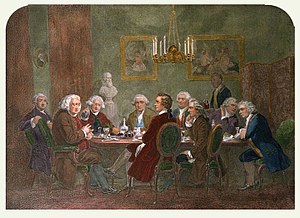
'A literary party at Sir Joshua Reynolds's'.[4] Use a cursor to see who is who.

A plaque to Oliver Goldsmith at Temple Church.
Goldsmith was described by contemporaries as prone to envy, a congenial but impetuous and disorganised personality who once planned to emigrate to America but failed because he missed his ship. Thomas De Quincey wrote of him 'All the motion of Goldsmith's nature moved in the direction of the true, the natural, the sweet, the gentle'.[5]
His premature death in 1774 may have been partly due to his own misdiagnosis of his kidney infection. Goldsmith was buried in Temple Church in London. The inscription reads; "HERE LIES/OLIVER GOLDSMITH". There is a monument to him in the centre of Ballymahon, also in Westminster Abbey with an epitaph written by Samuel Johnson.[6]
Works
See The Vicar of Wakefield, The Good-Natur'd Man, The Traveller, and She Stoops to Conquer.The Citizen of the World
In 1760 Goldsmith began to publish a series of letters in the Public Ledger under the title The Citizen of the World. Purportedly written by a Chinese traveller in England by the name of Lien Chi, they used this fictional outsider's perspective to comment ironically and at times moralistically on British society and manners. It was inspired by the earlier essay series Persian Letters by Charles de Secondat, Baron de Montesquieu.The Hermit
Goldsmith wrote this romantic ballad of precisely 160 lines in 1765. The hero and heroine are Edwin, a youth without wealth or power, and Angelina, the daughter of a lord "beside the Tyne." Angelina spurns many wooers, but refuses to make plain her love for young Edwin. "Quite dejected with my scorn," Edwin disappears and becomes a hermit. One day, Angelina turns up at his cell in boy's clothes and, not recognising him, tells him her story. Edwin then reveals his true identity, and the lovers never part again. The poem is notable for its interesting portrayal of a hermit, who is fond of the natural world and his wilderness solitude but maintains a gentle, sympathetic demeanor toward other people. In keeping with eremitical tradition, however, Edwin the Hermit claims to "spurn the [opposite] sex." This poem appears under the title of "A Ballad" sung by the character of Mr. Burchell in Chapter 8 of Goldsmith's novel, The Vicar of Wakefield.[7]The Deserted Village
Main article: The Deserted Village
In the 1760s Goldsmith witnessed the demolition of an ancient village
and destruction of its farms to clear land to become a wealthy man's
garden.[8] His poem The Deserted Village,
published in 1770, expresses a fear that the destruction of villages
and the conversion of land from productive agriculture to ornamental landscape gardens would ruin the peasantry.[8]Other works
- The Complete Poetical Works of Oliver Goldsmith (ed) Austin Dobson, 1887, kindle ebook March 2011 ASIN B004TP31VM
- The ironic poem, An Elegy on the Death of a Mad Dog was published in 1766.
- Goldsmith is also thought to have written the classic children's tale The History of Little Goody Two-Shoes.
Memorials concerning Oliver Goldsmith

A statue of Goldsmith at Trinity College, Dublin.
In the play Marx in Soho by Howard Zinn, Marx makes a reference to Goldsmiths' poem, The Deserted Village.[9]
A statue of him by JH Foley stands at the Front Arch of Trinity College, Dublin (see image).
His name has been given to a new lecture theatre and student accommodation on the Trinity College campus: Goldsmith Hall.
Somerset Maugham used the last line from An Elegy on the Death of a Mad Dog in his novel The Painted Veil (1925). The character Walter Fane's last words are The dog it was that died.
Auburn, Alabama, and Auburn University were named for the first line in Goldsmith's poem: "Sweet Auburn, loveliest village of the plain." Auburn is still referred to as the 'loveliest village on the plain.'
There is a statue in Ballymahon County Longford.
London Underground locomotive number 16 (used on the Metropolitan line of the London Underground until 1962) was named Oliver Goldsmith.
Longford based band Goldsmith are named after the famous writer.
Athlone Institute of Technology library is named the Goldsmith Library
In popular culture
Two characters in the 1951 comedy The Lavender Hill Mob quote the same line from Goldsmith's poem "The Traveller" – a subtle joke, because the film's plot involves the recasting of stolen gold.Notes
- http://www.britannica.com/EBchecked/topic/237932/Oliver-Goldsmith
- http://www.sligogrammarschool.org/historyschool.htm
- Craig, Maurice (1952). Dublin 1650–1860. Allen Figgis & Co. Ltd. p. 184.
- 'A literary party at Sir Joshua Reynolds's, D. George Thompson, published by Owen Bailey, after James William Edmund Doyle, published 1 October 1851
- De Quincey Writings (ed) James Thomas Fields 1850–1855
- "Oliver Goldsmith: A Poet, Naturalist, and Historian, who left scarcely any style of writing untouched, and touched nothing that he did not adorn. Of all the passions, whether smiles were to move or tears, a powerful yet gentle master. In genius, vivid, versatile, sublime. In style, clear, elevated, elegant." Epitaph written by Dr. Johnson, translated from the original Latin.
- Dyachok, 2012, pages 341–342
- Rowley, 1978, page 132
- Marx in Soho, Howard Zinn 1999, South End Press
References
- Austin Dobson, Henry (Editor) The Complete Poetical Works of Oliver Goldsmith, ISBN 1-58827-277-X
- Campbell, Gordon (ed.), Oliver Goldsmith (Everyman's Poetry Series), ISBN 0-460-87827-1
- Connellan, J.A., Oliver Goldsmith of Elphin, Published for the Goldsmith Society (1935)
- Forster, John, The life and times of Oliver Goldsmith, Published by: Ward, Lock and Co (London, New York, 1848)
- Goldsmith, Oliver, The Vicar of Wakefield, ISBN 0-19-283940-3
- Goldsmith, Oliver, She Stoops to Conquer, ISBN 0-486-26867-5
- Irving, Washington, Life of Oliver Goldsmith, ISBN 1-58963-236-2
- Prior, James, Life of Goldsmith, two volumes (London: John Murray, 1837) at Google Books
- Rousseau, George (1974), Goldsmith: The Critical Heritage (London: Routledge and Kegan Paul, 1974). ISBN 0-7100-7720-3
- Rowley, Trevor (1978). Villages in the Landscape. Archaeology in the Field Series. London: J.M. Dent & Sons Ltd. p. 132. ISBN 0-460-04166-5.
External links
 |
Wikiquote has quotations related to: Oliver Goldsmith |
 |
Wikimedia Commons has media related to Oliver Goldsmith. |
 |
Wikisource has original works written by or about: Oliver Goldsmith |
| Library resources about Oliver Goldsmith |
| By Oliver Goldsmith |
|---|
- Works by Oliver Goldsmith at Project Gutenberg
- Works by Oliver Goldsmith at LibriVox (public domain audiobooks)

- Essays by Oliver Goldsmith at Quotidiana.org
- The Deserted Village
- UNCG American Publishers' Trade Bindings: The Deserted Village
- Oliver Goldsmith: A Biography by Washington Irving from Project Gutenberg
- Goldsmith (English Men of Letters series) by William Black from Project Gutenberg
- An Essay on the Theatre; or, A Comparison Between Laughing and Sentimental Comedy
- Goldsmith Hall – student accommodation and lecture theatre, Trinity College, Dublin.
- Information on Goldsmith
- Oliver Goldsmith Resource
- Works by Oliver Goldsmith in e-book version
- The Goldsmith International Literary Festival Info on the Festival held annually in Goldsmith's Home County
- Poems and essays, Oliver Goldsmith, 1839, (William Smith, London)
- Oliver Goldsmith at Find a Grave

|
Categories:
- 1730 births
- 1774 deaths
- People from County Longford
- People from County Roscommon
- Anglo-Irish artists
- Anglo-Irish people
- Irish poets
- Irish novelists
- Irish Anglicans
- Irish dramatists and playwrights
- Alumni of Trinity College, Dublin
- Alumni of the University of Edinburgh
- Streathamites
- 18th-century Irish novelists
- 18th-century dramatists and playwrights


No comments:
Post a Comment
Please leave a comment-- or suggestions, particularly of topics and places you'd like to see covered