Saturday, February 14, 2015


Thursday, February 12, 2015
Slideshow of BIG's W57
Yesterday I walked by BIG – Bjarke Ingels Group's W57, a "courtscraper" under construction on Manhattan's West Side. The slideshow has 20 photos from my short jaunt, moving in a clockwise motion from the southeast to the northeast. The building is scheduled to be completed before the end of the year.
Wednesday, February 11, 2015
Today's archidose #813
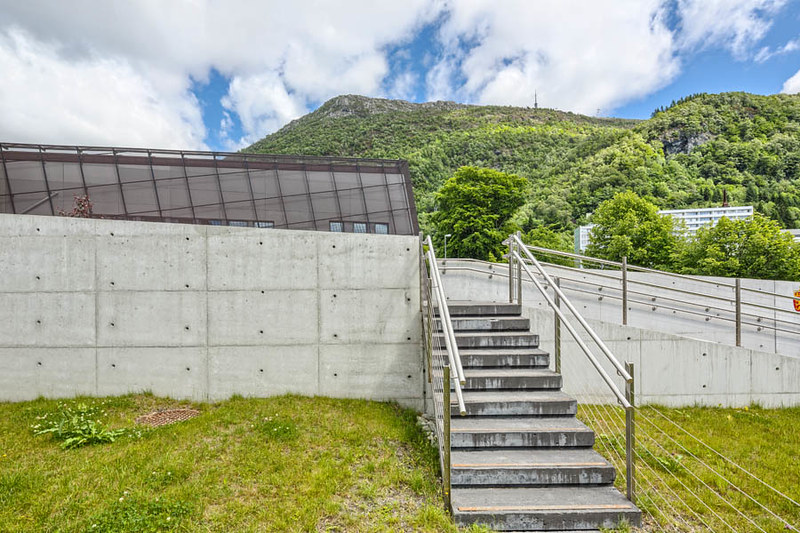
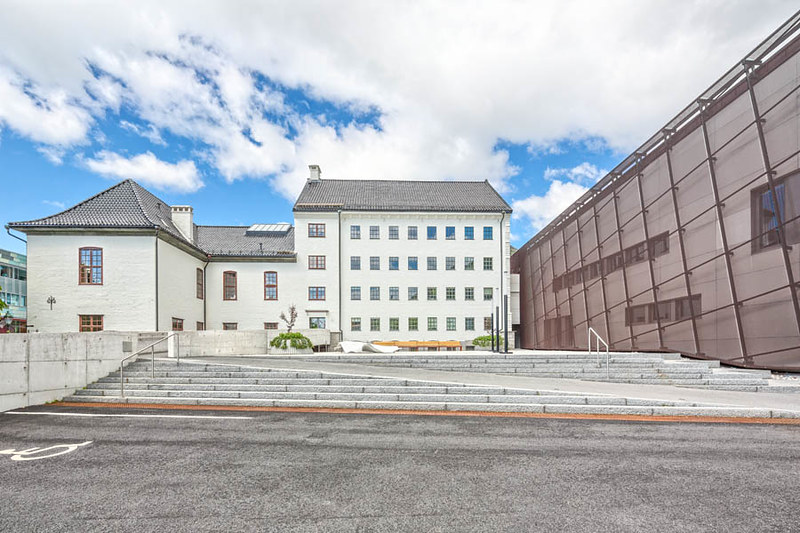
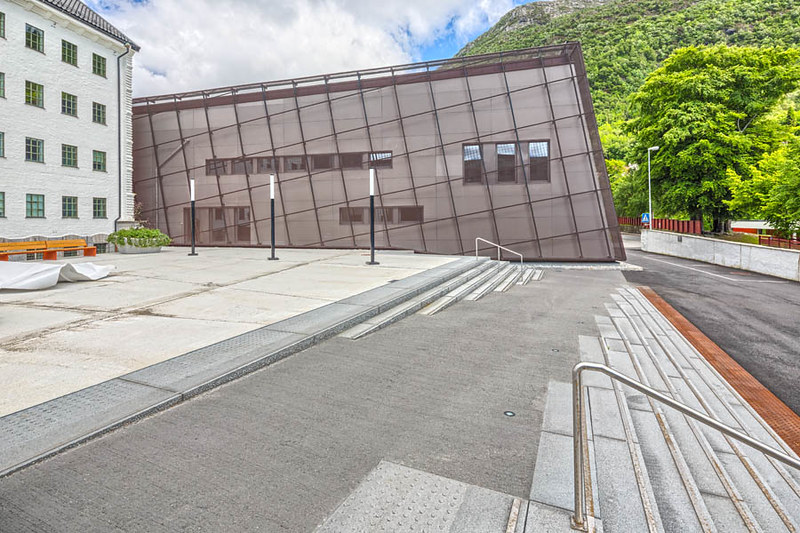
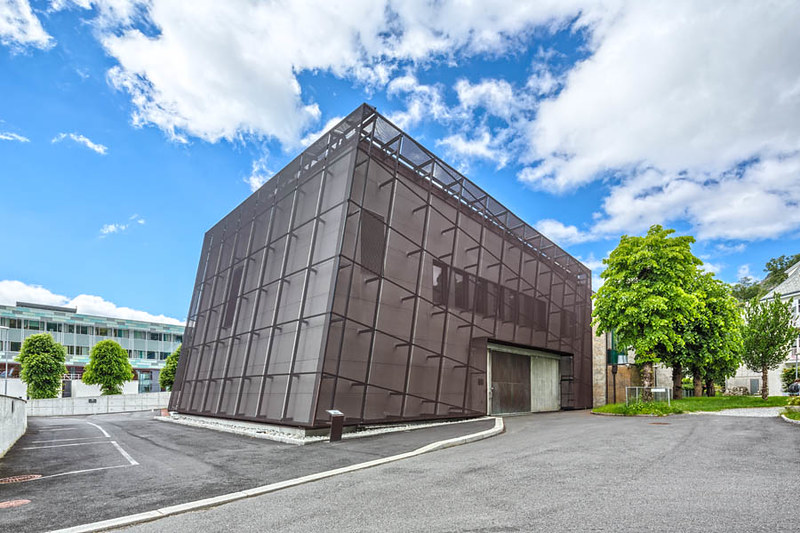
Here are a few photos of the addition to the Regional State Archives (addition 2012, original 1921) in Bergen, Norway, by NAV Architects with VY Arkitektur, photographed by Sindre Ellingsen.

To contribute your Flickr images for consideration, just:
To contribute your Flickr images for consideration, just:
:: Join and add photos to the archidose poolTo contribute your Instagram images for consideration, just:
:: Tag your photos #archidose
Tuesday, February 10, 2015
[RE] Engaged Architecture Symposium
Mark your calendars: March 28 is the [RE] Engaged Architecture Symposium: Celebrating 20 years of Studio 804. Details on the symposium, and the events taking place the day before and after, are below.
-crop-u10774.jpg)
[The Forum at Marvin Hall, Studio 804's 2014 project]
[The Forum at Marvin Hall, Studio 804's 2014 project]
[RE] Engaged Architecture Symposium: Celebrating 20 years of Studio 804
Saturday, March 28, 2015
8:30 a.m.–5:30 p.m.
The East Hills Construction Innovation Laboratory, 3813 Greenway Dr., Lawrence, KS 66046
Overview
This symposium celebrates Studio 804’s 20th Anniversary and its contribution to architecture culture at KU’s School of Architecture, Design and Planning.
The [Re]Engaged Architecture Symposium welcomes speakers of international stature to discuss projects and processes that embody this resistance, and to reflect upon the body of work created by Studio 804, headed by Distinguished Professor Dan Rockhill over the past 20 years. Studio 804 is an internationally recognized design/build program that engages design, craft, practice, and community to build healthy communities through the power of design.
Schedule
Friday, March 27
3:00 - 5:00 Ceremonial Ribbon-Cutting of the Forum
6:00 - 8:00 Studio 804 Alumni Lectures: Distinguished Studio 804 Alumni, many who are beginning to make a significant mark on the profession, are invited back for a Pecha Kucha-style event with faculty and students.
Saturday, March 28
(With remarks by Susan Szenasy, Editor, Metropolis magazine, and Prof. Dan Rockhill, Director, Studio 804)
8:30 - 9:00 Opening Reception
9:00 - 9:30 Opening Remarks
9:30 - 10:30 Frank Harmon
10:45 - 11:45 Brigitte Shim
12:00 - 1:15 Brian MacKay-Lyons
1:30 - 2:30 Andrew Freear
2:45 - 3:45 Ted Flato
4:00 - 5:00 Marlon Blackwell
5:00 - 5:30 Closing Remarks
Sunday, March 29
9:00 - 12:00 Self-guided tours of past Studio 804 projects in the Lawrence/Kansas City area and the East Hills Construction Innovation Laboratory
Registration
Early-bird registration $199. Register today, seating is extremely limited.
You can receive six AIA continuing ed credits for an additional $75.
$299 after Feb. 28.
Register at KU Continuing Ed.
Starting Feb. 28 KU students can register for $25 and non-KU students $39
For further information about the Symposium contact jcolistra@ku.edu
Monday, February 09, 2015
Book Review: Shape of Sound
Shape of Sound by Victoria Meyers
Artifice Books on Architecture, 2014
Hardcover, 144 pages

On my first encounter with the title phrase "shape of sound" my thoughts did not go to, say, how the shape of a room makes sounds reverberate, or some other architectural thought. Instead I was reminded of a couple scenes from 1993's Thirty Two Short Films About Glenn Gould, a great film about the Canadian pianist who died in 1982 at only 50 years old. The scenes – "Truck Stop" and "The Idea of North" – come back-to-back roughly in the middle of the film and are appropriately related to each other (the embedded YouTube clip below is set to play the two scenes). In the first scene we see Gould enter a truck stop diner and selectively hear conversations within the noisy space; and in the second one he moves about a sound studio and gestures as if to conduct the recorded voices that overlap each other. In each scenario space is mundane yet important: The conversations surround Gould in the diner to shape the space more than the walls and windows, and in the radio recording he creates a space of sound through the layering of voices.
Although these scenes do not directly apply to architect Victoria Meyers' book on sound and architecture, I find a similar approach to sound in that she considers it in a general manner, designing some buildings for maximum reverberation, others for silence, and even one as a piece of sonic interaction. Therefore the projects in Shape of Sound, be they designed by hanrahan Meyers architects (hMa) or some other studio, are diverse in how they approach sound as an integral part of existence and experience. In other words, the book is not a collection of concert halls, recording studios and sound installations, though these types are not necessarily excluded for the sake of others.
[Digital Water Pavilion | Photo by John Hill]
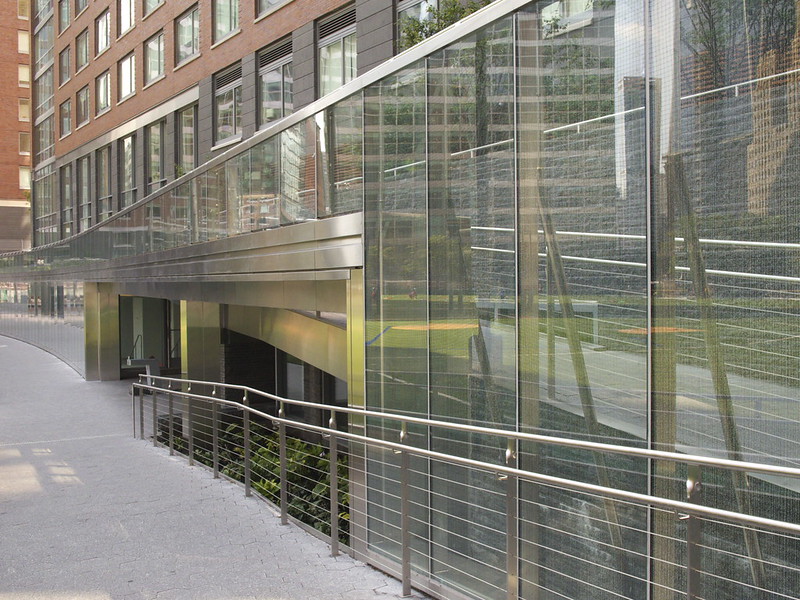
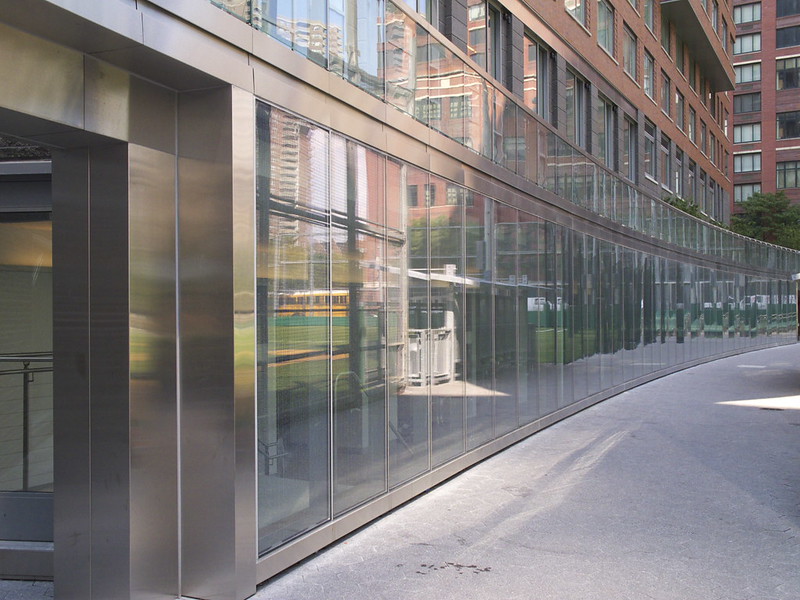
One of the hMa buildings, the one that graces the cover and is shown here, is the Digital Water i-Pavilion (DWiP), which houses recreational facilities and overlooks One World Trade Center in Lower Manhattan. As one of the last elements in Battery Park City, the pavilion adds some much-needed open space and low-scale building to the neighborhood built upon landfill. It also incorporates a sound piece by composer Michael J. Schumacher. "Where is it?" you may ask. It is located on the long glass facade that arcs from one street to the next and fronts a playing field on the east. The composition, called WaTER, is "found" in the frit pattern that covers the glass (also acting as a means of filtering direct sunlight) and then "played" with a smartphone app. It is just one manner of making a relationship between sound and architecture, in this case via technology and architectural materials.
[Digital Water Pavilion | Photo by John Hill]
Meyers examines sound through eight chapters: Form, Materiality, Windows, Sound Urbanism, Reflection, Virtuality, Sound Art, and Silence. The buildings of hMa are found within each chapter, but they are accompanied by other architects' projects as diverse as a Le Corbusier church built after he died and a sound/light installation created for the 2004 Olympics. Considering that the hMa projects are found in multiple chapters (DWiP is in Sound Urbanism and Virtuality, for example), the book reads like something between a monograph and a treatise. It's a commendable approach that firmly anchors Meyers' work into a particular way of thinking about architecture, while also being generously open to other voices and positions. So come to think of it, maybe the book is like the Glenn Gould scenes after all, since they both embrace the cacophony of sounds around to create something special.
Purchase at Amazon:
Artifice Books on Architecture, 2014
Hardcover, 144 pages
On my first encounter with the title phrase "shape of sound" my thoughts did not go to, say, how the shape of a room makes sounds reverberate, or some other architectural thought. Instead I was reminded of a couple scenes from 1993's Thirty Two Short Films About Glenn Gould, a great film about the Canadian pianist who died in 1982 at only 50 years old. The scenes – "Truck Stop" and "The Idea of North" – come back-to-back roughly in the middle of the film and are appropriately related to each other (the embedded YouTube clip below is set to play the two scenes). In the first scene we see Gould enter a truck stop diner and selectively hear conversations within the noisy space; and in the second one he moves about a sound studio and gestures as if to conduct the recorded voices that overlap each other. In each scenario space is mundane yet important: The conversations surround Gould in the diner to shape the space more than the walls and windows, and in the radio recording he creates a space of sound through the layering of voices.
Although these scenes do not directly apply to architect Victoria Meyers' book on sound and architecture, I find a similar approach to sound in that she considers it in a general manner, designing some buildings for maximum reverberation, others for silence, and even one as a piece of sonic interaction. Therefore the projects in Shape of Sound, be they designed by hanrahan Meyers architects (hMa) or some other studio, are diverse in how they approach sound as an integral part of existence and experience. In other words, the book is not a collection of concert halls, recording studios and sound installations, though these types are not necessarily excluded for the sake of others.
[Digital Water Pavilion | Photo by John Hill]
One of the hMa buildings, the one that graces the cover and is shown here, is the Digital Water i-Pavilion (DWiP), which houses recreational facilities and overlooks One World Trade Center in Lower Manhattan. As one of the last elements in Battery Park City, the pavilion adds some much-needed open space and low-scale building to the neighborhood built upon landfill. It also incorporates a sound piece by composer Michael J. Schumacher. "Where is it?" you may ask. It is located on the long glass facade that arcs from one street to the next and fronts a playing field on the east. The composition, called WaTER, is "found" in the frit pattern that covers the glass (also acting as a means of filtering direct sunlight) and then "played" with a smartphone app. It is just one manner of making a relationship between sound and architecture, in this case via technology and architectural materials.
[Digital Water Pavilion | Photo by John Hill]
Meyers examines sound through eight chapters: Form, Materiality, Windows, Sound Urbanism, Reflection, Virtuality, Sound Art, and Silence. The buildings of hMa are found within each chapter, but they are accompanied by other architects' projects as diverse as a Le Corbusier church built after he died and a sound/light installation created for the 2004 Olympics. Considering that the hMa projects are found in multiple chapters (DWiP is in Sound Urbanism and Virtuality, for example), the book reads like something between a monograph and a treatise. It's a commendable approach that firmly anchors Meyers' work into a particular way of thinking about architecture, while also being generously open to other voices and positions. So come to think of it, maybe the book is like the Glenn Gould scenes after all, since they both embrace the cacophony of sounds around to create something special.
Purchase at Amazon:


No comments:
Post a Comment
Please leave a comment-- or suggestions, particularly of topics and places you'd like to see covered