Astronomy Picture of the Day
Discover the cosmos! Each day a different image or photograph of our fascinating universe is featured, along with a brief explanation written by a professional astronomer.2015 February 15
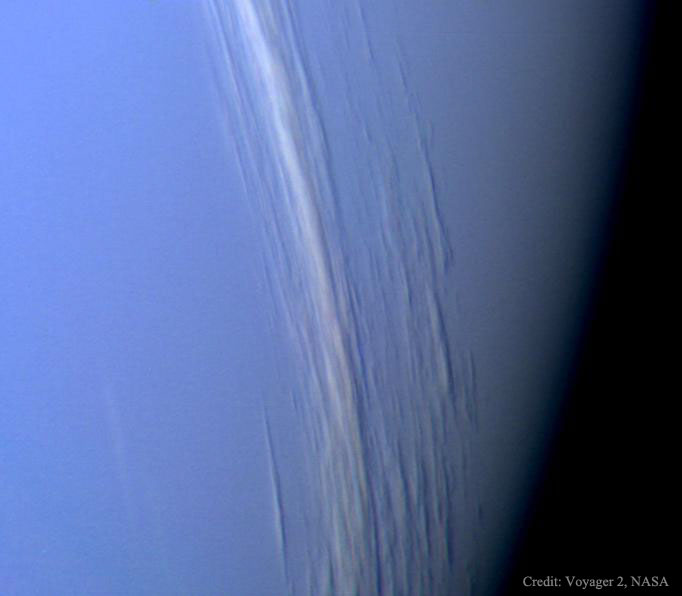
Image Credit: Voyager 2, NASA
Explanation: Two hours before closest approach to Neptune in 1989, the Voyager 2 robot spacecraft snapped this picture. Clearly visible for the first time were long light-colored cirrus-type clouds floating high in Neptune's atmosphere. Shadows of these clouds can even be seen on lower cloud decks. Most of Neptune's atmosphere is made of hydrogen and helium, which is invisible. Neptune's blue color therefore comes from smaller amounts of atmospheric methane, which preferentially absorbs red light. Neptune has the fastest winds in the Solar System, with gusts reaching 2000 kilometers per hour. Speculation holds that diamonds may be created in the dense hot conditions that exist under the cloud tops ofUranus and Neptune. Twenty-six years later, NASA's New Horizons is poised to be the first spacecraft to zoom past Pluto this July.
Tomorrow's picture: strange swirl
< | Archive | Submissions | Index | Search | Calendar | RSS | Education | About APOD | Discuss | >
Authors & editors: Robert Nemiroff (MTU) & Jerry Bonnell (UMCP)
NASA Official: Phillip Newman Specific rights apply.
NASA Web Privacy Policy and Important Notices
A service of: ASD at NASA / GSFC
& Michigan Tech. U.


No comments:
Post a Comment
Please leave a comment-- or suggestions, particularly of topics and places you'd like to see covered