Who Tells the NYPD What to Do: A Q&A on Power and Police Unions
Wednesday, January 07, 2015
Play
00:00 / 00:00
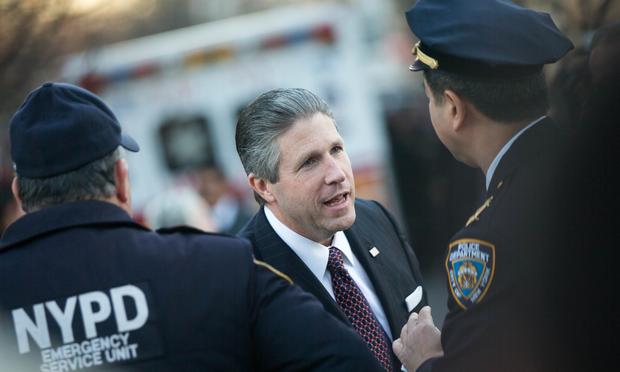 PBA president Patrick Lynch outside Christ Tabernacle Church prior to a wake held for a killed officer.(Andrew Theodorakis/Getty)
Relations between New York City police and City Hall are as tense as ever. For several weeks now, there's been a war of words in the wake of the killing of two police officers, and anti-police protests in the streets of New York. Scores of police officers turned their backs on the mayor as he spoke at funerals for the officers. And now a sharp slowdown in arrests in recent weeks has become apparent, though union officials deny any organized work slowdown.
WNYC's Brigid Bergin and Robert Lewis explore the power dynamics within the police union, and the political implications for Mayor de Blasio. Hear their conversation above.
WNYC's Brigid Bergin and Robert Lewis explore the power dynamics within the police union, and the political implications for Mayor de Blasio. Hear their conversation above.
How much authority do the police unions have?
On paper, the NYPD is a paramilitary organization with a rigid command structure where orders from superiors must be followed or else. But in practice, it can be a bit more complicated. The Patrolmen’s Benevolent Association represents about 24,000 officers. And they can mobilize members to take various job actions if they want to sway the city’s elected leaders.
One of the ways unions can mobilize members, of course, is a work slowdown. And some are suggesting that’s what we’re seeing over the past few weeks, with a sharp decline in arrests compared to this time last year. How unprecedented is this?
Slowdowns are a common tactic the union has deployed over the years. There was a ticket writing slowdown in 1997 during a contract dispute. In 1999 arrests dropped after officers were indicted in the fatal shooting of Amadou Diallo.
The president of the Patrolmen’s Benevolent Association says currently there’s “no union initiated or supported slowdown.” But the numbers from the NYPD are pretty staggering. Arrests are down more than 50 percent over the past two weeks as compared to the same time last year. Summonses are down even more. Last week cops wrote up 749 moving violations citywide. That same week a year ago, they wrote 9,349.
It’s worth mentioning that late Monday, five officers who were just finishing up their shifts and going off-duty heard a robbery call. They answered it and two were shot. So police are still policing the streets and putting their lives on the line.
How does Police Commissioner William Bratton deal with a slow-down and a union that has shown no problem attacking his boss, Mayor de Blasio?
The commissioner has a tough line to walk. He’s a political appointee and ultimately answers to the mayor. However, to run an organization effectively you need to have credibility with your workers.
One of the ways unions can mobilize members, of course, is a work slowdown. And some are suggesting that’s what we’re seeing over the past few weeks, with a sharp decline in arrests compared to this time last year. How unprecedented is this?
Slowdowns are a common tactic the union has deployed over the years. There was a ticket writing slowdown in 1997 during a contract dispute. In 1999 arrests dropped after officers were indicted in the fatal shooting of Amadou Diallo.
The president of the Patrolmen’s Benevolent Association says currently there’s “no union initiated or supported slowdown.” But the numbers from the NYPD are pretty staggering. Arrests are down more than 50 percent over the past two weeks as compared to the same time last year. Summonses are down even more. Last week cops wrote up 749 moving violations citywide. That same week a year ago, they wrote 9,349.
It’s worth mentioning that late Monday, five officers who were just finishing up their shifts and going off-duty heard a robbery call. They answered it and two were shot. So police are still policing the streets and putting their lives on the line.
How does Police Commissioner William Bratton deal with a slow-down and a union that has shown no problem attacking his boss, Mayor de Blasio?
The commissioner has a tough line to walk. He’s a political appointee and ultimately answers to the mayor. However, to run an organization effectively you need to have credibility with your workers.
Professor John Eterno is a former NYPD captain who now runs the graduate criminal justice program at Molloy College. He says Bratton could, of course, effectively order officers to end the slowdown. Eterno experienced several slowdowns during his career and says sometimes commanding officers would crack down. "They’ve had sergeants and lieutenants ride with officers and say 'look, you’re going to do this', and order them to do those sorts of things." he said, adding, "I don’t think we’ve come to that yet. It’s a matter of finding out what are the unions — what are they looking for here."
So far, it’s unclear what would satisfy the PBA.
Speaking on NPR yesterday, Lynch was asked how far an apology from Mayor de Blasio would go. He said "It would go a long way to say, we can now start the dialogue on how to correct the problem and do our jobs better rather than constantly putting gasoline on the fire." Has the mayor apologized?
No. And it's important to note, that there are many who would say that it's Lynch's rhetoric that has thrown gasoline on the fire.
Mayor de Blasio has repeatedly praised the work done by the NYPD. He issued a statement yesterday evening once again praising those officers Robert referred to who were shot in the Bronx Monday night. He called the incident "yet another reminder of how profoundly important the work of our police officers is, as well as the seriousness of the dangers they face every day in the line of duty." But he did take a more assertive tone at a press conference with Commissioner Bratton on Monday..
He and Bratton have also both stressed that the city has invested nearly $400 million dollars to give the NYPD new technology and training. But so far, there has been no apology.
What are the political perils of a continued standoff between the PBA and Mayor de Blasio?
If the evidence of the slowdown is conclusive, and crime actually rises in a real way, it feeds into the narrative Republicans tried to use in the 2013 mayoral election warning that New York City would return to the bad old days of crime if de Blasio was elected. That line didn't work then but there may be attempt to stoke those fears to create political problems for the mayor going forward.
De Blasio ran on a platform of reducing stop and frisks - and that's what's happened. Instead, he's leaned on a policy of "broken windows" - going after small crimes to prevent bigger ones. And it's worth noting that this week the city reported record low crime figures for the past year.
It's also important to give that "FEAR" narrative a little more context. Kenneth Sherrill is a professor emeritus in political science at Hunter College. He said when it comes to trying to run a campaign based on fear of the “bad old days”, it's important to remember how much the city has changed. He noted, when you take into account migration, births and deaths, a majority of the city's population now did not live here during that time."The electorate that you think you’re going to get on an appeal based on fear," he said, "may be an electorate more afraid of the police than it is of the mayor."
At the same time, there are people who have been supporters of de Blasio that still want to see more reforms in the NYPD and don't plan to stop protesting against the department.
So how does the city move past this battle between police and City Hall?
That remains to be seen. After a very trying two weeks, Mayor de Blasio appears to be going back to business as usual. He's speaking at an NYPD swearing in ceremony this morning. And he'll be making an education announcement this afternoon.
Certainly Governor Cuomo also continues to voice his support for playing a role in helping the city move through this crisis. Speaking at his father's funeral yesterday, he advised "to learn the lessons of the past tragedies, to identify the necessary reforms, to improve the our justice system, to have better safety measures for police officers and to move this city forward."
Of course, the elephant in the room remains resolving a new contract for the police officers union. The city and union had reached an impasse so that means it's headed to binding arbitration...which means a judge will make the final ruling on it. Three of the five NYPD unions did strike tentative deals with the city in early December. Those included 11 percent raises spread over nearly 7 years. Mayor de Blasio said that bump was deserved, because of the risks associated with these types of jobs.
Speaking on NPR yesterday, Lynch was asked how far an apology from Mayor de Blasio would go. He said "It would go a long way to say, we can now start the dialogue on how to correct the problem and do our jobs better rather than constantly putting gasoline on the fire." Has the mayor apologized?
No. And it's important to note, that there are many who would say that it's Lynch's rhetoric that has thrown gasoline on the fire.
Mayor de Blasio has repeatedly praised the work done by the NYPD. He issued a statement yesterday evening once again praising those officers Robert referred to who were shot in the Bronx Monday night. He called the incident "yet another reminder of how profoundly important the work of our police officers is, as well as the seriousness of the dangers they face every day in the line of duty." But he did take a more assertive tone at a press conference with Commissioner Bratton on Monday..
He and Bratton have also both stressed that the city has invested nearly $400 million dollars to give the NYPD new technology and training. But so far, there has been no apology.
What are the political perils of a continued standoff between the PBA and Mayor de Blasio?
If the evidence of the slowdown is conclusive, and crime actually rises in a real way, it feeds into the narrative Republicans tried to use in the 2013 mayoral election warning that New York City would return to the bad old days of crime if de Blasio was elected. That line didn't work then but there may be attempt to stoke those fears to create political problems for the mayor going forward.
De Blasio ran on a platform of reducing stop and frisks - and that's what's happened. Instead, he's leaned on a policy of "broken windows" - going after small crimes to prevent bigger ones. And it's worth noting that this week the city reported record low crime figures for the past year.
It's also important to give that "FEAR" narrative a little more context. Kenneth Sherrill is a professor emeritus in political science at Hunter College. He said when it comes to trying to run a campaign based on fear of the “bad old days”, it's important to remember how much the city has changed. He noted, when you take into account migration, births and deaths, a majority of the city's population now did not live here during that time."The electorate that you think you’re going to get on an appeal based on fear," he said, "may be an electorate more afraid of the police than it is of the mayor."
At the same time, there are people who have been supporters of de Blasio that still want to see more reforms in the NYPD and don't plan to stop protesting against the department.
So how does the city move past this battle between police and City Hall?
That remains to be seen. After a very trying two weeks, Mayor de Blasio appears to be going back to business as usual. He's speaking at an NYPD swearing in ceremony this morning. And he'll be making an education announcement this afternoon.
Certainly Governor Cuomo also continues to voice his support for playing a role in helping the city move through this crisis. Speaking at his father's funeral yesterday, he advised "to learn the lessons of the past tragedies, to identify the necessary reforms, to improve the our justice system, to have better safety measures for police officers and to move this city forward."
Of course, the elephant in the room remains resolving a new contract for the police officers union. The city and union had reached an impasse so that means it's headed to binding arbitration...which means a judge will make the final ruling on it. Three of the five NYPD unions did strike tentative deals with the city in early December. Those included 11 percent raises spread over nearly 7 years. Mayor de Blasio said that bump was deserved, because of the risks associated with these types of jobs.
MORE IN:

BRIGID BERGIN, Reporter
Brigid Bergin is the City Hall and politics reporter for WNYC.
ROBERT LEWIS, Reporter, WNYC News
Robert Lewis is a reporter for WNYC. He joined the station in December 2012 after a decade as an ink-stained wretch, working for newspapers across the country. He was previously on the investigations team at Newsday where he reported on prescription drug abuse, problems at a local housing authority and the Long Island Power Authority.

