Astronomy Picture of the Day
Discover the cosmos!
Each day a different image or photograph of our fascinating universe is
featured, along with a brief explanation written by a professional astronomer.
2014 July 28
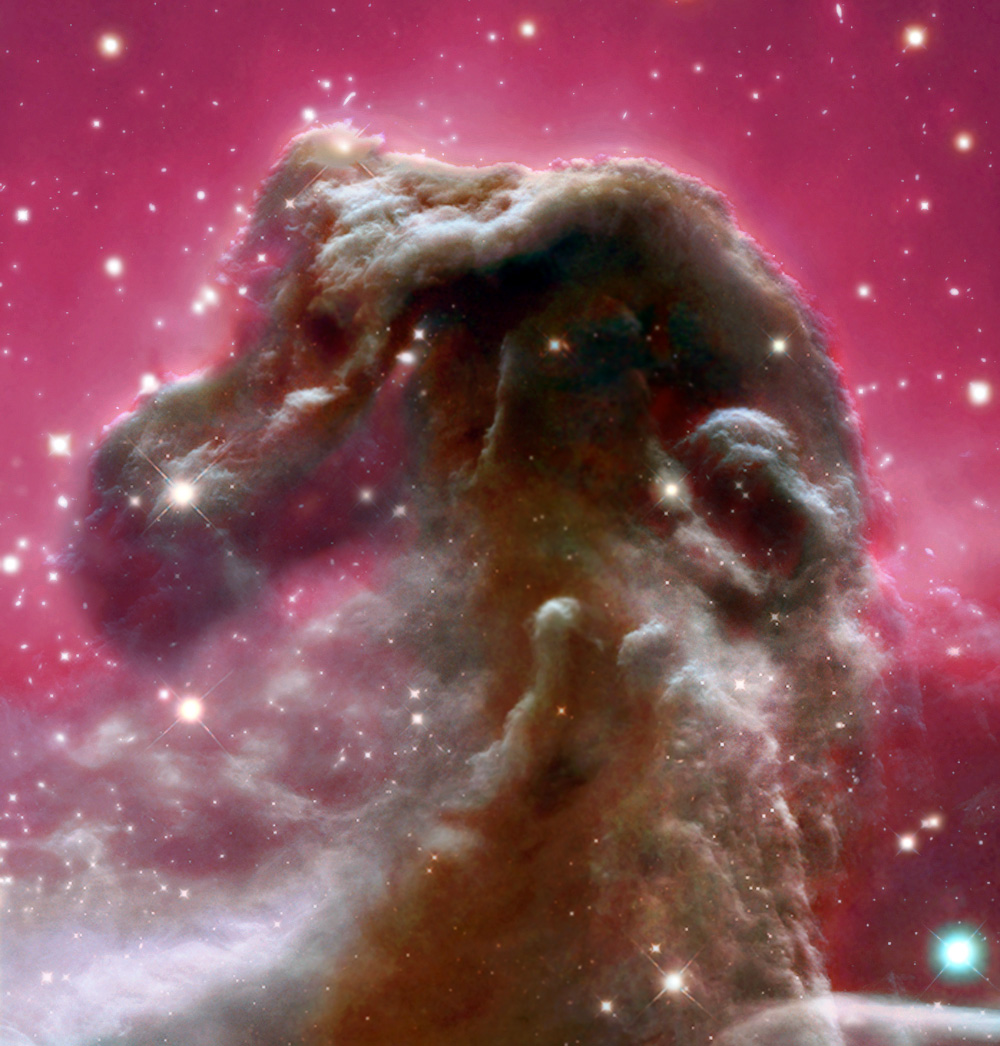
 The Horsehead Nebula from Blue to Infrared
Image Credit & Copyright:
Optical:
Aldo Mottino & Carlos Colazo,
OAC, Córdoba;
Infrared: Hubble Legacy Archive
Explanation:
One of the most identifiable nebulae in the sky,
the
Horsehead Nebula in
Orion, is part of a large, dark,
molecular cloud.
Also known as
Barnard 33, the unusual shape was first
discovered on a
photographic plate in the late 1800s.
The red glow originates from
hydrogen
gas predominantly behind the nebula, ionized by the nearby bright star
Sigma Orionis.
The darkness of the
Horsehead is caused mostly by thick
dust,
although the lower part of the
Horsehead's neck casts a shadow to the left.
Streams of gas leaving
the nebula are funneled by a strong
magnetic field.
Bright spots in the
Horsehead Nebula's base are
young stars just in the
process of forming.
Light takes about 1,500 years to reach us from the
Horsehead Nebula.
The above image is a digital combination of images taken in blue, green, red, and
hydrogen-alpha light from the
Argentina, and an
image taken in
infrared light by the orbiting
Hubble Space Telescope.
Follow APOD on:
Facebook,
Google Plus, or
Twitter
Tomorrow's picture: sky portal
<
|
Archive
|
Index
|
Search
|
Calendar
|
RSS
|
Education
|
About APOD
|
Discuss
|
>
Authors & editors:
Robert Nemiroff
(
MTU) &
Jerry Bonnell (
UMCP)
NASA Official: Phillip Newman
Specific rights apply.
NASA Web
Privacy Policy and Important Notices
A service of:
ASD at
NASA /
GSFC
& Michigan Tech. U.


No comments:
Post a Comment
Please leave a comment-- or suggestions, particularly of topics and places you'd like to see covered