Astronomy Picture of the Day
Discover the cosmos!
Each day a different image or photograph of our fascinating universe is
featured, along with a brief explanation written by a professional astronomer.
2014 July 2
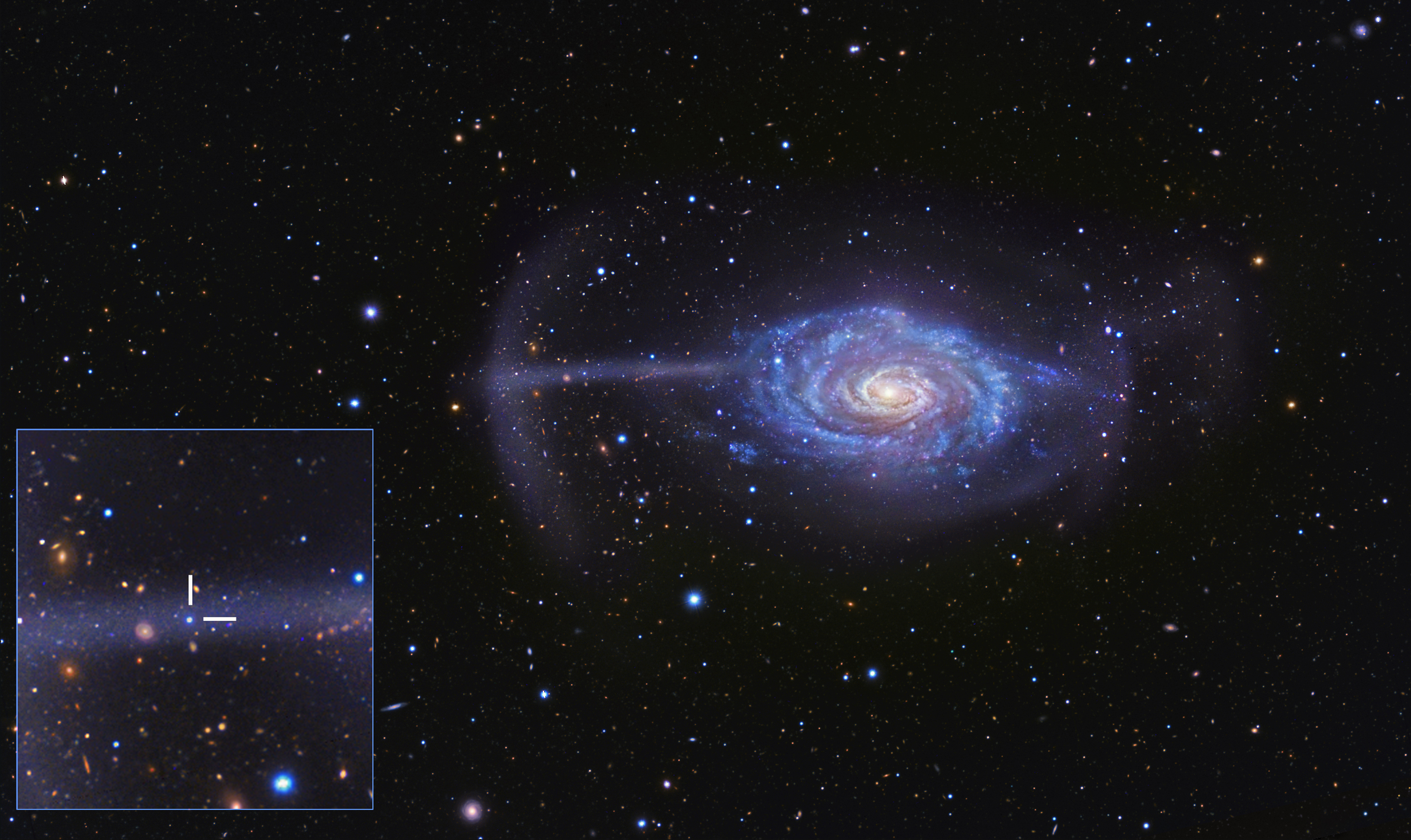
 NGC 4651: The Umbrella Galaxy
Image Credit &
Copyright:
R Jay Gabany
(Blackbird Observatories)
Collaboration:
C.Foster (Australian Astronomical Obs.),
H.Lux (U. Nottingham, Oxford),
A.Romanowsky (San Jose State, UCO),
D.Martínez-Delgado (Heidelberg),
et al.
Explanation:
Spiral galaxy NGC 4651 is a mere 62 million light-years distant,
toward the well-groomed northern constellation
Coma
Berenices.
About the size of our Milky Way, this island universe is seen to have
a faint umbrella-shaped structure that
seems to extend (left) some 100 thousand light-years
beyond the bright galactic disk.
The
giant cosmic umbrella is now known to be composed of
tidal star streams -
extensive trails of stars
gravitationally
stripped
from a smaller satellite galaxy.
The small galaxy was eventually
torn apart in repeated encounters as
it swept back and forth on eccentric orbits through NGC 4651.
In fact,
the picture insert zooms in on the smaller galaxy's remnant core,
identified in an extensive
exploration
of the system,
using data from the large Subaru and Keck telescopes
on Mauna Kea.
Work begun by a remarkable collaboration of amateur and professional
astronomers to image faint structures around bright galaxies
suggests that
even in nearby galaxies,
tidal star streams are common markers of
such galactic mergers.
The result is
explained by models
of galaxy formation that also apply to
our own
Milky Way.
Tomorrow's picture: vista revisited
<
|
Archive
|
Index
|
Search
|
Calendar
|
RSS
|
Education
|
About APOD
|
Discuss
|
>
Authors & editors:
Robert Nemiroff
(
MTU) &
Jerry Bonnell (
UMCP)
NASA Official: Phillip Newman
Specific rights apply.
NASA Web
Privacy Policy and Important Notices
A service of:
ASD at
NASA /
GSFC
& Michigan Tech. U.


No comments:
Post a Comment
Please leave a comment-- or suggestions, particularly of topics and places you'd like to see covered