I didn't have many readers for my blog, but already I was getting people from Japan, India, and Europe who were just curious to see Midtown Manhattan.
For some reason I do not understand, when I recopy this here the stories get broken up in strange ways and sometimes the copy does not exactly match the photos ( you have to figure out what it is referring to in context. It did not appear that way when it was originally posted, of course. I feel you can figure out what is going on though if you just look down the way the pix and photos eventually sort themselves out).
I have expanded some of the material because what I originally wrote was too brief.
That was a complaint I got a lot from friends and family at the time, that my comments were too short. One of the reasons for this was that I was loathe to cut and paste material from the internet, a distaste I overcame later when I realized I had been covering Midtown Manhattan for a couple of years and had reached the point where I was running out of new things to photograph.
In this respect, I have changed the style of the blog from that to a lot of Yelp- based reviews of businesses to what is now something of a "common book" of readings from all over the internet. If it turns out this is no longer possible because of copyright laws I will just have to find some other format.
North Face Sale
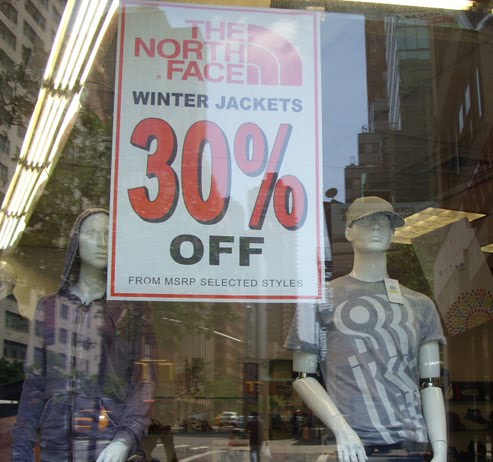 Not much of a discount for winter jackets in steamy weather...
But The North Face is one of the most popular brands in NYC, you see the jackets EVERYWHERE in the winter, with the logo on the back.


Chef Street Statue
 Pizza Man has disappeared but there still is the occasional street sculpture like this...
A friend of mine sent me a link to a company that makes figures like this, in various sizes. So people still buy and use them...
In Midtown, they just represent the past.
Rooftop Gardens
 All this foliage on house rooftops in Murray Hill suggests they may have little penthouses built on top of them...
Or else someone who owns the building wants a rooftop garden.
Two Men and a Mirror
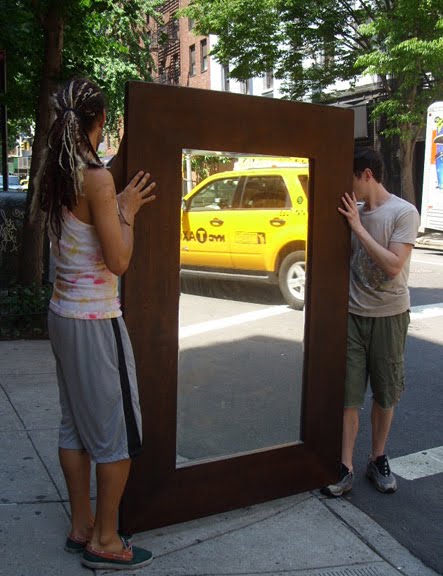 Watching these two guys move this mirror reminded me of Roman Polanski's famous short film "Two Men and a Wardrobe."
Monday, May 30, 2011
First Class Barber Shop
 Another
remnant of old New York of another age, this barber shop is next to a
bar that uses a famous World War II expression, "Snafu" ( sanitized
translation: Situation Normal, All Fouled Up.").
Another
remnant of old New York of another age, this barber shop is next to a
bar that uses a famous World War II expression, "Snafu" ( sanitized
translation: Situation Normal, All Fouled Up.").
Morgan Library- Illuminated Manuscripts
 Known
for its incredible collection of manuscripts of all kinds, the Morgan
Library and Museum is now putting on an exhibit about Dress in the
Middle Ages...
Known
for its incredible collection of manuscripts of all kinds, the Morgan
Library and Museum is now putting on an exhibit about Dress in the
Middle Ages...This place is more visited by scholars and professional people than the general public.
Commodore Vanderbilt
 Vanderbilt Avenue adjacent to the East side of Grand Central Terminal is eerily quiet on Memorial Day.
The man who started all of this was Cornelius Vanderbilt...
To quote Wikipedia again:
Railroad empire

New York and Harlem Railroad
Though Vanderbilt had relinquished his presidency of the Stonington Railroad during the California gold rush, he took an interest in several railroads during the 1850s, serving on the boards of directors of the Erie Railway, the New Jersey Central, the New Haven and Hartford, and the New York and Harlem (popularly known as the Harlem). In 1863, Vanderbilt took control of the Harlem in a famous stockmarket corner, and was elected its president. He later explained that he wanted to show that he could take this railroad, which was generally considered worthless, and make it valuable. It had a key advantage: it was the only steam railroad to enter the center of Manhattan, running down 4th Avenue (later Park Avenue) to a station on 26th Street, where it connected with a horse-drawn streetcar line. From Manhattan it ran up to Chatham Four Corners, New York, where it had a connection to the railroads running east and west.[17]Vanderbilt brought his son William Henry Vanderbilt in as vice-president of the Harlem. William had had a nervous breakdown early in life, and his father had sent him to a farm on Staten Island. But he proved himself a good businessman, and eventually became the head of the Staten Island Railway. Though the Commodore had once scorned him, he was impressed by William's success, and eventually made him operational manager of all his railroad lines. In 1864, the Commodore sold his last ships, concentrating on railroads.[18]
New York Central and Hudson River Railroad


Grand Central Depot
Main article: Grand Central Terminal
In
1869, he directed the Harlem to begin construction of the Grand
Central Depot on 42nd Street in Manhattan. It was finished in 1871, and
served as his lines' terminus in New York. He sank the tracks on 4th
Avenue in a cut that later became a tunnel, and 4th Avenue became Park
Avenue. The depot was replaced by Grand Central Terminal in 1913.
Memorial Day in Grand Central Terminal
 Upstairs
and downstairs (where the larger eating areas and the rest rooms are),
Grand Central Terminal is relatively quiet on Memorial Day.
Upstairs
and downstairs (where the larger eating areas and the rest rooms are),
Grand Central Terminal is relatively quiet on Memorial Day.Grand Central TERMINAL was destined to become Grand Central STATION (linked with Penn Station so trains could continue)...but that multi billion plans seems to be on ice, like so many other projects.
It is amazing that the Second Avenue Subway is still being built.
Historically: to quote Wikipedia:
Grand Central Terminal (GCT) — often incorrectly called Grand Central Station, or shortened to simply Grand Central — is a terminal station at 42nd Street and Park Avenue in Midtown Manhattan in New York City, United States. Built by and named for the New York Central Railroad in the heyday of American long-distance passenger trains, it is the largest train station in the world by number of platforms:[3] 44, with 67 tracks along them. They are on two levels, both below ground, with 41 tracks on the upper level and 26 on the lower, though the total number of tracks along platforms and in rail yards exceeds 100. When the Long Island Rail Road's new station opens in 2016 (see East Side Access), Grand Central will offer a total of 75 tracks and 48 platforms. The terminal covers an area of 48 acres (19 ha).
The terminal serves commuters traveling on the Metro-North Railroad to Westchester, Putnam, and Dutchess counties in New York State, and Fairfield and New Haven counties in Connecticut.
Although the terminal has been properly called "Grand Central Terminal" since 1913, many people continue to refer to it as "Grand Central Station." "Grand Central Station" is the name of the nearby post office, as well as the name of a previous rail station on the site, and it is also used to refer to a New York City subway station at the same location.


Sunday, May 29, 2011
The Gap
 Summer fashion for men at a Gap outlet.
As noted, fashions for men stay pretty stable year after year..
Although I have noted younger people have told me Cargo Shorts are "out."
Times Square from the South
 Times Square has been "Disneyfied" as many people call it..
For years it was as seedy as hell, and though there were plans for rebuilding the area, they really didn't get going til the mid 90's.
I , however, feel no nostalgia for the old seedy Times Square with all its porn theaters and muggings.
The distant past remains in places
 So
much changes around here so fast that is something of a surprise to
find a spot like this-- the Ribbon store and the diner-- so much like 50
years ago ( or longer ago than that).
So
much changes around here so fast that is something of a surprise to
find a spot like this-- the Ribbon store and the diner-- so much like 50
years ago ( or longer ago than that).
Saturday, May 28, 2011
Fountain & Kalikow
 Noted Kalikow Real Estate Offices behind fountain...
Kailikow has been involved in a lot of contentious matters in NYC.
One of them involved displacing a whole block of rent controlled apartments from a place on the Upper East Side. I don't know if the tenants won that one or not...
This is not mentioned in the Wikipedia article, which is just a list of his honors, etc.:
Peter S. Kalikow (born December 1, 1942) is President of H. J. Kalikow & Company, LLC, one of New York City's leading real estate firms. He is the former Chairman of the Metropolitan Transportation Authority (MTA), former Commissioner of the Port Authority of New York and New Jersey, and past owner and publisher of the New York Post.
In May 2000, Kalikow was named Chairman of the Grand Central Partnership Board of Directors. The Grand Central Partnership is one of the largest and most successful Business Improvement Districts (BIDs) in New York City. Kalikow is very familiar with the area covered by the Grand Central Partnership, as his company headquarters, 101 Park Avenue, was one of the first new office developments in the area dating back to 1982.
Kalikow began his career in real estate in 1967 and became President of H. J. Kalikow & Co. in 1973. Following his father's death in 1982, Kalikow assumed responsibility for all Kalikow holdings. Kalikow is the third generation to preside over his family’s 77 year-old real estate company founded in 1927.
Kalikow remains very active in local, state, and national politics. In June 1994, he was appointed to the Metropolitan Transportation Authority (MTA) of the State of New York by Governor Mario Cuomo. The MTA oversees the operations, planning, and financing of the New York metropolitan area’s subways, commuter railroads, buses, bridges, and tunnels. He was appointed by Governor George Pataki to the MTA Board in 1999 and served on the Board as its Chairman until October, 2007.
Seventh Day Adventists
 The
Seventh Day Adventist Church on 40th Street opposite Bryant Park also
is home to its Hungarian and Russian branches in New York.
The
Seventh Day Adventist Church on 40th Street opposite Bryant Park also
is home to its Hungarian and Russian branches in New York.To quote Wikipedia again:
The Seventh-day Adventist Church (commonly abbreviated SDA,[2][3][4][5] officially abbreviated Adventist[6]) is a Christian denomination which is distinguished by its observance of Saturday,[7] the original seventh day of the Judeo-Christian week, as the Sabbath, and by its emphasis on the imminent Second Coming (Advent) of Jesus Christ. As of May 2007, it was the twelfth-largest religious body in the world,[8] and the sixth-largest highly international religious body.[9] The denomination grew out of the Millerite movement in the United States during the middle part of the 19th century and was formally established in 1863.[10] Among its founders was Ellen G. White, whose extensive writings are still held in high regard by the church today.[11]
Much of the theology of the Seventh-day Adventist Church corresponds to Protestant Christian teachings such as the Godhead and the infallibility of Scripture. Distinctive teachings include the unconscious state of the dead and the doctrine of an investigative judgment. The church is also known for its emphasis on diet and health, its holistic understanding of the person, its promotion of religious liberty, and its conservative principles and lifestyle.

Bryant Park and Carousel
 Summer has come to Bryant Park and " Le Carrousel" is again running...
Le Carrousel in Bryant Park, specially created to complement the park’s French classical style, is an homage to both European and American traditions. Its fourteen delightful animals, replicas of classic carousel creatures, revolve to the sounds of French cabaret music.
You will find the carousel mid-park on the 40th Street side.
Hours
Sunday–Thursday 11:30am to 9pm
Friday–Saturday 11:30am to 10pm
All hours weather permitting.
Pricing – One ride $2.00


More Murray Hill Houses
 These
houses were built for the wealthy originally and today a lot of them
are owned by such organizations as consulates ( note Benin posting) and
businesses.
These
houses were built for the wealthy originally and today a lot of them
are owned by such organizations as consulates ( note Benin posting) and
businesses.
Friday, May 27, 2011
Madison Square Garden
 You go through this complex to get to Penn Station...
They wanted to move Penn Station further South to the site of the old Main Post Office but I believe this fell through finally because of the exorbitant cost.
Madison Square Garden ( which now is nowhere near Madison Square) has an interesting history.
To quote from Wikipedia:Madison Square Garden, often abbreviated as MSG and known colloquially as The Garden and/or The World's Most Famous Arena, is a multi-purpose indoor arena in the New York City borough of Manhattan and located at 8th Avenue, between 31st and 33rd Streets, situated on top of Pennsylvania Station.
Opened on February 11, 1968, it is the longest active major sporting facility in the New York Metropolitan area, and is the fourth incarnation of the arena in the city. One Penn Plaza stands at its side. Several other operating entities related to the venue that shares its name.
Madison Square Garden is the third busiest music arena in the world in terms of ticket sales, behind M.E.N. Arena, Manchester and The O2 Arena, London both in the United Kingdom.[1]
As of the start of the 2010–11 NHL season and 2010-11 NBA season, Madison Square Garden is the oldest arena in the NHL, and the second oldest in the NBA, following Oracle Arena, in Oakland.
Other Facts:
On February 11, 1968,[2] the current Madison Square Garden (sometimes referred to as Madison Square Garden IV) opened after the Pennsylvania Railroad tore down the above-ground portions of Pennsylvania Station and continued railway traffic underneath. The new structure was one of the first of its kind to be built above the platforms of an active railroad station. It was an engineering feat constructed by Robert E. McKee of El Paso, Texas.
Public outcry over the demolished Beaux-Arts structure led to the creation of the New York City Landmarks Preservation Commission.
The current Garden is the hub of Madison Square Garden Center in the office and entertainment complex formally addressed as Pennsylvania Plaza and commonly known as Penn Plaza for the railroad station atop which the complex is located.
Bead Center
 Typical big shop in Garment Center..
How often do you think about beads?
I almost never do.
Thursday, May 26, 2011
Father Mychal F. Judge Way
 This street sign honors the Fire Dept. Chaplain who was killed in the Twin Towers catastrophe.
He stayed in the area long after he should have run for cover and was killed by falling debris.
There are memorial signs like this all over Manhattan, as I have noted.
Here is an article on Father Judge from New York Magazine
The Firemen's Friar
He was the first and most famous victim of the World Trade Center attack, but the death of Father Mychal Judge, the beloved New York Fire Department chaplain, was not as extraordinary as his colorful and iconoclastic life.
ShareThis |
(Photo: AP)
|
Most of the mourners had no idea that Judge whirled through the city in so many different orbits, even though he had an extraordinarily high profile as one of five chaplains of the New York City Fire Department. Most also had no idea why they were commemorating a Catholic priest in an Episcopal church, until one of the event's organizers explained that this was where Judge used to go for AA meetings -- the other cornerstone of his spiritual life, besides the church -- and therefore had a very special significance to him.
"Only Father Mychal could get a room like this together," said Joe Hartnett, an electrician and father of five from New Jersey, when he took his turn at the altar to speak. Judge had been a pastor at Hartnett's parish in East Rutherford when he was a teenager. "I mean, I see firemen, policemen, recovering alcoholics, and people who are -- uh, here's a word I don't use very often -- gay."
And yet this was precisely who Mychal Judge was: a devout, gay, recovering-alcoholic Catholic priest, a fabled New York figure who had a knack for telling great stories and would burst into old Irish standards at the drop of a hat. (His rendition of "Frankie and Johnny" was a legendary crowd-pleaser; by verse three, he'd have his handkerchief out, pretending to weep.) Judge had a Clintonian talent for making people feel as though they were the only ones in the room and a bartender's gift for bringing strangers together. Like this crowd.
"I didn't know anything about his other side," Hartnett said later, after the service. "I just knew what a great guy he was and how he always gave people the time of day. He was everybody's priest."
Perhaps the first wisp of real poetry to emerge from the devastation of the World Trade Center was the tale of Mychal Judge's death. Within hours of the collapse, a story began circulating that he'd been hit by falling debris when he took his helmet off to give last rites to a firefighter, a man who himself had been crushed by someone who'd jumped from Tower One.
Seven weeks later, it seems that the story is at least partly myth, though perhaps a myth necessary to the demands of the day. For one thing, Judge's body was found in the lobby of Tower One, not on the sidewalk outside. For another, one of the firefighters who carried Judge out of the building, Christian Waugh, says he saw the chaplain standing upright by the emergency command post just seconds before they and scores of others got caught in a monsoon of rubble. "I'm assuming he gave last rites to the guy in Company 216 and then ran into the lobby," says Waugh. "Because I was with him in that lobby. He was standing right there, a few feet away from me."
But it's understandable how the myth bloomed. Those who knew Judge -- and he knew hundreds, if not thousands, of people -- wanted him to die gorgeously and aptly, in a way that expressed the depth of his faith. It was how they imagined him. Such a death suited a legend.
As it happens, the unembellished story of Mychal Judge's death is just as moving -- and an even more telling tribute to the chaplain, as well as to the men he served.
"There's a very old postcard of a giant Jesus looking in the window of the Empire State Building in those long, long robes," says McCourt, in a brogue as thick as potatoes. "And that was Mike Judge in New York. He was everywhere. Over the city. And ooohhh, how good it was to know he was there."
Judge was gregarious, mischievous, a luminous presence; he thrived on movement and kept a preposterous schedule, as if he'd found a wormhole beneath the friary on West 31st Street that allowed him to be in six places at once. On any given evening, he might be baptizing a fireman's child, ministering to an aids patient, or listening to Black 47, a Celtic rock band that had a regular gig at Connolly's on West 47th Street. Judge got 30 to 40 messages a day on his answering machine. Every six months, he'd wear another machine out.
"He was the busiest person alive," says Joe Falco, a firefighter with Engine 1-Ladder 24, the company across the street from Judge's home. "He'd come back at all hours of the morning, blowing his siren so we could park his car. No one knew how he did it. No one understood how he maintained his energy."
The firemen loved him. He had an encyclopedic memory for their family members' names, birthdays, and passions; he frequently gave them whimsical presents. Once, after visiting President Clinton in Washington, he handed out cocktail napkins emblazoned with the presidential seal. He'd managed to stuff dozens of them into his habit before leaving the White House.
"I would break his chops constantly," says Falco. "I wouldn't treat him like a priest. I'd treat him like any other guy. It wasn't a priest-parishioner relationship. It was . . . you know, man to man. He'd help guys out with their marital problems. With every problem, big or small. You could go to him."
Obviously, Mychal Judge was not what one might call a conventional priest. But he was, arguably, a typical New York Franciscan -- earthy, streetwise, thoroughly engaged with the characters and chaos of the city. If times required it, Judge would hold Mass in the most unlikely places, including firehouses and Pennsylvania Station. This drove certain literalists in the clergy crazy, but no matter -- Judge pressed on. (To one of his antagonists, a certain monsignor in the chancellery who frequently phoned to admonish him, Judge once said: "If I've ever done anything to embarrass or hurt the church I love so much, you can burn me at the stake in front of St. Patrick's.")
The other pillar of Judge's spiritual philosophy was Alcoholics Anonymous. Once, at the White House, he told Bill Clinton that he believed the founders of AA had done more for humanity than Mother Teresa. "He was a great comfort to those with troubles with the drink," says McCourt, who usually saw Judge twice a month at AA. "He'd always say, 'You're not a bad person -- you have a disease that makes you think you're a bad person, and it's going to fuck you up.' " McCourt pauses a moment. "He had no compunction about language. Not with me, anyway."
Back in the early eighties, Judge was one of the first members of the clergy to minister to young gay men with aids, doing their funeral Masses and consoling their partners and family members. He opened the doors of St. Francis of Assisi Church when Dignity, a gay Catholic organization, needed a home for its aids ministry, and he later ran an aids program at St. Francis. Last year, he marched in the first gay-inclusive St. Patrick's Day parade, which his friend Brendan Fay, a gay activist, organized in Queens.
Cardinal O'Connor wasn't exactly a fan. "I heard that if Mike got any money from the right wing," says McCourt, "he'd give it to the gay organizations. I don't know if that's true, but that's his humor, for sure."
Perhaps the most unusual thing about Judge was how simultaneously New York and un-New York he seemed. Judge's roots in this city ran deep -- he was born here and raised here -- and he knew everyone, from the homeless to the mayor. But he lived on an entirely different plane of priorities from that inhabited by most New Yorkers. He was nonacquisitive, unselfish, and uncomplaining. "Once in a while," his friend Michael Duffy, a friar from Philadelphia, said in his homily for Judge, "he would say to me, 'Michael Duffy' -- he always called me by my full name -- 'Michael Duffy, you know what I need?' And I would get excited because it was hard to buy him a present or anything. I said, 'No, what?'
"'You know what I really need?'
"'No, what, Mike?'
"'Absolutely nothing. I don't need a thing in the world. I am the happiest man on the face of the earth.'"
Fashion Institute
 Another West Side ( Chelsea) institution: the Fashion Institute of Technology.
Borrowing from Wikipedia:The Fashion Institute of Technology, generally known as FIT, is a State University of New York (SUNY) college of art, business, design, and technology connected to the fashion industry, with an urban campus located on West 27th Street between Seventh and Eighth Avenues in the Chelsea neighborhood of Manhattan , New York City. It was founded in 1944,[1] accredited in 1957, [2] and is ranked among the top five fashion schools in the world.[3] It has an enrollment of more than 10,000 students.[4] FIT's 2010-2011 tuition and fees are estimated at $5,438 for in-state students and $13,820 for out-of-state students. [5]
This stretch of 7th Avenue in the Garment District is known as Fashion Avenue...

Environmental Update
 Changing sign about carbon emissions calling attention to climate change.
Guess you know there is also a similar sign around (think it is in Times Square, or used to be) which shows the National Debt.
Flower District in Bloom Again
 The Flower District on the West Side is just a shadow of what it used to be, it seems to me...
Now summer has come it is back in business again though.
Infant abandoned amongst the rushes?

Wednesday, May 25, 2011
Old and New on West Side
 Typical contrast in Midtown between older ornate office buildings and the sleek modern ones.
I think the mixture makes them both more interesting.
The Training Institute for Mental Health
 New
York offers some great services and this about one of them:The Training
Institute for Mental Health at 115 West 27th Street in Manhattan.The TIMH trains therapists and provides affordable (below market) counseling and therapy.
New
York offers some great services and this about one of them:The Training
Institute for Mental Health at 115 West 27th Street in Manhattan.The TIMH trains therapists and provides affordable (below market) counseling and therapy.I do volunteer writing for their newsletter and am pleased to be associated with such a fine organization...
It draws a lot of students, people in the Arts and others from all of over Manhattan and particularly from lower Midtown.
People come in for intake interviews for a modest fee and then work out payments based on a sliding scale -- what they can afford.
There are also special low fees for the unemployed, which in these troubled times is especially helpful.
The Sarah A. Meehan Center helps people cope with all kinds of issues-- low self esteem, anger management, career difficulties, relationship conflicts and depression and anxiety among them.
It offers such services as individual psychotherapy, support groups , Gay/Lesbian/Bi-Sexual Affirmative therapy, Couples therapy and Family therapy.
Therapists are available Monday through Saturday, days and evenings. To make an appointment, call and speak with an intake specialist at 212 627 8181.
Shown here are the main entrance on 27th Street between 6th and 7th Avenues, the waiting room, one of the friendly receptionists, and the head of development,
my friend John McCaffrey ( his amiable wife also works at TIMH).
Just saw John today to talk about an article I will write for the next issue of the newsletter--- about psychotherapy and the problems of artists ( a lot of artists and art students come to the Training Institute).



450 Seventh Avenue- Nelson Tower
 There is one office building in the garment district that really stands out...to quote Wikipedia:
Nelson Tower is a 171 meter (560 feet) tall building located at 450 7th Avenue on Manhattan Island, New York, United States.
History
It was completed in 1931 and became the tallest building in the Garment district of New York. Today it is dwarfed by the 60 story One Penn Plaza that sits across 34th Street from the Nelson Tower but still visible from most directions except the southeast. It was designed by H. Craig Severance. The building was originally planned and built by New York developer, Julius Nelson.Architecture
The building has a rectangular base and recedes at different places. Each section is of brown stone with the top of them lined with white stone. The crown is completely white stone and has a slight slope.
Tuesday, May 24, 2011
HSBC?
 It
just dawned on me last week I didn't really know what HSBC stood for...
after all these years of its being one of the biggest banks around.
It
just dawned on me last week I didn't really know what HSBC stood for...
after all these years of its being one of the biggest banks around.To quote Wikipedia:
HSBC Holdings plc (Chinese: 滙豐控股有限公司) is a global banking and financial services company headquartered in Canary Wharf, London, United Kingdom.[3] As of 2010 it was the world's sixth-largest banking and financial services group and eighth-largest company according to a composite measure by Forbes magazine.[6][7] It has around 7,500 offices in 87 countries and territories across Africa, Asia, Europe, North America and South America and around 100 million customers.[4][8] As of 30 June 2010 it had total assets of $2.418 trillion, of which roughly half were in Europe, a quarter in the Americas and a quarter in Asia.[5]
HSBC Holdings plc was founded in London in 1991 by The Hongkong and Shanghai Banking Corporation to act as a new group holding company and to enable the acquisition of UK-based Midland Bank.[1] The origins of the bank lie in Hong Kong and Shanghai, where branches were first opened in 1865.[2] Today HSBC remains the largest bank in Hong Kong, and recent expansion in mainland China, where it is now the largest international bank, has returned it to that part of its roots.[8][9]
HSBC is a universal bank and is organised within four business groups: Commercial Banking; Global Banking and Markets (investment banking); Personal Financial Services (retail banking); and Private Banking.[10]
Smoking Bans
 I was out today suddenly noticed I had not seen anyone smoking for a good while.
Then that all changed when I walked down 36th Street between Madison and Park Avenues, where I saw about a dozen people in doorways smoking away furiously.
I didn't feel comfortable taking pictures of this people head on ( they are probably in a bad mood because of all the new NYC smoking bans) --
This woman is walking down Park Avenue...with her back to me. Cigarette is in her right hand.
As an ex-smoker myself, I know how hard it is to quit and wonder whether banning smoking in city parks and other public places just is not one step further on the road to out-and-out prohibition.
Actually, all reports are that all the major tobacco companies have been planning for this for years and have diversified most of their assets...and there are still plenty of developing countries offering markets to be exploited.
Garment District
 New
York still has its Garment District in Manhattan ( a stretch of 7th
Avenue is called "Fashion Avenue" --but its glory days and production
facilities are gone.
New
York still has its Garment District in Manhattan ( a stretch of 7th
Avenue is called "Fashion Avenue" --but its glory days and production
facilities are gone.To quote Wikipedia about the decline:
Cheaper overseas labor and production has dramatically affected the New York industry for decades. This change has forced many designers who once manufactured their lines in the city to shift production overseas, which has in turn affected small cutting and sewing rooms as well as zipper, button and supply stores in the Garment District.[3]
Charles Bagli of the New York Times wrote "Some city officials and industry leaders worry that if manufacturing is wiped out, many of the designers who bring so much luster to New York will leave, along with the city’s claim to be a fashion capital rivaling Paris and Milan. The damage would be undeniable, given that the industry’s two big annual events — Fashion Week in September and February — attract enormous numbers of visitors and generate hundreds of millions of dollars in economic activity."[3]
Although these are difficult times for many industries, including New York's Garment District, there are many organizations working hard to keep this district vital. One such organization is The Fashion Center Business Improvement District (also known as The Fashion Center or the Fashion Center BID). This non-profit organization works hard to sustain and improve upon the vibrancy and vitality of Midtown Manhattan’s Fashion District by promoting the area as a strategic business location for fashion and non-fashion related business alike.[4]
Summer Fashions
 Lord and Taylor store windows and a boutique nearby called Janique.
Notice beachwear is not always that revealing...
Well, that much exposure to the sun is not good for you anyway.


Monday, May 23, 2011
City University Exhibit Sign
 On the other side of the Science Library is a section managed by the City University of New York..
This show is called "The New American Painting Captures Europe."
Wish there was not so much reflection in the window, makes it hard to see images.
Doorway
 Just liked this doorway....seems very typical of the very early 20th century.


No comments:
Post a Comment
Please leave a comment-- or suggestions, particularly of topics and places you'd like to see covered