Astronomy Picture of the Day
Discover the cosmos!
Each day a different image or photograph of our fascinating universe is
featured, along with a brief explanation written by a professional astronomer.
2014 April 17
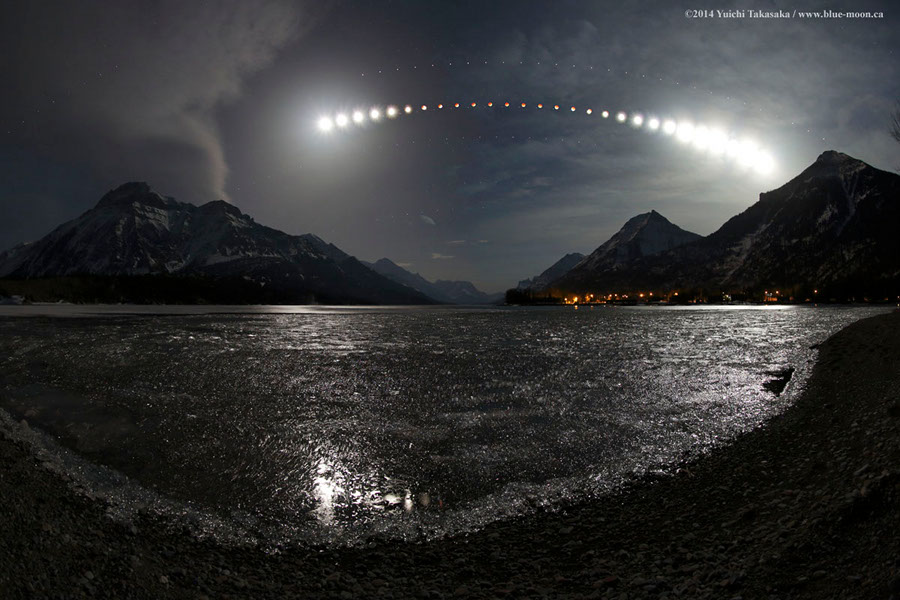 Waterton Lake Eclipse
Image Credit &
Copyright:
Yuichi Takasaka /
TWAN /
www.blue-moon.ca
Explanation:
Recorded on April 15th, this
total
lunar eclipse sequence looks south down icy Waterton Lake from the
Waterton
Lakes National Park in Alberta, Canada, planet Earth.
The most distant horizon includes peaks in
Glacier National Park,
USA.
An exposure every 10 minutes captured the Moon's position and
eclipse phase, as it arced, left to right, above the rugged skyline
and Waterton town lights.
In fact, the sequence effectively measures the roughly 80 minute
duration
of the total phase of the
eclipse.
Around 270 BC, the Greek astronomer
Aristarchus
also measured the duration of lunar eclipses - though probably without
the benefit of
digital clocks and cameras.
Still,
using geometry, he
devised a simple and impressively accurate way to calculate
the Moon's distance, in terms of the radius of planet Earth,
from the eclipse duration.
This modern eclipse sequence also tracks the successive positions of Mars,
above and right of the Moon, bright star Spica next to the reddened
lunar disk, and Saturn to the left and below.
Tomorrow's picture: moon beam
<
|
Archive
|
Index
|
Search
|
Calendar
|
RSS
|
Education
|
About APOD
|
Discuss
|
>
Authors & editors:
Robert Nemiroff
(
MTU) &
Jerry Bonnell (
UMCP)
NASA Official: Phillip Newman
Specific rights apply.
NASA Web
Privacy Policy and Important Notices
A service of:
ASD at
NASA /
GSFC
& Michigan Tech. U.

No comments:
Post a Comment
Please leave a comment-- or suggestions, particularly of topics and places you'd like to see covered