| This place with its rogues' gallery of hairstyles seems sort of out of date but probably OK. | If my present barber ever quits, ( I hope not), I may give this place a try. |
Putting my experiences of Life In NYC in a more personal perspective, and checking in with international/national, tech and some other news
Translation from English
Thursday, August 18, 2011
Hairstyles.....sort of old fashioned
Wednesday, August 17, 2011
Dinesen and Dickenson Quotes
Quotes from a number of authors and on bronze plaques embedded in the sidewalk near the main Public Library building....
Let me see if I can google something--yes, this is a short piece of a very long article on the internet:

Mija Riedel took a walk around Manhattan last year with downcast eyes.
Here's her story, which appeared in the October 30 Washington Post, about what lies beneath.
The Words on the Street In New York, 96 Reasons To Lower Your Gaze
In New York, the wittiest, wisest ideas lie underfoot — literally.
All you have to do is look down.
I was heading west on East 41st Street between Madison and Fifth avenues, scanning the pavement for open cellar doors and rickety grates, when I walked across a bronze plaque embedded in the sidewalk.
Roughly 2-1/2 by 1-1/2 feet, it illustrated in low relief a molecular diagram built around nine words: "The universe is made of stories, not of atoms."
A pair of black sneakers then crossed the panel (titled "Muriel Rukeyser, 1913–1980"), then white high tops.
The unexpected appearance of Rukeyser's words beneath my boots stopped me in the middle of the sidewalk at the height of lunch hour.
Intrigued, I moved on, keeping my eyes to the ground.
At 41st and Fifth, beneath a dallying pair of moccasins, another plaque resembling an open book proclaimed: "Library Walk. A Celebration of the World's Great Literature, Brought to You by the Grand Central Partnership and the New York Public Library. Sculptor: Gregg LeFevre."
In the two blocks of 41st Street between Park and Fifth avenues, LeFevre's 96 plaques quote 45 writers (11 women, 34 men) from 11 countries, spanning 20 centuries.
Each is illustrated with images inspired by the text.
The Grand Central Partnership (GCP), a nonprofit organization committed to revitalizing the neighborhood around Grand Central Terminal, conceived the project in the early 1990s.
Quotes were submitted — many by New York City librarians — and selections were made by a panel of literary experts convened by the GCP, the New York Public Library and the New Yorker magazine.
After 10 years and more than $100,000, Library Way (its official name) was dedicated in May 2004.
On this cloudless afternoon, sunlight glinted on the edges of a third panel [top] depicting a row of books, two hen bookends and a quote from E.B. White: "I don't know which is more discouraging, literature or chickens."
A pair of pointy, patent leather pumps stopped short where concrete bordered bronze.
"Oh! Sorry," said a female voice.
The shiny black stilettos pirouetted left and disappeared.
Across Fifth Avenue, students and laptop-laden researchers climbed the main stairs of the New York Public Library, dodging the tourists being photographed between its iconic lions.
I ducked in the front door to inquire further about the panels.
Both volunteers at the Friends of the Library counter paused, clearly surprised that someone had noticed the plaques.
"Did anyone else stop?" said one Friend, who wore the heavy, half-frame reading glasses that every child recognizes as visual shorthand for "librarian."
"No."
Then I remembered the moccasins.
"One paused."
"New Yorkers," she sighed, flipping through piles of brochures.
"They're too busy."
After a minute she located a pamphlet and passed it to me.
"More people should read them."
Outside I stood between the lions, Patience and Fortitude, as crowds flooded 41st Street.
The people passed the Chemists Club, the Dylan Hotel, YuYu41 Spa and the Vegetable Garden Kosher and Dairy Restaurant.
The modern, mirrored skyscraper on my left reflected the cast and chiseled facades of smaller skyscrapers, a passing cloud and the steel blue sky.
I was accustomed to Manhattan's relentless dazzle from eye level up but here on 41st Street the city had finally and completely closed the gap, becoming 360 degrees of head-to-foot, skyscraper-to-sidewalk stimulation.
Later that afternoon, I spent an hour on the GCP Web site studying photos of each plaque I'd missed, by the likes of Emily Dickinson, Gu Cheng, Lewis Carroll and Wallace Stevens.
Rene Descartes' quote — "The reading of good books is like a conversation with the best men of past centuries" — is illustrated with nine men wearing stiff suit coats and top hats, engaged in animated discourse among themselves and oblivious to a bustled woman standing alone off to the side.
Lucille Clifton wrote, "They ask me to remember but they want me to remember their memories and I keep on remembering mine."
Willa Cather's two lines are repeated until her panel overflowed with her words: "There are only two or three human stories, and they go on repeating themselves as fiercely as if they had never happened before. There are only two or three human stories...."
The Descartes panel, along with a Gu Cheng poem and the sandy, wavy imagery illustrating Georges Braque ("Truth exists, only falsehood has to be invented") are the sculptor's favorites.
LeFevre has been making site-specific sculptures since 1984; all told, he has 127 projects around the country, including more than a dozen around New York City.
Most of his works are bronze, terrazzo or concrete set in pavement, and many are, like Library Way, a series of panels with text and images.
The following Saturday, I returned to browse Library Way without the stampeding weekday crowds.
No delivery trucks crowded the sidewalks.
No heels shuffled, tapped or clicked along the concrete.
I strolled around each plaque as if it were a flower bed.
Stevens' words were criss-crossed with bronze bird tracks.
Langston Hughes' were illustrated with breaking chains.
The bronze images and words were cast just high enough to register faintly through the soles of my shoes.
In front of the Dylan Hotel at 52 E. 41st, a doorman in his mid–twenties with a longish crew cut and polished black lace–up shoes lingered on the steps.
At his feet were the words of Thomas Jefferson: "Where the press is free, and every man able to read, all is safe."
I nudged the plaque [below] with my toe.

"What do you think of these?"
He shrugged.
"They're nice. This one's the best," he nodded toward Jefferson.
"Right in front? You're not tired of it?"
"It's the only one I've read, but it's the best."
Let me see if I can google something--yes, this is a short piece of a very long article on the internet:
'Word Down' — New York City's Library Walk
Mija Riedel took a walk around Manhattan last year with downcast eyes.
Here's her story, which appeared in the October 30 Washington Post, about what lies beneath.
The Words on the Street In New York, 96 Reasons To Lower Your Gaze
In New York, the wittiest, wisest ideas lie underfoot — literally.
All you have to do is look down.
I was heading west on East 41st Street between Madison and Fifth avenues, scanning the pavement for open cellar doors and rickety grates, when I walked across a bronze plaque embedded in the sidewalk.
Roughly 2-1/2 by 1-1/2 feet, it illustrated in low relief a molecular diagram built around nine words: "The universe is made of stories, not of atoms."
A pair of black sneakers then crossed the panel (titled "Muriel Rukeyser, 1913–1980"), then white high tops.
The unexpected appearance of Rukeyser's words beneath my boots stopped me in the middle of the sidewalk at the height of lunch hour.
Intrigued, I moved on, keeping my eyes to the ground.
At 41st and Fifth, beneath a dallying pair of moccasins, another plaque resembling an open book proclaimed: "Library Walk. A Celebration of the World's Great Literature, Brought to You by the Grand Central Partnership and the New York Public Library. Sculptor: Gregg LeFevre."
In the two blocks of 41st Street between Park and Fifth avenues, LeFevre's 96 plaques quote 45 writers (11 women, 34 men) from 11 countries, spanning 20 centuries.
Each is illustrated with images inspired by the text.
The Grand Central Partnership (GCP), a nonprofit organization committed to revitalizing the neighborhood around Grand Central Terminal, conceived the project in the early 1990s.
Quotes were submitted — many by New York City librarians — and selections were made by a panel of literary experts convened by the GCP, the New York Public Library and the New Yorker magazine.
After 10 years and more than $100,000, Library Way (its official name) was dedicated in May 2004.
On this cloudless afternoon, sunlight glinted on the edges of a third panel [top] depicting a row of books, two hen bookends and a quote from E.B. White: "I don't know which is more discouraging, literature or chickens."
A pair of pointy, patent leather pumps stopped short where concrete bordered bronze.
"Oh! Sorry," said a female voice.
The shiny black stilettos pirouetted left and disappeared.
Across Fifth Avenue, students and laptop-laden researchers climbed the main stairs of the New York Public Library, dodging the tourists being photographed between its iconic lions.
I ducked in the front door to inquire further about the panels.
Both volunteers at the Friends of the Library counter paused, clearly surprised that someone had noticed the plaques.
"Did anyone else stop?" said one Friend, who wore the heavy, half-frame reading glasses that every child recognizes as visual shorthand for "librarian."
"No."
Then I remembered the moccasins.
"One paused."
"New Yorkers," she sighed, flipping through piles of brochures.
"They're too busy."
After a minute she located a pamphlet and passed it to me.
"More people should read them."
Outside I stood between the lions, Patience and Fortitude, as crowds flooded 41st Street.
The people passed the Chemists Club, the Dylan Hotel, YuYu41 Spa and the Vegetable Garden Kosher and Dairy Restaurant.
The modern, mirrored skyscraper on my left reflected the cast and chiseled facades of smaller skyscrapers, a passing cloud and the steel blue sky.
I was accustomed to Manhattan's relentless dazzle from eye level up but here on 41st Street the city had finally and completely closed the gap, becoming 360 degrees of head-to-foot, skyscraper-to-sidewalk stimulation.
Later that afternoon, I spent an hour on the GCP Web site studying photos of each plaque I'd missed, by the likes of Emily Dickinson, Gu Cheng, Lewis Carroll and Wallace Stevens.
Rene Descartes' quote — "The reading of good books is like a conversation with the best men of past centuries" — is illustrated with nine men wearing stiff suit coats and top hats, engaged in animated discourse among themselves and oblivious to a bustled woman standing alone off to the side.
Lucille Clifton wrote, "They ask me to remember but they want me to remember their memories and I keep on remembering mine."
Willa Cather's two lines are repeated until her panel overflowed with her words: "There are only two or three human stories, and they go on repeating themselves as fiercely as if they had never happened before. There are only two or three human stories...."
The Descartes panel, along with a Gu Cheng poem and the sandy, wavy imagery illustrating Georges Braque ("Truth exists, only falsehood has to be invented") are the sculptor's favorites.
LeFevre has been making site-specific sculptures since 1984; all told, he has 127 projects around the country, including more than a dozen around New York City.
Most of his works are bronze, terrazzo or concrete set in pavement, and many are, like Library Way, a series of panels with text and images.
The following Saturday, I returned to browse Library Way without the stampeding weekday crowds.
No delivery trucks crowded the sidewalks.
No heels shuffled, tapped or clicked along the concrete.
I strolled around each plaque as if it were a flower bed.
Stevens' words were criss-crossed with bronze bird tracks.
Langston Hughes' were illustrated with breaking chains.
The bronze images and words were cast just high enough to register faintly through the soles of my shoes.
In front of the Dylan Hotel at 52 E. 41st, a doorman in his mid–twenties with a longish crew cut and polished black lace–up shoes lingered on the steps.
At his feet were the words of Thomas Jefferson: "Where the press is free, and every man able to read, all is safe."
I nudged the plaque [below] with my toe.
"What do you think of these?"
He shrugged.
"They're nice. This one's the best," he nodded toward Jefferson.
"Right in front? You're not tired of it?"
"It's the only one I've read, but it's the best."
Chiseler
Stone or whatever mason who did all these bas reliefs around windows and doors on Midtown building thought to include a self portrait...
King Kong curio
King Kong climbs the Empire State building in this unusual little statuette...don't see Fay Wray, though.
Tuesday, August 16, 2011
Empire State Peeking Through
Old buildings in Garment District contrast so much with Empire State Building peeking out above them....
Accessories Palace
This is a huge accessories place in the Garment District....I would have loved to be able to browse around here and take photos...(this one taken through the window).
Endless Scaffolding in Midtown
You are under scaffolding all the time in Midtown...
I often wonder about scaffolding accidents. Let me check the internet (this is from last year):
Suspended about 14 stories above Broadway in Lower Manhattan just before noon yesterday, a construction worker suddenly felt the scaffolding rig under his feet slip away. But he did not fall far.
He was wearing a lifeline, a cable suspended from the roof independent of the scaffold and clamped to a harness around his legs and shoulders, which caught him as the rig slipped.
He crawled to safety on a terrace on the 14th floor, a fire official said. He made his way to the street, and minutes later stepped uninjured out of an ambulance, pulled a cigarette from his pocket and fumbled for a lighter.
“Somebody give this man a light,” yelled a bystander from the crowd of onlookers. Someone did, and the construction worker, who would not identify himself, took a long drag.
“I’m O.K.,” he said. “A little excited.”
After a spate of scaffolding accidents that have resulted in five deaths this year, officials called yesterday’s mishap an example of what happens when construction workers and site supervisors follow safety guidelines.
Through Nov. 1, there were 19 scaffolding accidents this year, some of which resulted in injuries, compared with 11 last year and 5 in 2004, a spokeswoman for the Buildings Department said.
“There’s a big difference between doing things the wrong way and doing things the right way, and it shows,” said Robert Guerrerio, president of RSG Caulking and Waterproofing, which employed the worker at the construction site, for a residential building going up at Leonard Street and Broadway.
I often wonder about scaffolding accidents. Let me check the internet (this is from last year):
Suspended about 14 stories above Broadway in Lower Manhattan just before noon yesterday, a construction worker suddenly felt the scaffolding rig under his feet slip away. But he did not fall far.
Cory Conover for The New York Times
A construction worker looked for a light Tuesday after he escaped injury in the accident.
He crawled to safety on a terrace on the 14th floor, a fire official said. He made his way to the street, and minutes later stepped uninjured out of an ambulance, pulled a cigarette from his pocket and fumbled for a lighter.
“Somebody give this man a light,” yelled a bystander from the crowd of onlookers. Someone did, and the construction worker, who would not identify himself, took a long drag.
“I’m O.K.,” he said. “A little excited.”
After a spate of scaffolding accidents that have resulted in five deaths this year, officials called yesterday’s mishap an example of what happens when construction workers and site supervisors follow safety guidelines.
Through Nov. 1, there were 19 scaffolding accidents this year, some of which resulted in injuries, compared with 11 last year and 5 in 2004, a spokeswoman for the Buildings Department said.
“There’s a big difference between doing things the wrong way and doing things the right way, and it shows,” said Robert Guerrerio, president of RSG Caulking and Waterproofing, which employed the worker at the construction site, for a residential building going up at Leonard Street and Broadway.
Sunday, August 14, 2011
Le Cachet- Holistic Care
Skin Care place claims to be holistic...
You see terms like this and "organic" bandied around a lot...
Checking the internet:
We've canvassed the field of holistic medicine and compiled a glossary of the most popular modalities and remedies available.
A holistic approach to healing recognizes that the emotional, mental, spiritual and physical elements of each person comprise a system. By working with this systems approach the cause of an illness is targeted, rather than just the symptoms.
Acupressure
Acupuncture
Aromatherapy
Astrology
Aura Readers
Automatic Writing
Ayurveda
Bach Flower Remedies
Bioenergetics
Biofeedback
Bioidentical Hormone Replacement Therapy
Biomagnetics
Breathwork
Chakra Balancing
Channeling
Chelation
Chi Gong
Chi Kung
Chiropractic
Colonics
Cranio Sacral
Craniofascial Integrative Therapy
Dance Therapy
Doulas
Dream Analysis
Ear Candling
Edta
Energy Balancing
Facials
Feldenkrais Method
Feng Shui
Hair Analysis
Healing Circle
Healing Touch
Health Touch
Herbology
Holistic
Holistic Dentistry
Holistic Veterinary
Home
Homeopathy
Hypnobirthing
Hypnotherapy
Index
Infant Massage
Inner Child
And the list goes on.....
You see terms like this and "organic" bandied around a lot...
Checking the internet:
What Is Holistic?
This site will help you gain some understanding of the the terms and modalities in the field of holistic medicine.We've canvassed the field of holistic medicine and compiled a glossary of the most popular modalities and remedies available.
A holistic approach to healing recognizes that the emotional, mental, spiritual and physical elements of each person comprise a system. By working with this systems approach the cause of an illness is targeted, rather than just the symptoms.
Related Topics
And the list goes on.....
Touro College Building still for sale
This great Beaux Arts building was once an Art School...
At some point became part of Touro College, which has been trying to unload it for I think about two years.
I am not sure if it is a landmarked building or not...that may be why they are having so much trouble selling or leasing it.
At some point became part of Touro College, which has been trying to unload it for I think about two years.
I am not sure if it is a landmarked building or not...that may be why they are having so much trouble selling or leasing it.
What was "Rock the Vote"?
Mannequins seem ghostly in Vintage Clothing shop window...
Let me see if I can google anything about "Rock the Vote"--
Wikipedia article claims:
Rock the Vote is a non-profit organization in the United States of America whose mission is to engage and build the political power of young people.[1]
Rock the Vote uses their Democracy Class program along with music, popular culture and new technologies to engage and incite young people to register and vote in every U.S. election. They claim to give young people the tools to identify, learn about, and take action on the issues that affect their lives, and leverage their power in the political process.[2]
Group takes credit for helping reverse trend of low younger voter turnout.
Let me see if I can google anything about "Rock the Vote"--
Wikipedia article claims:
Rock the Vote is a non-profit organization in the United States of America whose mission is to engage and build the political power of young people.[1]
Rock the Vote uses their Democracy Class program along with music, popular culture and new technologies to engage and incite young people to register and vote in every U.S. election. They claim to give young people the tools to identify, learn about, and take action on the issues that affect their lives, and leverage their power in the political process.[2]
Group takes credit for helping reverse trend of low younger voter turnout.
Friday, August 12, 2011
No Smoking again
You see more and more signs like this....first saw them outside of hospitals and other public buildings, now apartment buildings are posting them too.
Wikipedia has some historical insight:
In 1604, King James I of England wrote A Counterblast to Tobacco, where he described smoking as: "A custome loathsome to the eye, hateful to the nose, harmeful to the brain, dangerous to the lungs, and in the black stinking fume thereof, nearest resembling the horrible Stigian smoke of the pit that is bottomeless."
Smoking was banned in Berlin in 1723, in Königsberg in 1742, and in Stettin in 1744. These bans were repealed in the revolutions of 1848.[3]
Although not a government entity, in 1833 the Church of Jesus Christ of Latter Day Saints introduced the Word of Wisdom into its doctrine, which in addition to other things, said that tobacco should not be smoked or chewed.
The Nazi Party imposed a tobacco ban in every German university, post office, military hospital and Nazi Party office, under the auspices of Karl Astel's Institute for Tobacco Hazards Research, created in 1941 under orders from Adolf Hitler.[4] Major anti-tobacco campaigns were widely broadcast by the Nazis until the demise of the regime in 1945.[5]
Wikipedia has some historical insight:
History of opposition to smoking
Pope Urban VII's 13-day papal reign included the world's first known public smoking ban in 1590 when he threatened to excommunicate anyone who "took tobacco in the porchway of or inside a church, whether it be by chewing it, smoking it with a pipe or sniffing it in powdered form through the nose".[2] The earliest citywide European smoking bans were enacted in Bavaria, Kursachsen, and certain parts of Austria in the late 17th century.In 1604, King James I of England wrote A Counterblast to Tobacco, where he described smoking as: "A custome loathsome to the eye, hateful to the nose, harmeful to the brain, dangerous to the lungs, and in the black stinking fume thereof, nearest resembling the horrible Stigian smoke of the pit that is bottomeless."
Smoking was banned in Berlin in 1723, in Königsberg in 1742, and in Stettin in 1744. These bans were repealed in the revolutions of 1848.[3]
Although not a government entity, in 1833 the Church of Jesus Christ of Latter Day Saints introduced the Word of Wisdom into its doctrine, which in addition to other things, said that tobacco should not be smoked or chewed.
The Nazi Party imposed a tobacco ban in every German university, post office, military hospital and Nazi Party office, under the auspices of Karl Astel's Institute for Tobacco Hazards Research, created in 1941 under orders from Adolf Hitler.[4] Major anti-tobacco campaigns were widely broadcast by the Nazis until the demise of the regime in 1945.[5]
Flea Market for Actors
Never knew there was an Episcopal Actors Guild...
Let me check their website...well, I can't cut and paste it for reason but you can check it out at:
http://www.actorsguild.org/aboutus2.html
It is the only surviving offspring of the Actors Church Alliance (1899-1923), an ecumenical organization founded by a young actor, Walter Bentley, who gave up his career to become a priest. In 1923, its members and officers then founded the Episcopal Actors’ Guild, encouraged by Father Bentley and welcomed to its permanent headquarters by The Rev. Randolph Ray, the newly-seated Rector of the “Little Church Around the Corner.” Father Ray, a cousin to Tallulah
Let me check their website...well, I can't cut and paste it for reason but you can check it out at:
http://www.actorsguild.org/aboutus2.html
MORE ABOUT THE EPISCOPAL ACTORS’ GUILD:
“The Stage has, beyond any other profession, been ever the handmaiden of charity. Does disaster occur, has a suffering to be healed, has a charity to be lifted up, the eye of the supplicant first looks to the stage, and never looks there in vain.”
This wonderful observation on the generosity of people of the ken from an 1871 New York City newspaper in our Guild Archives, most certainly applies to the members of today’s ecumenical and inter-denominational Episcopal Actors’ Guild. The Guild was founded in 1923 and incorporated as a 501 (c) (3) non-profit in 1926. It is a charitable fellowship organization governed by its Constitution and By-Laws, and is the result of the youthful idealism of several extraordinary individuals.
ould like to tell you about our Guild’s
Century USA Inc.--Multi-store
Perfume, luggage, health and beauty....and a lot more at this store near Herald Square.
What don't they sell?
Just googled the place...they are a department store! No really large stores though, I guess.
What don't they sell?
Just googled the place...they are a department store! No really large stores though, I guess.
Child Boom in White Manhattan
Recently I reported on pre-schools in Midtown.
My personal observations in Kips Bay and Murray Hill are confirmed by latest report I heard on New York Public Radio today-- people with small children are moving into Manhattan below 102nd Street at an increasing rate ( In Murray Hill, you are sometimes startled to see how many blond toddlers you see walking or being wheeled around by mothers or nannies).
These childrens' families are usually white, and by necessity, pretty affluent. While some parents choose public schools, most opt for one of the many private schools around.
When the kids get older, a lot of these families move to the suburbs....but some remain. One woman caller to the radio show I listened to has a younger daughter in college.
These families also tend to have fewer children -- one or two at the most it seems. New York apartments that are large enough to accommodate more kids are hard to come by and very expensive.
This following is from an article from 2007, before the child boom in Manhattan had gotten into full swing....even then, it was a noticeable change.
My personal observations in Kips Bay and Murray Hill are confirmed by latest report I heard on New York Public Radio today-- people with small children are moving into Manhattan below 102nd Street at an increasing rate ( In Murray Hill, you are sometimes startled to see how many blond toddlers you see walking or being wheeled around by mothers or nannies).
These childrens' families are usually white, and by necessity, pretty affluent. While some parents choose public schools, most opt for one of the many private schools around.
When the kids get older, a lot of these families move to the suburbs....but some remain. One woman caller to the radio show I listened to has a younger daughter in college.
These families also tend to have fewer children -- one or two at the most it seems. New York apartments that are large enough to accommodate more kids are hard to come by and very expensive.
This following is from an article from 2007, before the child boom in Manhattan had gotten into full swing....even then, it was a noticeable change.
The Manhattan Baby Boom
By SAM ROBERTSSince 2000, according to census figures released last year, the number of children under age 5 living in Manhattan mushroomed by more than 32 percent. And though their ranks have been growing for several years, a new analysis for The New York Times makes clear for the first time who has been driving that growth: wealthy white families.
At least half of the growth was generated by children who are white and non-Hispanic. Their ranks expanded by more than 40 percent from 2000 to 2005. For the first time since at least the 1960s, white children now outnumber either black or Hispanic youngsters in that age group in Manhattan.
The analysis shows that Manhattan’s 35,000 or so white non-Hispanic toddlers are being raised by parents whose median income was $284,208 a year in 2005, which means they are growing up in wealthier households than similar youngsters in any other large county in the country.
What those findings imply, demographers say, is not only that the socioeconomic gap between Manhattan and the other boroughs is widening, but also that the population of Manhattan, in some ways, is beginning to look more like the suburbs — or what they used to look like — than like the rest of the city.
“We knew Manhattan was having a baby boom,” said Andrew A. Beveridge, a demographer at Queens College of the City University of New York, who conducted the analysis. “Now we know who’s having the babies.”
The raw numbers are subject to interpretation, but, coupled with anecdotal evidence, what they generally suggest is that more well-to-do Manhattanites who might otherwise have moved to the suburbs with their children are choosing to raise them in the city, at least early on.
Here’s Chris Osborne, 44, who lives on the Upper West Side with his wife Marcia, 37, and their two children, ages 4 and 6:
Affluent White Families Lead Way in Manhattan Baby Boom
At least half of the growth was generated by children who are white and non-Hispanic. Their ranks expanded by more than 40 percent from 2000 to 2005. For the first time since at least the 1960s, white children now outnumber either black or Hispanic youngsters in that age group in Manhattan.
The analysis shows that Manhattan’s 35,000 or so white non-Hispanic toddlers are being raised by parents whose median income was $284,208 a year in 2005, which means they are growing up in wealthier households than similar youngsters in any other large county in the country.
What those findings imply, demographers say, is not only that the socioeconomic gap between Manhattan and the other boroughs is widening, but also that the population of Manhattan, in some ways, is beginning to look more like the suburbs — or what they used to look like — than like the rest of the city.
“We knew Manhattan was having a baby boom,” said Andrew A. Beveridge, a demographer at Queens College of the City University of New York, who conducted the analysis. “Now we know who’s having the babies.”
The raw numbers are subject to interpretation, but, coupled with anecdotal evidence, what they generally suggest is that more well-to-do Manhattanites who might otherwise have moved to the suburbs with their children are choosing to raise them in the city, at least early on.
Here’s Chris Osborne, 44, who lives on the Upper West Side with his wife Marcia, 37, and their two children, ages 4 and 6:
If both parents are working, it actually becomes logistically difficult to live in the suburbs. If you’re 90 minutes away, we just don’t like that feeling.Details
Even if we were disposed to — for the usual space, quality of life reasons — to go to suburbs, we would have to consider the practical difficulty.
Affluent White Families Lead Way in Manhattan Baby Boom
Thursday, August 11, 2011
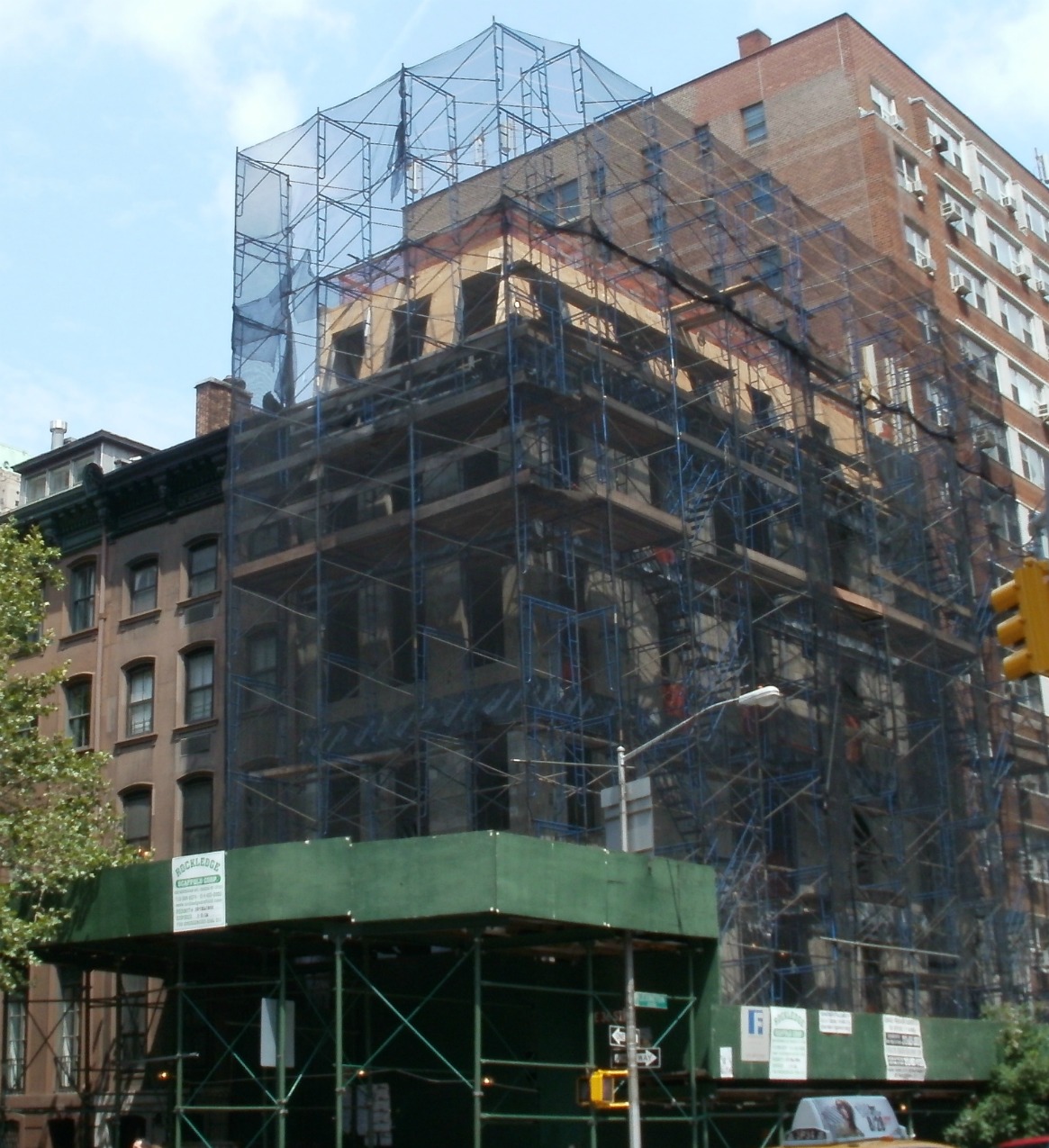
Renovation completed (almost)
Last time I took a photo of this building it was covered with scaffolding.
Near Herald Square, this stretch of Broadway has seen the renovation and restoration of many old buildings...sometimes turned into condo units.
Lots of renovation going on in Lower Midtown and downtown, often on relatively newer buildings. From article in the New York Times:
535 Madison Avenue to invest in the building’s first major upgrades in more than two decades. That the wager, at a cost of more than $5 million, was made in 2009 at the depths of the market only made it riskier.
But with lobby, elevator and electrical renovations now complete at the 37-story office tower, the building’s owners say the bet is already paying off. Since last year, more than half of the 200,000 square feet UBS vacated has been leased, with much of the common space spruced up just as the Manhattan office leasing market begins to show signs of improvement.
“We’re absolutely ecstatic with the way tenants have responded to it,” said Alfred Bradshaw, the executive vice president of the Park Tower Group, which owns and manages the building at Madison and 54th Street. “The response, both from the tenants and the prospective tenants and all the people in the real estate industry, has really been universally positive.” The Park Tower Group and the few other landlords who sank substantial sums into renovations during the economic downturn are now beginning to see results in the form of higher rents and a renewed interest from tenants, the owners said. (Park Tower is asking $75 to $125 per square foot.)
As rents fell across the city in the downturn, some owners who were unwilling or unable to invest in new construction focused instead on refurbishing their properties. Among the buildings renovated from 2007 through 2009 were 535 Madison Avenue, 545 Madison Avenue, the boutique office building 681 Fifth Avenue and the Empire State Building.
“Think about the foresight it took for some of these guys to say, ‘Now is the time to go in and fix this because when we come out of this we want to be the best positioned as the go-to product,’ ” said Jonathan Serko, a vice chairman of Cushman & Wakefield who advised the owners of 1385 Broadway on renovations that began in late 2008. “And obviously, for the ones who stuck with the strategy, it’s all worked out according to plan.”
Near Herald Square, this stretch of Broadway has seen the renovation and restoration of many old buildings...sometimes turned into condo units.
Lots of renovation going on in Lower Midtown and downtown, often on relatively newer buildings. From article in the New York Times:
535 Madison Avenue to invest in the building’s first major upgrades in more than two decades. That the wager, at a cost of more than $5 million, was made in 2009 at the depths of the market only made it riskier.
Michelle V. Agins/The New York Times
The office building at 535 Madison Avenue, center, is among those renovated during the downturn.
“We’re absolutely ecstatic with the way tenants have responded to it,” said Alfred Bradshaw, the executive vice president of the Park Tower Group, which owns and manages the building at Madison and 54th Street. “The response, both from the tenants and the prospective tenants and all the people in the real estate industry, has really been universally positive.” The Park Tower Group and the few other landlords who sank substantial sums into renovations during the economic downturn are now beginning to see results in the form of higher rents and a renewed interest from tenants, the owners said. (Park Tower is asking $75 to $125 per square foot.)
As rents fell across the city in the downturn, some owners who were unwilling or unable to invest in new construction focused instead on refurbishing their properties. Among the buildings renovated from 2007 through 2009 were 535 Madison Avenue, 545 Madison Avenue, the boutique office building 681 Fifth Avenue and the Empire State Building.
“Think about the foresight it took for some of these guys to say, ‘Now is the time to go in and fix this because when we come out of this we want to be the best positioned as the go-to product,’ ” said Jonathan Serko, a vice chairman of Cushman & Wakefield who advised the owners of 1385 Broadway on renovations that began in late 2008. “And obviously, for the ones who stuck with the strategy, it’s all worked out according to plan.”
Pre-Schools etc.
Robber stamps, anyone?
Who uses rubber stamps anymore, anyway? If you do, let me know...
Rest of store with sign is more up to date.
Used to have a friend, many years ago, who had a collection of different kinds of rubber stamps...
He got them to go with his big rolltop desk that he was very proud of. He loved all the little drawers and old fashioned aspects....
Rest of store with sign is more up to date.
Used to have a friend, many years ago, who had a collection of different kinds of rubber stamps...
He got them to go with his big rolltop desk that he was very proud of. He loved all the little drawers and old fashioned aspects....
Monday, August 8, 2011
Correction on Sikhs
Just a correction on one of my postings about the Sikh Center in Midtown:
A reader writes:
I'm a Sikh and sometimes it surprises me to see my people thriving in the most unlikely places. One correction, if I may, to your description of Sikhs as an Indian sect. Sikhism actually the world's 5th largest religion, founded in the 1400's by Guru Nanak.
Doodads, Costume Jewelry, etc.
This is the kind of store you see in Midtown that sells weird and novelty knicknacks, doodads and assorted "chachkeys."
From the internet== NY Magazine:
New Stuff
Photographs by Davies + Starr; Courtesy of Banana Republic (necklace)
Trolling for Vintage
DIGGING OUT THE GOOD STUFF
If you’d rather rummage through boxes at a thrift store than buy new, there are ways to make sure your piece won’t fall apart in a week. Eva Weiss, co-owner of vintage boutique Beauty Crisis, explains.
Heft says a lot. Generally, the older the piece, the heavier it will be. Twenties-era pieces were made of more substantial “pot metals” like brass and steel. After World War II, designers started to use aluminum and plastics.
Look for a name on the back of the settings. Signed pieces from well-known designers like Miriam Haskell, Hattie Carnegie, and Sarah Coventry will be better assembled than no-names. Check the back of the clasps or the balls of the rhinestones.
Learn your clasps. Many older pieces used simple hooklike C-clasps, but those came undone easily and fell out of use. Around the sixties, clasps started to get sturdier, more like the lobster-claw forms common today.
Grime should not be a deterrent. Take it to a watch cleaner—typically cheaper than jewelry specialists. You can also clean it at home with light steel wool. Buff off any surface tarnish (gently; these metals are often patinaed), or swab it with a Q-tip moistened with rubbing alcohol.
Prime Hunting Ground
Stores and fleas with excellent track records.
Housing Works
157 E. 23rd St., nr. Third Ave.; 212-529-5955
Housing Works is reliable for big designer pieces from the seventies and eighties. Saturdays are best, since the store puts out its finest stuff after close on Friday to attract weekend browsers.
St. Nicholas of Tolentine
80-22 Parsons Blvd., nr. Union Pkwy., Jamaica; 718-591-1815
If you can’t make it out to this parish flea market by two o’clock on the weekends, don’t bother. Crowds flock here for unusual finds like nautical- or animal-inspired bracelets or necklaces from the twenties through the eighties.
Church of the Resurrection
85-09 118th St., nr. Lefferts Blvd., Kew Gardens; 718-847-2649
Tables and tables of earrings, necklaces, and rings for as little as 50 cents. This is a great resource for budget gifts. The church affiliation yields an unusually high selection of crosses. The next sale is October 18 and 19.
Italian Charities of America
83-20 Queens Blvd., nr. Van Loon St., Elmhurst; 718-478-3100
Hit and miss: Sometimes there’s a jewelry-store owner unloading a trove; other times, it’s a jumble of junk. There’s a good chance you’ll find a few hefty necklaces from the twenties and thirties. Next flea market: September 27.
From the internet== NY Magazine:
Big Fakers
Huge costume jewelry is on the march. Delicate chains and tiny gems have been batted aside by beefy assemblages of glass, plastic, and metal. The best of the new stuff, where and how to buy vintage, and why a “fake” necklace costs $500.
- By Aja Mangum
- Published Aug 3, 2008
|
|
|
|
|
|
Trolling for Vintage
DIGGING OUT THE GOOD STUFF
If you’d rather rummage through boxes at a thrift store than buy new, there are ways to make sure your piece won’t fall apart in a week. Eva Weiss, co-owner of vintage boutique Beauty Crisis, explains.
Heft says a lot. Generally, the older the piece, the heavier it will be. Twenties-era pieces were made of more substantial “pot metals” like brass and steel. After World War II, designers started to use aluminum and plastics.
Look for a name on the back of the settings. Signed pieces from well-known designers like Miriam Haskell, Hattie Carnegie, and Sarah Coventry will be better assembled than no-names. Check the back of the clasps or the balls of the rhinestones.
Learn your clasps. Many older pieces used simple hooklike C-clasps, but those came undone easily and fell out of use. Around the sixties, clasps started to get sturdier, more like the lobster-claw forms common today.
Grime should not be a deterrent. Take it to a watch cleaner—typically cheaper than jewelry specialists. You can also clean it at home with light steel wool. Buff off any surface tarnish (gently; these metals are often patinaed), or swab it with a Q-tip moistened with rubbing alcohol.
Prime Hunting Ground
Stores and fleas with excellent track records.
Housing Works
157 E. 23rd St., nr. Third Ave.; 212-529-5955
Housing Works is reliable for big designer pieces from the seventies and eighties. Saturdays are best, since the store puts out its finest stuff after close on Friday to attract weekend browsers.
St. Nicholas of Tolentine
80-22 Parsons Blvd., nr. Union Pkwy., Jamaica; 718-591-1815
If you can’t make it out to this parish flea market by two o’clock on the weekends, don’t bother. Crowds flock here for unusual finds like nautical- or animal-inspired bracelets or necklaces from the twenties through the eighties.
Church of the Resurrection
85-09 118th St., nr. Lefferts Blvd., Kew Gardens; 718-847-2649
Tables and tables of earrings, necklaces, and rings for as little as 50 cents. This is a great resource for budget gifts. The church affiliation yields an unusually high selection of crosses. The next sale is October 18 and 19.
Italian Charities of America
83-20 Queens Blvd., nr. Van Loon St., Elmhurst; 718-478-3100
Hit and miss: Sometimes there’s a jewelry-store owner unloading a trove; other times, it’s a jumble of junk. There’s a good chance you’ll find a few hefty necklaces from the twenties and thirties. Next flea market: September 27.
Sunday, August 7, 2011
The Mustard Seed
The Mustard Seed sounds like the name of a secret society or something...
I remember vaguely some Buddhist teaching involving death and a mustard seed.
From internet--seems to be associated with AA:
Searching for a meeting?
Register for InTheRooms.com now to get exclusive free access to Daily Meditations, Speaker Tapes, and over 143,000 people in recovery who are willing to share their experience, strength and hope with YOU.
Learn More About InTheRooms.com
I remember vaguely some Buddhist teaching involving death and a mustard seed.
From internet--seems to be associated with AA:
Searching for a meeting?
Get REAL recovery online now!
Register for InTheRooms.com now to get exclusive free access to Daily Meditations, Speaker Tapes, and over 143,000 people in recovery who are willing to share their experience, strength and hope with YOU.Learn More About InTheRooms.com
The Maltese Consulate
Besides being home to the Maltese Falcon, I don't know much about Malta except that it is in the Mediterrenean and is supposed to have a great climate.
From Wikipedia again:
Malta (
i/ˈmɔːltə/), officially known as the Republic of Malta (Maltese: Repubblika ta' Malta), is a Southern European country consisting of an archipelago situated in the centre of the Mediterranean, 93 km south of Sicily and 288 km east of Tunisia, with the Strait of Gibraltar 1,826 km to the west and Alexandria 1,510 km to the east.[7]
Malta covers just over 300 km² in land area, making it one of the world's smallest and most densely populated countries.[8][9][10] Its de facto capital is Valletta and the largest town is Birkirkara. The main island is made up of many small towns, which together form one Larger Urban Zone (LUZ) with a population of 368,250 (majority of the population of the country) according to Eurostat.[11] The country has two official languages – Maltese and English – with Maltese being considered the national language.
Throughout history, Malta's location has given it great strategic importance,[12] and a sequence of powers including the Phoenicians, Greeks, Romans, Normans, Sicilians, Knights of St John, French and the British ruled the islands. Malta gained independence from the United Kingdom in 1964 and became a republic in 1974, whilst retaining membership in the Commonwealth of Nations. It is a member of the United Nations (since 1964) and a member of the European Union (since 2004). Malta is also party to the Schengen Agreement (since 2007)[13] and member of the eurozone (since 2008).
Malta has a long Christian legacy and is an Apostolic See. According to the Acts of the Apostles in the Bible,[14] St. Paul was shipwrecked on "Melite", as the Greeks called the island, and ministered there.[15] Catholicism continues to be the official and dominant religion in Malta.[16][17]
Malta is internationally renowned as a tourist resort, with numerous recreational areas and historical monuments, including nine UNESCO World Heritage Sites,[18] most prominently the Megalithic Temples which are some of the oldest free-standing structures in the world.[19][20][21]
From Wikipedia again:
Malta (
Malta covers just over 300 km² in land area, making it one of the world's smallest and most densely populated countries.[8][9][10] Its de facto capital is Valletta and the largest town is Birkirkara. The main island is made up of many small towns, which together form one Larger Urban Zone (LUZ) with a population of 368,250 (majority of the population of the country) according to Eurostat.[11] The country has two official languages – Maltese and English – with Maltese being considered the national language.
Throughout history, Malta's location has given it great strategic importance,[12] and a sequence of powers including the Phoenicians, Greeks, Romans, Normans, Sicilians, Knights of St John, French and the British ruled the islands. Malta gained independence from the United Kingdom in 1964 and became a republic in 1974, whilst retaining membership in the Commonwealth of Nations. It is a member of the United Nations (since 1964) and a member of the European Union (since 2004). Malta is also party to the Schengen Agreement (since 2007)[13] and member of the eurozone (since 2008).
Malta has a long Christian legacy and is an Apostolic See. According to the Acts of the Apostles in the Bible,[14] St. Paul was shipwrecked on "Melite", as the Greeks called the island, and ministered there.[15] Catholicism continues to be the official and dominant religion in Malta.[16][17]
Malta is internationally renowned as a tourist resort, with numerous recreational areas and historical monuments, including nine UNESCO World Heritage Sites,[18] most prominently the Megalithic Temples which are some of the oldest free-standing structures in the world.[19][20][21]
Namibian Consulate
Namibian Consulate is getting overhaul in Murray Hill.
OK, just where and what the hell is Namibia anyway. From Wikipedia:
Namibia, officially the Republic of Namibia (Afrikaans: Republiek van Namibië, German: Republik Namibia), is a country in southern Africa whose western border is the Atlantic Ocean. It shares land borders with Angola and Zambia to the north, Botswana to the east and South Africa to the south and east. It gained independence from South Africa on 21 March 1990, following the Namibian War of Independence. Its capital and largest city is Windhoek. Namibia is a member state of the United Nations (UN), the Southern African Development Community (SADC), the African Union (AU), and the Commonwealth of Nations.
The dry lands of Namibia were inhabited since early times by Bushmen, Damara, and Namaqua, and since about the 14th century AD by immigrating Bantu who came with the Bantu expansion. It became a German Imperial protectorate in 1884 and remained a German colony until the end of World War I. In 1920, the League of Nations mandated the country to South Africa, which imposed its laws and, from 1948, its apartheid policy.
In 1966, uprisings and demands by African leaders led the UN to assume direct responsibility over the territory. It recognized the South West Africa People’s Organization (SWAPO) as the official representative of the Namibian people in 1973. Namibia, however, remained under South African administration during this time. Following internal violence, South Africa installed an interim administration in Namibia in 1985. Namibia obtained full independence from South Africa in 1990, with the exception of Walvis Bay and the Penguin Islands, which remained under South African control until 1994.
Namibia has a population of 2.1 million people and a stable multi-party parliamentary democracy. Agriculture, herding, tourism and the mining industry – including mining for gem diamonds, uranium, gold, silver, and base metals form the backbone of Namibia's economy. After Mongolia it is the second least densely populated country in the world. Approximately half the population live below the international poverty line, and the nation has suffered heavily from the effects of HIV/AIDS, with 15% of the adult population infected with HIV in 2007.
OK, just where and what the hell is Namibia anyway. From Wikipedia:
Namibia, officially the Republic of Namibia (Afrikaans: Republiek van Namibië, German: Republik Namibia), is a country in southern Africa whose western border is the Atlantic Ocean. It shares land borders with Angola and Zambia to the north, Botswana to the east and South Africa to the south and east. It gained independence from South Africa on 21 March 1990, following the Namibian War of Independence. Its capital and largest city is Windhoek. Namibia is a member state of the United Nations (UN), the Southern African Development Community (SADC), the African Union (AU), and the Commonwealth of Nations.
The dry lands of Namibia were inhabited since early times by Bushmen, Damara, and Namaqua, and since about the 14th century AD by immigrating Bantu who came with the Bantu expansion. It became a German Imperial protectorate in 1884 and remained a German colony until the end of World War I. In 1920, the League of Nations mandated the country to South Africa, which imposed its laws and, from 1948, its apartheid policy.
In 1966, uprisings and demands by African leaders led the UN to assume direct responsibility over the territory. It recognized the South West Africa People’s Organization (SWAPO) as the official representative of the Namibian people in 1973. Namibia, however, remained under South African administration during this time. Following internal violence, South Africa installed an interim administration in Namibia in 1985. Namibia obtained full independence from South Africa in 1990, with the exception of Walvis Bay and the Penguin Islands, which remained under South African control until 1994.
Namibia has a population of 2.1 million people and a stable multi-party parliamentary democracy. Agriculture, herding, tourism and the mining industry – including mining for gem diamonds, uranium, gold, silver, and base metals form the backbone of Namibia's economy. After Mongolia it is the second least densely populated country in the world. Approximately half the population live below the international poverty line, and the nation has suffered heavily from the effects of HIV/AIDS, with 15% of the adult population infected with HIV in 2007.
Tuesday, August 2, 2011
Murray Hill building ornaments
Some neighborhoods in NY have all these handsome old houses, many with distinctive ornamentation...
Wonder when this house dates from. Probably the 1860's.
Internet on Murray Hill:
In mid-century the rich, temporarily, and the upper middle class more permanently filled the brownstone row houses that filled Murray Hill's streets, the Brick Presbyterian Church followed its congregation; selling its site facing City Hall Park, it rebuilt in 1857 closer to its congregation, on the smoothed brow of Murray Hill, at Fifth Avenue and 37th Street.[14] But when J. P. Morgan built his conservative brownstone free-standing mansion in 1882 on Madison Avenue at 36th Street, which is today a part of The Morgan Library & Museum, it was considered a fashionable but slightly old-fashioned address,[15] as the rich were filling Fifth Avenue with palaces as far as Central Park. Instead stylish merchandising was changing the neighborhood; Madison Square Park, at this time considered a part of Murray Hill, was bordered by the fashionable ladies' shops of the day on Fifth Avenue.
The community is also home to the CUNY Graduate Center which share the landmark former B. Altman Building with the New York Public Library Science, Industry and Business Library or SIBL and Oxford University Press. The neighborhood is also home to Stern College for Women of Yeshiva University, The Morgan Library & Museum and Scandinavia House - The Nordic Center in America, The Mexican Cultural Institute of New York and a historically notable private institution, the Union League Club of New York. On January 29, 2008, the Whitney Museum of American Art branch gallery at what had been the Philip Morris headquarters opposite Grand Central Terminal closed after a 25-year run. For around fifty years the neighborhood has been home to National Review, the conservative journal of opinion founded by William F. Buckley, Jr., most of that time at 150 East 35th Street, currently at 215 Lexington Avenue at 33rd Street. 150 East 35th Street was purchased by Yeshiva University.
Wonder when this house dates from. Probably the 1860's.
Internet on Murray Hill:
Nineteenth century
During the 19th century, this neighborhood was "uptown" with the city ending with the reservoir at Fifth Avenue and 42nd Street covering what today is the New York Public Library and Bryant Park. To the north was for the most part farmland. In the bitter winter of 1808 during the embargo that closed New York harbor, an innovative work relief program kept out-of-work dock workers busy reducing the height of Murray Hill;[10] between twenty and forty feet were sliced off its summit and used for fill.[11] In 1833 the railroad cut was begun, to carry the New York and Harlem Rail Road through Murray Hill; the route under the most prominent obstacle in its right-of-way was opened 1 May 1834;[12] then the locomotives, which had met the horse-cars that ran through the city's streets at the station at 27th Street, could pass the reduced hill; by an act of 1850 the city pemitted to roof over the cut for the passage of steam locomotives. This Park Avenue Tunnel, enlarged and relined, is devoted to automobile traffic since 1937.[13]In mid-century the rich, temporarily, and the upper middle class more permanently filled the brownstone row houses that filled Murray Hill's streets, the Brick Presbyterian Church followed its congregation; selling its site facing City Hall Park, it rebuilt in 1857 closer to its congregation, on the smoothed brow of Murray Hill, at Fifth Avenue and 37th Street.[14] But when J. P. Morgan built his conservative brownstone free-standing mansion in 1882 on Madison Avenue at 36th Street, which is today a part of The Morgan Library & Museum, it was considered a fashionable but slightly old-fashioned address,[15] as the rich were filling Fifth Avenue with palaces as far as Central Park. Instead stylish merchandising was changing the neighborhood; Madison Square Park, at this time considered a part of Murray Hill, was bordered by the fashionable ladies' shops of the day on Fifth Avenue.
[edit] Twentieth century
For much of the 20th century, the neighborhood was a quiet and rather formal place, with many wealthy older residents. Since the late 1990s, many upper-class young professionals in their twenties and thirties have begun to move into the area.[16] On weekends, the raucous restaurant-and-bar scene along Third Avenue, beyond the traditional eastern limits of Murray Hill, particularly reflects this change.The community is also home to the CUNY Graduate Center which share the landmark former B. Altman Building with the New York Public Library Science, Industry and Business Library or SIBL and Oxford University Press. The neighborhood is also home to Stern College for Women of Yeshiva University, The Morgan Library & Museum and Scandinavia House - The Nordic Center in America, The Mexican Cultural Institute of New York and a historically notable private institution, the Union League Club of New York. On January 29, 2008, the Whitney Museum of American Art branch gallery at what had been the Philip Morris headquarters opposite Grand Central Terminal closed after a 25-year run. For around fifty years the neighborhood has been home to National Review, the conservative journal of opinion founded by William F. Buckley, Jr., most of that time at 150 East 35th Street, currently at 215 Lexington Avenue at 33rd Street. 150 East 35th Street was purchased by Yeshiva University.
Twenty-first century
Though housing in the neighborhood is slightly cheaper than in fashionable nearby parts of Manhattan, prices for apartments here rose a great deal during the boom of the late 1990s and early 2000s—as much as 500 percent in a decade.Smoker skulking in doorway
Guy smokes in doorway away from sidewalk and in shade...looks like something from a movie.
They have banned smoking just about everywhere in New York City, which I guess is a good thing,
but having once been a nicotine addict, I sympathize with those who are still hooked.
About NYC laws (this is from last May):
Smokers in New York City looking to light up in most public places will not be able to without paying a price after an outdoor citywide smoking ban takes effect Monday.
The law, which Mayor Michael Bloomberg signed in February after it was passed by the New York City Council, will make smoking illegal in New York City's 1,700 parks and on the city's 14 miles of public beaches. Smoking will also be prohibited in pedestrian plazas like Times Square.
They have banned smoking just about everywhere in New York City, which I guess is a good thing,
but having once been a nicotine addict, I sympathize with those who are still hooked.
About NYC laws (this is from last May):
Smokers in New York City looking to light up in most public places will not be able to without paying a price after an outdoor citywide smoking ban takes effect Monday.
The law, which Mayor Michael Bloomberg signed in February after it was passed by the New York City Council, will make smoking illegal in New York City's 1,700 parks and on the city's 14 miles of public beaches. Smoking will also be prohibited in pedestrian plazas like Times Square.
Subscribe to:
Posts (Atom)