Translation from English

Tuesday, June 7, 2011

St. Patrick's Cathedral

Was on Fifth Avenue many years ago with some friends from Italy and one of them wanted to know how many centuries St.Patrick's had been there...they were surprised to find it was barely one century old.

From Wikipedia:

Architectural features

‎*The cathedral is built of brick, not marble because brick is stronger. However, it was then covered with marble, quarried in New York and Massachusetts.

Window gazing at Cartier

More people checking out one of the jewelers on Fifth Avenue.

These places cluster near 57th Street.

Sunday, June 5, 2011

Paris Cine

In the heart of Midtown ( Fifth Avenue and 58th Street), the Paris shows great first run
French films.

Used to go there all the time when I was a film student and many years afterward...

There used to be one or two other movie houses in the area that showed European movies but I think they are now gone.

Hammacher Schlemmer

Hammacher Schlemmer has always been famous for its novelty products and gift ideas....

They are NOT items you will find in upscale stores and boutiques...Hammacher Schlemmer is often somewhat ahead of its time in its products.

For instance, Wikipedia lists these as H.S. retail "Firsts"

Firsts

Year First
1862-1863 Was one of the first companies to issue “Rebellion Tokens” during the Civil War
1878 Among first 271 subscribers listed in New York City Bell Telephone directory

1896 One of the first in the country to have electric lighting in showroom
1899 First home delivery service driven by automobile
1930 Pop-Up Toaster
1930 Portable Radio
1931 First houseware catalog (first for Hammacher, and first of its kind in the country)
1934 Electric Dry Shaver
1934 Waring Blender (in the 30s Fred Waring created this unusual device because his wife’s illness meant that she could only eat mashed foods)/Electric Food Processor
1935 Miss Palmer is the first female salesperson at the store on 57th Street
1948 Automatic Steam Iron
1948 Electric Broom
1955 First Electric Toothbrush
1961 Home Bowling Alley
1961 “Nothing Box”
1968 “Telephone Valet”- Answering Machine
1968 Radarange Microwave Oven
1971 Cordless Telephone
1973 Mr. Coffee
1976 Cuisinart Food Processor
1977 First full color catalog for Hammacher Schlemmer
1994 Integrated Caller ID & Digital Answering Machine
1998 Recordable Compact Disc Player
2002 'Roomba' robotic vacuum cleaner

Hand-Held Paperless Fax Viewer

Electric Can Opener

Stainless Steel Kitchenware

Schick Razor

Salton Hotray

Home Freezer

Mechanical Ice Crusher

Plug-In Intercom

Card Shuffler

Martini Mixer

Battery-Operated Radio

Battery-Operated Toothbrush

Owl Clock

No particular reason for this...

I just like the clock...at North end of Herald Square.

Saks Summer Fashion & What People Actually Wear

Well, there is Saks and then there is reality....

Comedy Club

I have been to Comedy Clubs only rarely.

Quality was very mixed...

Think they serve a necessary function, however...

I love a parade

Every group in NYC has a parade at some point it seems.

These people are Filipino...

Banner reads "Aklan Association"-- Wikipedia:

Aklan is a province of the Philippines located in the Western Visayas. Its capital is Kalibo. It is located at the northwest portion of Panay Island, bordering Antique Province to the southwest, and Capiz Province to the east. Aklan faces the Sibuyan Sea and Romblon Province to the north.


Saturday, June 4, 2011

Louis Comfort Tiffany


Since I failed to get a shot of Tiffany's store in Midtown, thought I would say something about Louis Comfort Tiffany, the famous designer ( especially associated with Art Nouveau) who did so much work in stained glass...

His father was a successful businessman. Louis attended a number of schools include a military school and studied with artists in New York and Paris.

To quote Wikipedia about his early career:

Tiffany started out as a painter, but became interested in glassmaking from about 1875 and worked at several glasshouses in Brooklyn between then and 1878. In 1879, he joined with Candace Wheeler, Samuel Colman and Lockwood de Forest to form Louis Comfort Tiffany and Associated American Artists. Tiffany's leadership and talent, as well as his father's money and connections, led this business to thrive.

In 1881 Tiffany did the interior design of the Mark Twain House in Hartford, Connecticut, which still remains, but the new firm's most notable work came in 1882 when President Chester Alan Arthur refused to move into the White House until it had been redecorated. He commissioned Tiffany, who had begun to make a name for himself in New York society for the firm's interior design work, to redo the state rooms, which Arthur found charmless. Tiffany worked on the East Room, the Blue Room, the Red Room, the State Dining Room and the Entrance Hall, refurnishing, repainting in decorative patterns, installing newly designed mantelpieces, changing to wallpaper with dense patterns and, of course, adding Tiffany glass to gaslight fixtures, windows and adding the opalescent floor to ceiling glass screen in the Entrance Hall.[4][5][6]

A desire to concentrate on art in glass led to the breakup of the firm in 1885 when Tiffany chose to establish his own glassmaking firm that same year. The first Tiffany Glass Company was incorporated December 1, 1885 and in 1902 became known as the Tiffany Studios.

In the beginning of his career, Tiffany used cheap jelly jars and bottles because they had the mineral impurities that finer glass lacked. When he was unable to convince fine glassmakers to leave the impurities in, he began making his own glass. Tiffany used opalescent glass in a variety of colors and textures to create a unique style of stained glass. This can be contrasted with the method of painting in enamels or glass paint on colorless glass that had been the dominant method of creating stained glass for hundred of years in Europe. (The First Presbyterian Church building of 1905 in Pittsburgh, Pennsylvania is unique in that it uses Tiffany windows that partially make use of painted glass.) Use of the colored glass itself to create stained glass pictures was motivated by the ideals of the Arts and Crafts movement and its leader William Morris in England. Fellow artists and glassmakers Oliver Kimberly and Frank Duffner, founders of the Duffner and Kimberly Company and John La Farge were Tiffany's chief competitors in this new American style of stained glass. Tiffany, Duffner and Kimberly, along with La Farge, had learned their craft at the same glasshouses in Brooklyn in the late 1870s.

In 1893, Tiffany built a new factory called the Stourbridge Glass Company, later called Tiffany Glass Furnaces, which was located in Corona, Queens, New York. In 1893, his company also introduced the term Favrile in conjunction with his first production of blown glass at his new glass factory. Some early examples of his lamps were exhibited in the 1893 World's Fair in Chicago. At the Exposition Universelle (1900) in Paris, he won a gold medal with his stained glass windows The Four Seasons.

Of course, Tiffany is also associated with fine jewelry. To quote Wikipedia again

It appears that Louis Comfort Tiffany waited until after his father’s death (Charles Lewis Tiffany) in 1902 before beginning to create jewelry. On March 22, 1902 Tiffany was approved to become a member of Tiffany & Co.’s Board of Directors, afterwards becoming vice-president and art director. This motion gave Tiffany the ability to make executive choices, without being under the shadow of his father any longer Tiffany was able to focus his creative energies on his jewelry.[1] Tiffany began to dabble with jewelry designs in 1902 at Tiffany Furnaces, with the intent of showing his pieces as part of Tiffany & Co.’s display at the St. Louis Exposition. It was the perfect venue for him to show his range of talent in a variety of mediums. All the jewelry Tiffany made during this time was stamped with “Louis C. Tiffany,” along with “Artist.”[2] Unfortunately there are no day books or ledgers that survived to help provide information on how Tiffany went about his jewelry prior to 1907, however his exhibit at the St. Louis Exposition provides some knowledge of his ventures.[3]

Inspiration

For many of the pieces that Tiffany produced during this time, his focus gravitated towards flower-like inspirations. The nature theme was also a current motif that occurred in many of his other works. He also produced some pieces based on Etruscan prototypes.[3]

Motifs such as wild carrots, dandelions, birds and blackberries were quite common. The scarab theme was also used quite frequently as a decorative motive in his jewelry and desktop items.[4] It is noted that many of the pieces took on a very chunky appearance, reminiscent of the jewelry worn by the Celts. His work was very different from the airy, fluttery look of the Art Nouveau.[5] Tiffany’s jewelry can be categorized into two main areas of influence, naturalism and historicism, but after further investigation it is apparent that he had many other influences, some being quite unidentifiable.[6] How does he use colour and pattern?

Most of Tiffany’s work has a lot of pattern, and looks busy but his use of colour makes his work stand out from everyone else’s. He uses mostly different tones of greens, blues and yellows in his glass work and lamps.


Bike rental

Years ago, I went with a group of people and we rented bikes and rode through Central Park. It was fun.

I think it must be a lot more expensive now.

Pretzels

I don't think NYC is the only place you can find these big doughy pretzels but I don't remember having seen them anywhere else.

Harry Winston and Street Vendor

Right near famous jeweler Harry Winston, a street vendor shows off cheaper merchandise.

Was going to show a picture of Tiffany's but I forgot where it was and couldn't find it.

Central Park Horse Carriage

There is a lot of controversy now whether using horses for these rides in Park constitutes cruelty to animals or not.

I suppose it depends on how individual horses are treated.

London Blog

Just in case you want to see an interesting blog from London with great off beat photos, see

http://aglimpseoflondon.blogspot.com/

Photos from the Internet- Empire State and London Eye

I googled up these pictures 1) from top of Empire State Building 2) of London Eye just for the hell of it.

When I started this blog I said I wanted to avoid pix that were too cliche and touristy, but this time I am just posting some anyway.

I am showing the London Eye because someone just sent me a Powerpoint presentation on it.
For views of London, it is probably the equivalent of the Empire State though not anywhere near so high up....but London is still basically a low rise city anyway.

One of my friends was not impressed by the Eye. He writes:

I did see the Eye when I was in London. How could one miss it? I didn't ride it, thinking it was touristy kitsch. I would rather go to the British Museum (free) and stand in the presence of the Rosetta Stone and the Elgin marbles. Tickets to the Eye for seniors cost about $50.


Thursday, June 2, 2011

View from Fifth Avenue over Library and Bryant Park

Can see yet another building with Met Life on it.

Center building looks something like the originally named "Freedom Tower" going up on the site of the destroyed World Trade Center.

Building at right is modern architecture at its most boxy and uninteresting...

Engine 21- FDNY

Interesting how Midtown has some small fire stations.

This one seems to house an ambulance only, but it DOES have an engine, I have seen it on the street.

In fact, one of them came to a fire at my building! Luckily it was nothing serious. Really glad to see the firefighters there, though!!

None of the Midtown stations are set to be cut in the budget meltdown...
cuts ( I think except one) are all out in the Boroughs.

Everyone thinks Manhattan gets preferential treatment. It most likely does.

Tuesday, May 31, 2011

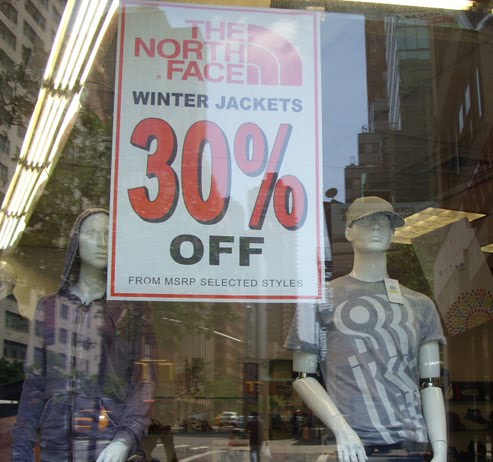
North Face Sale

Not much of a discount for winter jackets in steamy weather...

But The North Face is one of the most popular brands in NYC, you see the jackets EVERYWHERE in the winter, with the logo on the back.

Chef Street Statue

Pizza Man has disappeared but there still is the occasional street sculpture like this...

A friend of mine sent me a link to a company that makes figures like this, in various sizes. So people still buy and use them...

In Midtown, they just represent the past.

Rooftop Gardens

All this foliage on house rooftops in Murray Hill suggests they may have little penthouses built on top of them...

Or else someone who owns the building wants a rooftop garden.

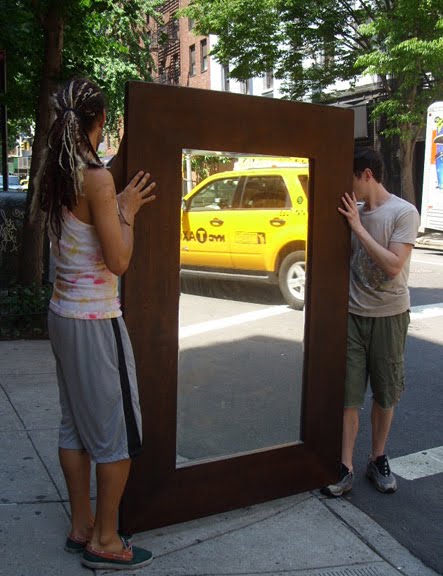
Two Men and a Mirror

Watching these two guys move this mirror reminded me of Roman Polanski's famous short film "Two Men and a Wardrobe."

Monday, May 30, 2011

First Class Barber Shop

Another remnant of old New York of another age, this barber shop is next to a bar that uses a famous World War II expression, "Snafu" ( sanitized translation: Situation Normal, All Fouled Up.").

Morgan Library- Illuminated Manuscripts

Known for its incredible collection of manuscripts of all kinds, the Morgan Library and Museum is now putting on an exhibit about Dress in the Middle Ages...

This place is more visited by scholars and professional people than the general public.

Commodore Vanderbilt

Vanderbilt Avenue adjacent to the East side of Grand Central Terminal is eerily quiet on Memorial Day.

The man who started all of this was Cornelius Vanderbilt...

To quote Wikipedia again:

Railroad empire

Cornelius Vanderbilt versus Jim Fisk in a famous rivalry with the Erie Railroad

New York and Harlem Railroad

Though Vanderbilt had relinquished his presidency of the Stonington Railroad during the California gold rush, he took an interest in several railroads during the 1850s, serving on the boards of directors of the Erie Railway, the New Jersey Central, the New Haven and Hartford, and the New York and Harlem (popularly known as the Harlem). In 1863, Vanderbilt took control of the Harlem in a famous stockmarket corner, and was elected its president. He later explained that he wanted to show that he could take this railroad, which was generally considered worthless, and make it valuable. It had a key advantage: it was the only steam railroad to enter the center of Manhattan, running down 4th Avenue (later Park Avenue) to a station on 26th Street, where it connected with a horse-drawn streetcar line. From Manhattan it ran up to Chatham Four Corners, New York, where it had a connection to the railroads running east and west.[17]

Vanderbilt brought his son William Henry Vanderbilt in as vice-president of the Harlem. William had had a nervous breakdown early in life, and his father had sent him to a farm on Staten Island. But he proved himself a good businessman, and eventually became the head of the Staten Island Railway. Though the Commodore had once scorned him, he was impressed by William's success, and eventually made him operational manager of all his railroad lines. In 1864, the Commodore sold his last ships, concentrating on railroads.[18]

New York Central and Hudson River Railroad

Looking out the north end of the Murray Hill Tunnel towards the station in 1880; note the labels for the New York, Harlem and New York, and New Haven Railroads; the New York Central and Hudson River was off to the left. The two larger portals on the right allowed some horse-drawn trains to continue further downtown.
Statue at the modern Grand Central Terminal

Once in charge of the Harlem, Vanderbilt encountered conflicts with connecting lines. In each case, the strife ended in a battle that Vanderbilt won. He bought control of the Hudson River Railroad in 1864, the New York Central Railroad in 1867, and the Lake Shore and Michigan Southern Railway in 1869. He later bought the Canada Southern as well. In 1870, he consolidated two of his key lines into the New York Central and Hudson River Railroad, one of the first giant corporations in American history.[19]

Grand Central Depot

In 1869, he directed the Harlem to begin construction of the Grand Central Depot on 42nd Street in Manhattan. It was finished in 1871, and served as his lines' terminus in New York. He sank the tracks on 4th Avenue in a cut that later became a tunnel, and 4th Avenue became Park Avenue. The depot was replaced by Grand Central Terminal in 1913.

Memorial Day in Grand Central Terminal

Upstairs and downstairs (where the larger eating areas and the rest rooms are), Grand Central Terminal is relatively quiet on Memorial Day.

Grand Central TERMINAL was destined to become Grand Central STATION (linked with Penn Station so trains could continue)...but that multi billion plans seems to be on ice, like so many other projects.

It is amazing that the Second Avenue Subway is still being built.

Historically: to quote Wikipedia:

Grand Central Terminal (GCT) — often incorrectly called Grand Central Station, or shortened to simply Grand Central — is a terminal station at 42nd Street and Park Avenue in Midtown Manhattan in New York City, United States. Built by and named for the New York Central Railroad in the heyday of American long-distance passenger trains, it is the largest train station in the world by number of platforms:[3] 44, with 67 tracks along them. They are on two levels, both below ground, with 41 tracks on the upper level and 26 on the lower, though the total number of tracks along platforms and in rail yards exceeds 100. When the Long Island Rail Road's new station opens in 2016 (see East Side Access), Grand Central will offer a total of 75 tracks and 48 platforms. The terminal covers an area of 48 acres (19 ha).

The terminal serves commuters traveling on the Metro-North Railroad to Westchester, Putnam, and Dutchess counties in New York State, and Fairfield and New Haven counties in Connecticut.

Although the terminal has been properly called "Grand Central Terminal" since 1913, many people continue to refer to it as "Grand Central Station." "Grand Central Station" is the name of the nearby post office, as well as the name of a previous rail station on the site, and it is also used to refer to a New York City subway station at the same location.