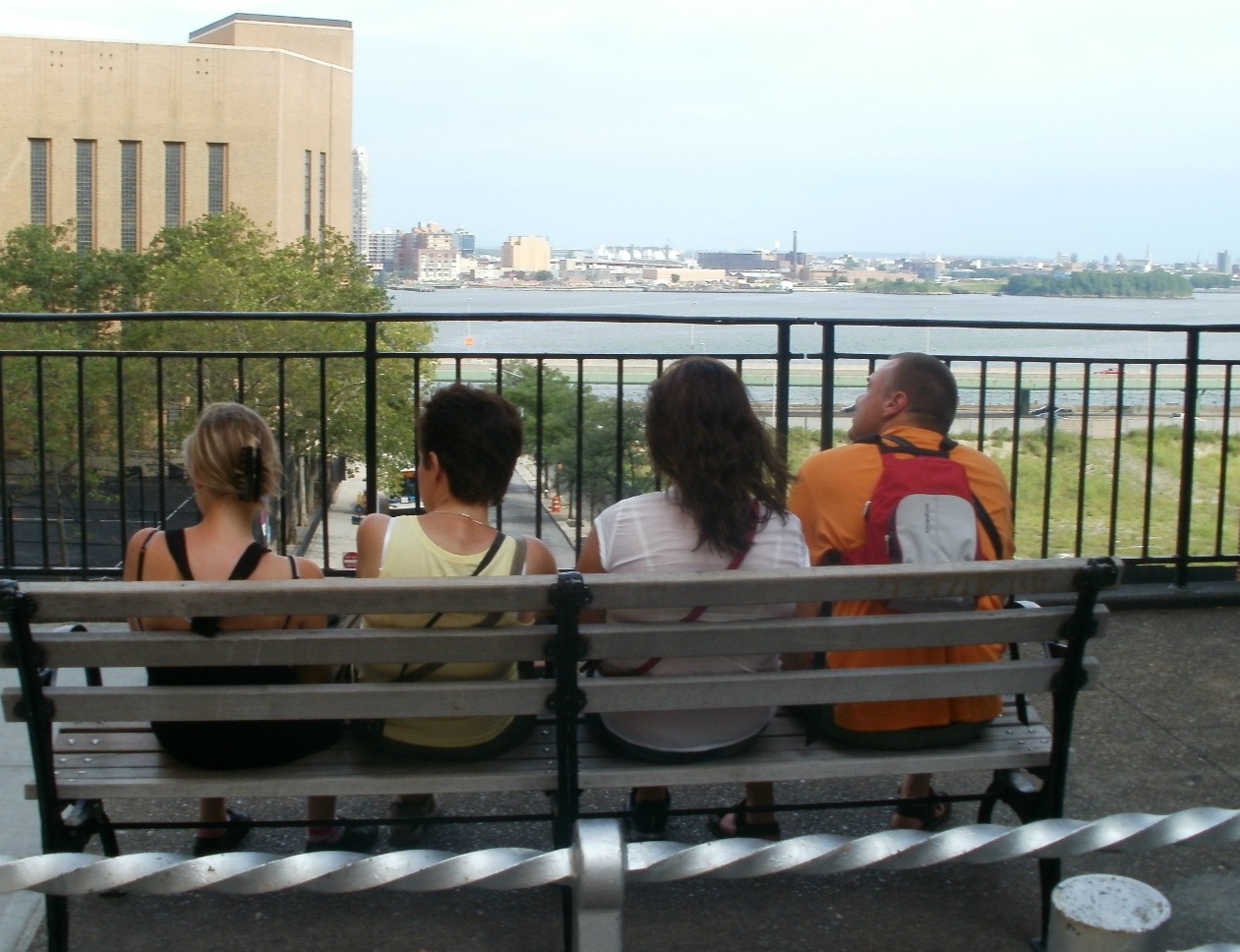
Did not get out with camera until some time after tremor here....people who were out awhile after it told me all these people had evacuated from high rises on 34th Street...
Saw more people holding hands than usual. And small groups of what seemed like tourists texting away....
Just heard snippets of conversation....outside one building on 34th Street, some people were still staying out of the building and smoking etc.
According to radio news, some people felt the tremor much more than others. People in upper floors of office buildings felt the most, it seems.
A lot of people said their first sensation was that they were experiencing vertigo...one man though another was shaking his desk...only in a few places in the NY area did people get a real jolt it seems.
The Lincoln and Holland tunnels were closed for about 20 minutes after the tremor...causing big traffic jams of course. Trains out of NYC are running at slow speeds which means commuting home will be a long ride for a lot of people...think some were leaving early this afternoon just on general principles.
Putting my experiences of Life In NYC in a more personal perspective, and checking in with international/national, tech and some other news
Translation from English
Tuesday, August 23, 2011
Monday, August 22, 2011
Tudo City in late summer
Some people just like to sit and look at the view across the East River on a late Sunday afternoon....or sit in one of the two pretty little parks....while the fantasy architecture of Fred French contrasts so much with the austerity of modern buildings around it....
Sunday, August 21, 2011
Official Public Space in Midtown Office Building
This was something new to me: I know the City has Cooling Centers during the summer where people can go who either do not have a/c or cannot afford to run it all the time,--but I never saw some place just designated a "Public Space" before. Seems like pretty affluent people hang out there, it is no magnet for homeless people as far as I can tell....(like the public libraries used to be).
See what Internet says...nope. nothing that seems to explain this place.
Sam Ash
This is a very big music store on a Midtown street where I think there used to be more of them.
Internet says:
SamAsh.com is part of the more than 84-year-old Sam Ash family of companies, including Sam Ash Musical Instrument Megastores with 46 locations in 16 states from coast to coast!
Internet says:
SamAsh.com is part of the more than 84-year-old Sam Ash family of companies, including Sam Ash Musical Instrument Megastores with 46 locations in 16 states from coast to coast!
Information about Sam Ash Music Retail Stores:
Professional musicians, music students, and hobbyists worldwide are familiar with the Sam Ash name from its stores in New York, New Jersey, Connecticut, Pennsylvania, Virginia, North Carolina, Florida, Texas, Nevada, Illinois, Arizona, California, Ohio, Tennessee, Indiana, and Georgia. For more information about Sam Ash Retail Stores, go to their website at www.samashmusic.com for a complete listing with maps and directions to their stores, phone numbers, lists of special events, and other information about a Sam Ash Musical Instrument Megastore near you.Street Fair on 6th Avenue
WOW, are there parades and bikeathons and street fairs this weekend! You can get trapped on the wrong side of a parade and have to wait until they have a break to cross the Avenue....
Just saw the NYPD marching band leading some parade on Madison Avenue...I don't know what.
This street fair yesterday on 6th Avenue was the usual thing pretty much but since it blocked off Radio City Music Hall I thought it must be something special...maybe not.
Just saw the NYPD marching band leading some parade on Madison Avenue...I don't know what.
This street fair yesterday on 6th Avenue was the usual thing pretty much but since it blocked off Radio City Music Hall I thought it must be something special...maybe not.
Saturday, August 20, 2011
Bikeathon on Park Avenue
Seems hardly a week goes by in the summer and fall without a walk or a run or something dedicated to some charitable cause.
Internet suggests this is just for fun:
Summer Streets 2011
NYC DOT and its partners are proud to present Summer Streets. This summer, for the fourth year in a row, Summer Streets will temporarily close Park Avenue and connecting streets from the Brooklyn Bridge to Central Park to motor vehicles and open it up to people on three consecutive Saturdays in August (August 6, 13, & 20).
Learn more about activities and events
Route Map
DOT also partners with groups citywide to bring some summer streets fun to neighborhoods in all five boroughs. Find a Weekend Walk near you.NYC DOT and its partners are proud to present Summer Streets. This summer, for the fourth year in a row, Summer Streets will temporarily close Park Avenue and connecting streets from the Brooklyn Bridge to Central Park to motor vehicles and open it up to people on three consecutive Saturdays in August (August 6, 13, & 20).
Diamond Center
Manhattan's famed block on 47th Street between 5th and 6th Avenues is the Diamond Center....almost all closed on a Saturday except for a shop or two I saw that seemed to be owned by Asians.
Wikipedia says:
The district was created when dealers moved north from an earlier district near Canal Street and the Bowery that was created in the 1920s, and from a second district located in the Financial District, near the intersection of Fulton and Nassau Streets, which started in 1931. The move uptown started in 1941. The district grew in importance when the German Nazis invaded the Netherlands and Belgium, forcing thousands of Orthodox Jews in the diamond business to flee Antwerp and Amsterdam and settle in New York City. Most of them remained after World War II, and remain a dominant influence in the Diamond District.[1]
A notable, long-time anomaly of the district was the famous Gotham Book Mart, a bookstore, which was located at 41 West 47th Street from 1946 to 2004.
The area is one of the primary centers of the global diamond industry (along with London - rough stones; the Antwerp diamond district in Belgium - historical but waning; Mumbai, India - increasing in significance, Ramat Gan, Israel - also growing, and Johannesburg, South Africa - the major historical source), as well as the premier center for jewelry shopping in the city. An estimated 90% of diamonds in the United States enter through New York.
Wikipedia says:
The district was created when dealers moved north from an earlier district near Canal Street and the Bowery that was created in the 1920s, and from a second district located in the Financial District, near the intersection of Fulton and Nassau Streets, which started in 1931. The move uptown started in 1941. The district grew in importance when the German Nazis invaded the Netherlands and Belgium, forcing thousands of Orthodox Jews in the diamond business to flee Antwerp and Amsterdam and settle in New York City. Most of them remained after World War II, and remain a dominant influence in the Diamond District.[1]
A notable, long-time anomaly of the district was the famous Gotham Book Mart, a bookstore, which was located at 41 West 47th Street from 1946 to 2004.
The area is one of the primary centers of the global diamond industry (along with London - rough stones; the Antwerp diamond district in Belgium - historical but waning; Mumbai, India - increasing in significance, Ramat Gan, Israel - also growing, and Johannesburg, South Africa - the major historical source), as well as the premier center for jewelry shopping in the city. An estimated 90% of diamonds in the United States enter through New York.
Operation
It has been reported[2] that total receipts for the value of a single day's trade on the block average $400 million. There are 2,600 independent businesses located in the district, nearly all of them dealing in diamonds or jewelry. Most are located in booths at one of the 25 "exchanges" in the district. Many deals are finalized by a simple, traditional blessing (mazel und brucha[1]) and handshake. The Diamond Dealers Club — also known as the DDC — is an exclusive club that acts as a de facto diamond exchange and has its own synagogue. Retailers with shops line the streets outside. Above the bazaar is the Gemological Institute of America which trains gem dealers.Friday, August 19, 2011
One other bas relief from Library Walk
I don't think most people remember "Born Yesterday"-- Kanin was very influential on Broadway in his time.
Wikipedia says:
His 1946 play Born Yesterday, which he also directed, ran for 1,642 performances. Kanin worked, uncredited, on the screenplay of the 1950 film adaptation.[1] His other stage work includes directing The Diary of Anne Frank (1955), which ran for 717 performances, and the musical Funny Girl (1964), which ran for 1,348 performances.
In 1990, Kanin, a widower since 1985, married the actress Marian Seldes, who survives him. In 1999, Kanin died at age 86 in New York City of undisclosed causes.
Wikipedia says:
Film and stage career
His first film as a director was A Man to Remember (1938), which The New York Times considered one of the ten best films of 1938. Kanin is best remembered, however, for his collaborations with his wife, actress Ruth Gordon, whom he married in 1942. Together, they wrote the Spencer Tracy/Katharine Hepburn film comedies Adam's Rib (1949) and Pat and Mike (1952), both directed by George Cukor.His 1946 play Born Yesterday, which he also directed, ran for 1,642 performances. Kanin worked, uncredited, on the screenplay of the 1950 film adaptation.[1] His other stage work includes directing The Diary of Anne Frank (1955), which ran for 717 performances, and the musical Funny Girl (1964), which ran for 1,348 performances.
In 1990, Kanin, a widower since 1985, married the actress Marian Seldes, who survives him. In 1999, Kanin died at age 86 in New York City of undisclosed causes.
Acquaintances and memorable sayings
He was a colleague of Thornton Wilder, who mentored him, and an admirer of the work of Frank Capra. Kanin said "I'd rather be Capra than God, if there is a Capra." Kanin and Katharine Hepburn were the only witnesses to Laurence Olivier and Vivien Leigh's wedding in California on August 31, 1940. In 1941, he and Katharine Hepburn worked with his brother Michael Kanin and Ring Lardner, Jr., on the early drafts of what would become Woman of the Year, right before Garson enlisted in the Army. He is also quoted as saying, "When your work speaks for itself, don't interrupt."Inside Le Pain Quotidien
Le Pain Quotidien has some outlets in Midtown...
Chiefly seems to draw young upscale crowd ( assume croissants and coffee are a staple here) but in one place advertises itself as a family restaurant.
Bas relief of significant buildings
Bas reliefs of significant Midtown Buildings around Peter Kalikow building near Grand Central.
Kalikow has done a lot in NYC and has also drawn severe criticism.
From the internet:
Riding uptown in his chauffeur-driven Lincoln one recent snowy morning, MTA chairman Peter Kalikow was worried about his switches. All through this unusually frigid winter, the cold has caused Metro-North and Long Island railroad switches to freeze, playing havoc with train schedules and Kalikow’s peace of mind.
“You cannot believe what the weather does to our system,” he says, shaking his head in frustration. “All the maintenance, all the track work, all the attention to detail goes out the goddamned window because of the cold. Unbelievable.”
It seems an odd thing to have to fret about for someone at Kalikow’s point in life. Rather than sit on a few corporate boards and attend fund-raisers, the man who spent three decades building high-rise towers, once owned the New York Post, and was the financial architect of Alfonse D’Amato’s Senate career is consumed with the grinding task of overseeing a public-transportation network that employs 65,000 people and serves 8 million riders a day (3 billion a year). It is a job in which he gets blamed for every closed token booth, dirty subway car, and broken escalator.
People often ask him why he subjects himself to the rigors of the chairmanship when he could be doing just about anything else. “I had no idea what I was getting into,” he sometimes smiles and says.
But the truth is more complicated. After surviving a painful, highly public bankruptcy in the early nineties, Kalikow was determined to give something back. The impulse is part altruism, part effort to erase the blot on his record through achievement.
Kalikow likes to say he doesn’t want anything from the job (“What could I want? I have everything”), but, of course, that’s not entirely true. Making money is no longer paramount. “I do this,” he says, “because I want my legacy to be something other than money.”
Though Kalikow has already changed the MTA in significant ways—he’s instituted management reforms to ensure increased accountability and efficiency, and put more transparency in the budget process—he has staked his legacy on expansion. The MTA is about to begin the largest, most far-reaching construction of public-transportation facilities in the city in more than 60 years. It is the kind of infrastructure-building program that will dramatically affect life in New York for decades.
Kalikow believes his experience as a developer has uniquely prepared him for this challenge. He knows how to manage megaprojects (“I’ve been known to have the ability to make sure people do what they’re supposed to when I want something done”) and has the vision to see and understand what the construction will mean to New York 30 or 40 years from now. “They left us a system that’s gone 60 years without expansion,” he says. “And in truth, we weren’t ready to expand. We didn’t really know how to run a system. Now we’ve proved we can do it, and that’s why we can ask for the money. It’s time.”
First up is what’s referred to as East Side Access. At a cost of $6.3 billion, this project will enable Long Island Rail Road trains to go directly into Grand Central Terminal. Right now, 40 percent of all LIRR riders are forced to backtrack to get to the East Side once they reach Penn Station. In addition to saving commuter time and energy, East Side Access would ease the burden on buses, subways, and taxis.
Kalikow has done a lot in NYC and has also drawn severe criticism.
From the internet:
Underground Man
Real-estate tycoon Peter Kalikow is rewriting his legacy by presiding over the biggest expansion of New York’s transit system in 60 years. And the Second Avenue subway is only part of the MTA chairman’s plan.
Train Man: MTA Chairman Peter Kalikow in one of his cars. (Photo: Emily Shur) |
“You cannot believe what the weather does to our system,” he says, shaking his head in frustration. “All the maintenance, all the track work, all the attention to detail goes out the goddamned window because of the cold. Unbelievable.”
Related Story
The Line that Time Forgot
By Greg Sargent
They call the Second Avenue subway the greatest New York project never built. They may have to think of a new name. (April 5, 2004 issue of New York Magazine)
The Line that Time Forgot
By Greg Sargent
They call the Second Avenue subway the greatest New York project never built. They may have to think of a new name. (April 5, 2004 issue of New York Magazine)
People often ask him why he subjects himself to the rigors of the chairmanship when he could be doing just about anything else. “I had no idea what I was getting into,” he sometimes smiles and says.
But the truth is more complicated. After surviving a painful, highly public bankruptcy in the early nineties, Kalikow was determined to give something back. The impulse is part altruism, part effort to erase the blot on his record through achievement.
Kalikow likes to say he doesn’t want anything from the job (“What could I want? I have everything”), but, of course, that’s not entirely true. Making money is no longer paramount. “I do this,” he says, “because I want my legacy to be something other than money.”
Though Kalikow has already changed the MTA in significant ways—he’s instituted management reforms to ensure increased accountability and efficiency, and put more transparency in the budget process—he has staked his legacy on expansion. The MTA is about to begin the largest, most far-reaching construction of public-transportation facilities in the city in more than 60 years. It is the kind of infrastructure-building program that will dramatically affect life in New York for decades.
Kalikow believes his experience as a developer has uniquely prepared him for this challenge. He knows how to manage megaprojects (“I’ve been known to have the ability to make sure people do what they’re supposed to when I want something done”) and has the vision to see and understand what the construction will mean to New York 30 or 40 years from now. “They left us a system that’s gone 60 years without expansion,” he says. “And in truth, we weren’t ready to expand. We didn’t really know how to run a system. Now we’ve proved we can do it, and that’s why we can ask for the money. It’s time.”
First up is what’s referred to as East Side Access. At a cost of $6.3 billion, this project will enable Long Island Rail Road trains to go directly into Grand Central Terminal. Right now, 40 percent of all LIRR riders are forced to backtrack to get to the East Side once they reach Penn Station. In addition to saving commuter time and energy, East Side Access would ease the burden on buses, subways, and taxis.
Thursday, August 18, 2011
Acupuncture etc.
Places like this are all over lower Midtown. Annie Waterman's nephew has a place somewhere down there too...tried to visit them but it never worked out. Hope they are doing well.
Flower District
The Flower District (shown here on 28th Street between 6th and 7th Avenues) seems to contract in size every year.
This is its prime season, however....
Let me see what I can google:(This from NY Times article):
Manhattan’s century-old flower district occupies little more than a block of West 28th Street, between Avenue of the Americas and Seventh Avenue, whittled down over the years by soaring real estate prices and condominium encroachment. Yet what a block it is: a startlingly verdant oasis that can be explored in less than half a day. Plants, branches, vases and garden accoutrements crowd its sidewalks, and usually cost less than what florists and other vendors charge. Much of the business is wholesale, but many shops now welcome walk-in customers, too. “These days,” one vendor said, “we’ll take anything.”
This is its prime season, however....
Let me see what I can google:(This from NY Times article):
Manhattan’s century-old flower district occupies little more than a block of West 28th Street, between Avenue of the Americas and Seventh Avenue, whittled down over the years by soaring real estate prices and condominium encroachment. Yet what a block it is: a startlingly verdant oasis that can be explored in less than half a day. Plants, branches, vases and garden accoutrements crowd its sidewalks, and usually cost less than what florists and other vendors charge. Much of the business is wholesale, but many shops now welcome walk-in customers, too. “These days,” one vendor said, “we’ll take anything.”
Hairstyles.....sort of old fashioned
Wednesday, August 17, 2011
Dinesen and Dickenson Quotes
Quotes from a number of authors and on bronze plaques embedded in the sidewalk near the main Public Library building....
Let me see if I can google something--yes, this is a short piece of a very long article on the internet:

Mija Riedel took a walk around Manhattan last year with downcast eyes.
Here's her story, which appeared in the October 30 Washington Post, about what lies beneath.
The Words on the Street In New York, 96 Reasons To Lower Your Gaze
In New York, the wittiest, wisest ideas lie underfoot — literally.
All you have to do is look down.
I was heading west on East 41st Street between Madison and Fifth avenues, scanning the pavement for open cellar doors and rickety grates, when I walked across a bronze plaque embedded in the sidewalk.
Roughly 2-1/2 by 1-1/2 feet, it illustrated in low relief a molecular diagram built around nine words: "The universe is made of stories, not of atoms."
A pair of black sneakers then crossed the panel (titled "Muriel Rukeyser, 1913–1980"), then white high tops.
The unexpected appearance of Rukeyser's words beneath my boots stopped me in the middle of the sidewalk at the height of lunch hour.
Intrigued, I moved on, keeping my eyes to the ground.
At 41st and Fifth, beneath a dallying pair of moccasins, another plaque resembling an open book proclaimed: "Library Walk. A Celebration of the World's Great Literature, Brought to You by the Grand Central Partnership and the New York Public Library. Sculptor: Gregg LeFevre."
In the two blocks of 41st Street between Park and Fifth avenues, LeFevre's 96 plaques quote 45 writers (11 women, 34 men) from 11 countries, spanning 20 centuries.
Each is illustrated with images inspired by the text.
The Grand Central Partnership (GCP), a nonprofit organization committed to revitalizing the neighborhood around Grand Central Terminal, conceived the project in the early 1990s.
Quotes were submitted — many by New York City librarians — and selections were made by a panel of literary experts convened by the GCP, the New York Public Library and the New Yorker magazine.
After 10 years and more than $100,000, Library Way (its official name) was dedicated in May 2004.
On this cloudless afternoon, sunlight glinted on the edges of a third panel [top] depicting a row of books, two hen bookends and a quote from E.B. White: "I don't know which is more discouraging, literature or chickens."
A pair of pointy, patent leather pumps stopped short where concrete bordered bronze.
"Oh! Sorry," said a female voice.
The shiny black stilettos pirouetted left and disappeared.
Across Fifth Avenue, students and laptop-laden researchers climbed the main stairs of the New York Public Library, dodging the tourists being photographed between its iconic lions.
I ducked in the front door to inquire further about the panels.
Both volunteers at the Friends of the Library counter paused, clearly surprised that someone had noticed the plaques.
"Did anyone else stop?" said one Friend, who wore the heavy, half-frame reading glasses that every child recognizes as visual shorthand for "librarian."
"No."
Then I remembered the moccasins.
"One paused."
"New Yorkers," she sighed, flipping through piles of brochures.
"They're too busy."
After a minute she located a pamphlet and passed it to me.
"More people should read them."
Outside I stood between the lions, Patience and Fortitude, as crowds flooded 41st Street.
The people passed the Chemists Club, the Dylan Hotel, YuYu41 Spa and the Vegetable Garden Kosher and Dairy Restaurant.
The modern, mirrored skyscraper on my left reflected the cast and chiseled facades of smaller skyscrapers, a passing cloud and the steel blue sky.
I was accustomed to Manhattan's relentless dazzle from eye level up but here on 41st Street the city had finally and completely closed the gap, becoming 360 degrees of head-to-foot, skyscraper-to-sidewalk stimulation.
Later that afternoon, I spent an hour on the GCP Web site studying photos of each plaque I'd missed, by the likes of Emily Dickinson, Gu Cheng, Lewis Carroll and Wallace Stevens.
Rene Descartes' quote — "The reading of good books is like a conversation with the best men of past centuries" — is illustrated with nine men wearing stiff suit coats and top hats, engaged in animated discourse among themselves and oblivious to a bustled woman standing alone off to the side.
Lucille Clifton wrote, "They ask me to remember but they want me to remember their memories and I keep on remembering mine."
Willa Cather's two lines are repeated until her panel overflowed with her words: "There are only two or three human stories, and they go on repeating themselves as fiercely as if they had never happened before. There are only two or three human stories...."
The Descartes panel, along with a Gu Cheng poem and the sandy, wavy imagery illustrating Georges Braque ("Truth exists, only falsehood has to be invented") are the sculptor's favorites.
LeFevre has been making site-specific sculptures since 1984; all told, he has 127 projects around the country, including more than a dozen around New York City.
Most of his works are bronze, terrazzo or concrete set in pavement, and many are, like Library Way, a series of panels with text and images.
The following Saturday, I returned to browse Library Way without the stampeding weekday crowds.
No delivery trucks crowded the sidewalks.
No heels shuffled, tapped or clicked along the concrete.
I strolled around each plaque as if it were a flower bed.
Stevens' words were criss-crossed with bronze bird tracks.
Langston Hughes' were illustrated with breaking chains.
The bronze images and words were cast just high enough to register faintly through the soles of my shoes.
In front of the Dylan Hotel at 52 E. 41st, a doorman in his mid–twenties with a longish crew cut and polished black lace–up shoes lingered on the steps.
At his feet were the words of Thomas Jefferson: "Where the press is free, and every man able to read, all is safe."
I nudged the plaque [below] with my toe.

"What do you think of these?"
He shrugged.
"They're nice. This one's the best," he nodded toward Jefferson.
"Right in front? You're not tired of it?"
"It's the only one I've read, but it's the best."
Let me see if I can google something--yes, this is a short piece of a very long article on the internet:
'Word Down' — New York City's Library Walk
Mija Riedel took a walk around Manhattan last year with downcast eyes.
Here's her story, which appeared in the October 30 Washington Post, about what lies beneath.
The Words on the Street In New York, 96 Reasons To Lower Your Gaze
In New York, the wittiest, wisest ideas lie underfoot — literally.
All you have to do is look down.
I was heading west on East 41st Street between Madison and Fifth avenues, scanning the pavement for open cellar doors and rickety grates, when I walked across a bronze plaque embedded in the sidewalk.
Roughly 2-1/2 by 1-1/2 feet, it illustrated in low relief a molecular diagram built around nine words: "The universe is made of stories, not of atoms."
A pair of black sneakers then crossed the panel (titled "Muriel Rukeyser, 1913–1980"), then white high tops.
The unexpected appearance of Rukeyser's words beneath my boots stopped me in the middle of the sidewalk at the height of lunch hour.
Intrigued, I moved on, keeping my eyes to the ground.
At 41st and Fifth, beneath a dallying pair of moccasins, another plaque resembling an open book proclaimed: "Library Walk. A Celebration of the World's Great Literature, Brought to You by the Grand Central Partnership and the New York Public Library. Sculptor: Gregg LeFevre."
In the two blocks of 41st Street between Park and Fifth avenues, LeFevre's 96 plaques quote 45 writers (11 women, 34 men) from 11 countries, spanning 20 centuries.
Each is illustrated with images inspired by the text.
The Grand Central Partnership (GCP), a nonprofit organization committed to revitalizing the neighborhood around Grand Central Terminal, conceived the project in the early 1990s.
Quotes were submitted — many by New York City librarians — and selections were made by a panel of literary experts convened by the GCP, the New York Public Library and the New Yorker magazine.
After 10 years and more than $100,000, Library Way (its official name) was dedicated in May 2004.
On this cloudless afternoon, sunlight glinted on the edges of a third panel [top] depicting a row of books, two hen bookends and a quote from E.B. White: "I don't know which is more discouraging, literature or chickens."
A pair of pointy, patent leather pumps stopped short where concrete bordered bronze.
"Oh! Sorry," said a female voice.
The shiny black stilettos pirouetted left and disappeared.
Across Fifth Avenue, students and laptop-laden researchers climbed the main stairs of the New York Public Library, dodging the tourists being photographed between its iconic lions.
I ducked in the front door to inquire further about the panels.
Both volunteers at the Friends of the Library counter paused, clearly surprised that someone had noticed the plaques.
"Did anyone else stop?" said one Friend, who wore the heavy, half-frame reading glasses that every child recognizes as visual shorthand for "librarian."
"No."
Then I remembered the moccasins.
"One paused."
"New Yorkers," she sighed, flipping through piles of brochures.
"They're too busy."
After a minute she located a pamphlet and passed it to me.
"More people should read them."
Outside I stood between the lions, Patience and Fortitude, as crowds flooded 41st Street.
The people passed the Chemists Club, the Dylan Hotel, YuYu41 Spa and the Vegetable Garden Kosher and Dairy Restaurant.
The modern, mirrored skyscraper on my left reflected the cast and chiseled facades of smaller skyscrapers, a passing cloud and the steel blue sky.
I was accustomed to Manhattan's relentless dazzle from eye level up but here on 41st Street the city had finally and completely closed the gap, becoming 360 degrees of head-to-foot, skyscraper-to-sidewalk stimulation.
Later that afternoon, I spent an hour on the GCP Web site studying photos of each plaque I'd missed, by the likes of Emily Dickinson, Gu Cheng, Lewis Carroll and Wallace Stevens.
Rene Descartes' quote — "The reading of good books is like a conversation with the best men of past centuries" — is illustrated with nine men wearing stiff suit coats and top hats, engaged in animated discourse among themselves and oblivious to a bustled woman standing alone off to the side.
Lucille Clifton wrote, "They ask me to remember but they want me to remember their memories and I keep on remembering mine."
Willa Cather's two lines are repeated until her panel overflowed with her words: "There are only two or three human stories, and they go on repeating themselves as fiercely as if they had never happened before. There are only two or three human stories...."
The Descartes panel, along with a Gu Cheng poem and the sandy, wavy imagery illustrating Georges Braque ("Truth exists, only falsehood has to be invented") are the sculptor's favorites.
LeFevre has been making site-specific sculptures since 1984; all told, he has 127 projects around the country, including more than a dozen around New York City.
Most of his works are bronze, terrazzo or concrete set in pavement, and many are, like Library Way, a series of panels with text and images.
The following Saturday, I returned to browse Library Way without the stampeding weekday crowds.
No delivery trucks crowded the sidewalks.
No heels shuffled, tapped or clicked along the concrete.
I strolled around each plaque as if it were a flower bed.
Stevens' words were criss-crossed with bronze bird tracks.
Langston Hughes' were illustrated with breaking chains.
The bronze images and words were cast just high enough to register faintly through the soles of my shoes.
In front of the Dylan Hotel at 52 E. 41st, a doorman in his mid–twenties with a longish crew cut and polished black lace–up shoes lingered on the steps.
At his feet were the words of Thomas Jefferson: "Where the press is free, and every man able to read, all is safe."
I nudged the plaque [below] with my toe.
"What do you think of these?"
He shrugged.
"They're nice. This one's the best," he nodded toward Jefferson.
"Right in front? You're not tired of it?"
"It's the only one I've read, but it's the best."
Chiseler
Stone or whatever mason who did all these bas reliefs around windows and doors on Midtown building thought to include a self portrait...
King Kong curio
King Kong climbs the Empire State building in this unusual little statuette...don't see Fay Wray, though.
Tuesday, August 16, 2011
Empire State Peeking Through
Old buildings in Garment District contrast so much with Empire State Building peeking out above them....
Accessories Palace
This is a huge accessories place in the Garment District....I would have loved to be able to browse around here and take photos...(this one taken through the window).
Endless Scaffolding in Midtown
You are under scaffolding all the time in Midtown...
I often wonder about scaffolding accidents. Let me check the internet (this is from last year):
Suspended about 14 stories above Broadway in Lower Manhattan just before noon yesterday, a construction worker suddenly felt the scaffolding rig under his feet slip away. But he did not fall far.
He was wearing a lifeline, a cable suspended from the roof independent of the scaffold and clamped to a harness around his legs and shoulders, which caught him as the rig slipped.
He crawled to safety on a terrace on the 14th floor, a fire official said. He made his way to the street, and minutes later stepped uninjured out of an ambulance, pulled a cigarette from his pocket and fumbled for a lighter.
“Somebody give this man a light,” yelled a bystander from the crowd of onlookers. Someone did, and the construction worker, who would not identify himself, took a long drag.
“I’m O.K.,” he said. “A little excited.”
After a spate of scaffolding accidents that have resulted in five deaths this year, officials called yesterday’s mishap an example of what happens when construction workers and site supervisors follow safety guidelines.
Through Nov. 1, there were 19 scaffolding accidents this year, some of which resulted in injuries, compared with 11 last year and 5 in 2004, a spokeswoman for the Buildings Department said.
“There’s a big difference between doing things the wrong way and doing things the right way, and it shows,” said Robert Guerrerio, president of RSG Caulking and Waterproofing, which employed the worker at the construction site, for a residential building going up at Leonard Street and Broadway.
I often wonder about scaffolding accidents. Let me check the internet (this is from last year):
Suspended about 14 stories above Broadway in Lower Manhattan just before noon yesterday, a construction worker suddenly felt the scaffolding rig under his feet slip away. But he did not fall far.
Cory Conover for The New York Times
A construction worker looked for a light Tuesday after he escaped injury in the accident.
He crawled to safety on a terrace on the 14th floor, a fire official said. He made his way to the street, and minutes later stepped uninjured out of an ambulance, pulled a cigarette from his pocket and fumbled for a lighter.
“Somebody give this man a light,” yelled a bystander from the crowd of onlookers. Someone did, and the construction worker, who would not identify himself, took a long drag.
“I’m O.K.,” he said. “A little excited.”
After a spate of scaffolding accidents that have resulted in five deaths this year, officials called yesterday’s mishap an example of what happens when construction workers and site supervisors follow safety guidelines.
Through Nov. 1, there were 19 scaffolding accidents this year, some of which resulted in injuries, compared with 11 last year and 5 in 2004, a spokeswoman for the Buildings Department said.
“There’s a big difference between doing things the wrong way and doing things the right way, and it shows,” said Robert Guerrerio, president of RSG Caulking and Waterproofing, which employed the worker at the construction site, for a residential building going up at Leonard Street and Broadway.
Sunday, August 14, 2011
Le Cachet- Holistic Care
Skin Care place claims to be holistic...
You see terms like this and "organic" bandied around a lot...
Checking the internet:
We've canvassed the field of holistic medicine and compiled a glossary of the most popular modalities and remedies available.
A holistic approach to healing recognizes that the emotional, mental, spiritual and physical elements of each person comprise a system. By working with this systems approach the cause of an illness is targeted, rather than just the symptoms.
Acupressure
Acupuncture
Aromatherapy
Astrology
Aura Readers
Automatic Writing
Ayurveda
Bach Flower Remedies
Bioenergetics
Biofeedback
Bioidentical Hormone Replacement Therapy
Biomagnetics
Breathwork
Chakra Balancing
Channeling
Chelation
Chi Gong
Chi Kung
Chiropractic
Colonics
Cranio Sacral
Craniofascial Integrative Therapy
Dance Therapy
Doulas
Dream Analysis
Ear Candling
Edta
Energy Balancing
Facials
Feldenkrais Method
Feng Shui
Hair Analysis
Healing Circle
Healing Touch
Health Touch
Herbology
Holistic
Holistic Dentistry
Holistic Veterinary
Home
Homeopathy
Hypnobirthing
Hypnotherapy
Index
Infant Massage
Inner Child
And the list goes on.....
You see terms like this and "organic" bandied around a lot...
Checking the internet:
What Is Holistic?
This site will help you gain some understanding of the the terms and modalities in the field of holistic medicine.We've canvassed the field of holistic medicine and compiled a glossary of the most popular modalities and remedies available.
A holistic approach to healing recognizes that the emotional, mental, spiritual and physical elements of each person comprise a system. By working with this systems approach the cause of an illness is targeted, rather than just the symptoms.
Related Topics
And the list goes on.....
Touro College Building still for sale
This great Beaux Arts building was once an Art School...
At some point became part of Touro College, which has been trying to unload it for I think about two years.
I am not sure if it is a landmarked building or not...that may be why they are having so much trouble selling or leasing it.
At some point became part of Touro College, which has been trying to unload it for I think about two years.
I am not sure if it is a landmarked building or not...that may be why they are having so much trouble selling or leasing it.
What was "Rock the Vote"?
Mannequins seem ghostly in Vintage Clothing shop window...
Let me see if I can google anything about "Rock the Vote"--
Wikipedia article claims:
Rock the Vote is a non-profit organization in the United States of America whose mission is to engage and build the political power of young people.[1]
Rock the Vote uses their Democracy Class program along with music, popular culture and new technologies to engage and incite young people to register and vote in every U.S. election. They claim to give young people the tools to identify, learn about, and take action on the issues that affect their lives, and leverage their power in the political process.[2]
Group takes credit for helping reverse trend of low younger voter turnout.
Let me see if I can google anything about "Rock the Vote"--
Wikipedia article claims:
Rock the Vote is a non-profit organization in the United States of America whose mission is to engage and build the political power of young people.[1]
Rock the Vote uses their Democracy Class program along with music, popular culture and new technologies to engage and incite young people to register and vote in every U.S. election. They claim to give young people the tools to identify, learn about, and take action on the issues that affect their lives, and leverage their power in the political process.[2]
Group takes credit for helping reverse trend of low younger voter turnout.
Friday, August 12, 2011
No Smoking again
You see more and more signs like this....first saw them outside of hospitals and other public buildings, now apartment buildings are posting them too.
Wikipedia has some historical insight:
In 1604, King James I of England wrote A Counterblast to Tobacco, where he described smoking as: "A custome loathsome to the eye, hateful to the nose, harmeful to the brain, dangerous to the lungs, and in the black stinking fume thereof, nearest resembling the horrible Stigian smoke of the pit that is bottomeless."
Smoking was banned in Berlin in 1723, in Königsberg in 1742, and in Stettin in 1744. These bans were repealed in the revolutions of 1848.[3]
Although not a government entity, in 1833 the Church of Jesus Christ of Latter Day Saints introduced the Word of Wisdom into its doctrine, which in addition to other things, said that tobacco should not be smoked or chewed.
The Nazi Party imposed a tobacco ban in every German university, post office, military hospital and Nazi Party office, under the auspices of Karl Astel's Institute for Tobacco Hazards Research, created in 1941 under orders from Adolf Hitler.[4] Major anti-tobacco campaigns were widely broadcast by the Nazis until the demise of the regime in 1945.[5]
Wikipedia has some historical insight:
History of opposition to smoking
Pope Urban VII's 13-day papal reign included the world's first known public smoking ban in 1590 when he threatened to excommunicate anyone who "took tobacco in the porchway of or inside a church, whether it be by chewing it, smoking it with a pipe or sniffing it in powdered form through the nose".[2] The earliest citywide European smoking bans were enacted in Bavaria, Kursachsen, and certain parts of Austria in the late 17th century.In 1604, King James I of England wrote A Counterblast to Tobacco, where he described smoking as: "A custome loathsome to the eye, hateful to the nose, harmeful to the brain, dangerous to the lungs, and in the black stinking fume thereof, nearest resembling the horrible Stigian smoke of the pit that is bottomeless."
Smoking was banned in Berlin in 1723, in Königsberg in 1742, and in Stettin in 1744. These bans were repealed in the revolutions of 1848.[3]
Although not a government entity, in 1833 the Church of Jesus Christ of Latter Day Saints introduced the Word of Wisdom into its doctrine, which in addition to other things, said that tobacco should not be smoked or chewed.
The Nazi Party imposed a tobacco ban in every German university, post office, military hospital and Nazi Party office, under the auspices of Karl Astel's Institute for Tobacco Hazards Research, created in 1941 under orders from Adolf Hitler.[4] Major anti-tobacco campaigns were widely broadcast by the Nazis until the demise of the regime in 1945.[5]
Flea Market for Actors
Never knew there was an Episcopal Actors Guild...
Let me check their website...well, I can't cut and paste it for reason but you can check it out at:
http://www.actorsguild.org/aboutus2.html
It is the only surviving offspring of the Actors Church Alliance (1899-1923), an ecumenical organization founded by a young actor, Walter Bentley, who gave up his career to become a priest. In 1923, its members and officers then founded the Episcopal Actors’ Guild, encouraged by Father Bentley and welcomed to its permanent headquarters by The Rev. Randolph Ray, the newly-seated Rector of the “Little Church Around the Corner.” Father Ray, a cousin to Tallulah
Let me check their website...well, I can't cut and paste it for reason but you can check it out at:
http://www.actorsguild.org/aboutus2.html
MORE ABOUT THE EPISCOPAL ACTORS’ GUILD:
“The Stage has, beyond any other profession, been ever the handmaiden of charity. Does disaster occur, has a suffering to be healed, has a charity to be lifted up, the eye of the supplicant first looks to the stage, and never looks there in vain.”
This wonderful observation on the generosity of people of the ken from an 1871 New York City newspaper in our Guild Archives, most certainly applies to the members of today’s ecumenical and inter-denominational Episcopal Actors’ Guild. The Guild was founded in 1923 and incorporated as a 501 (c) (3) non-profit in 1926. It is a charitable fellowship organization governed by its Constitution and By-Laws, and is the result of the youthful idealism of several extraordinary individuals.
ould like to tell you about our Guild’s
Subscribe to:
Posts (Atom)