Perfume, luggage, health and beauty....and a lot more at this store near Herald Square.
What don't they sell?
Just googled the place...they are a department store! No really large stores though, I guess.
Putting my experiences of Life In NYC in a more personal perspective, and checking in with international/national, tech and some other news
Translation from English
Friday, August 12, 2011
Child Boom in White Manhattan
Recently I reported on pre-schools in Midtown.
My personal observations in Kips Bay and Murray Hill are confirmed by latest report I heard on New York Public Radio today-- people with small children are moving into Manhattan below 102nd Street at an increasing rate ( In Murray Hill, you are sometimes startled to see how many blond toddlers you see walking or being wheeled around by mothers or nannies).
These childrens' families are usually white, and by necessity, pretty affluent. While some parents choose public schools, most opt for one of the many private schools around.
When the kids get older, a lot of these families move to the suburbs....but some remain. One woman caller to the radio show I listened to has a younger daughter in college.
These families also tend to have fewer children -- one or two at the most it seems. New York apartments that are large enough to accommodate more kids are hard to come by and very expensive.
This following is from an article from 2007, before the child boom in Manhattan had gotten into full swing....even then, it was a noticeable change.
My personal observations in Kips Bay and Murray Hill are confirmed by latest report I heard on New York Public Radio today-- people with small children are moving into Manhattan below 102nd Street at an increasing rate ( In Murray Hill, you are sometimes startled to see how many blond toddlers you see walking or being wheeled around by mothers or nannies).
These childrens' families are usually white, and by necessity, pretty affluent. While some parents choose public schools, most opt for one of the many private schools around.
When the kids get older, a lot of these families move to the suburbs....but some remain. One woman caller to the radio show I listened to has a younger daughter in college.
These families also tend to have fewer children -- one or two at the most it seems. New York apartments that are large enough to accommodate more kids are hard to come by and very expensive.
This following is from an article from 2007, before the child boom in Manhattan had gotten into full swing....even then, it was a noticeable change.
The Manhattan Baby Boom
By SAM ROBERTSSince 2000, according to census figures released last year, the number of children under age 5 living in Manhattan mushroomed by more than 32 percent. And though their ranks have been growing for several years, a new analysis for The New York Times makes clear for the first time who has been driving that growth: wealthy white families.
At least half of the growth was generated by children who are white and non-Hispanic. Their ranks expanded by more than 40 percent from 2000 to 2005. For the first time since at least the 1960s, white children now outnumber either black or Hispanic youngsters in that age group in Manhattan.
The analysis shows that Manhattan’s 35,000 or so white non-Hispanic toddlers are being raised by parents whose median income was $284,208 a year in 2005, which means they are growing up in wealthier households than similar youngsters in any other large county in the country.
What those findings imply, demographers say, is not only that the socioeconomic gap between Manhattan and the other boroughs is widening, but also that the population of Manhattan, in some ways, is beginning to look more like the suburbs — or what they used to look like — than like the rest of the city.
“We knew Manhattan was having a baby boom,” said Andrew A. Beveridge, a demographer at Queens College of the City University of New York, who conducted the analysis. “Now we know who’s having the babies.”
The raw numbers are subject to interpretation, but, coupled with anecdotal evidence, what they generally suggest is that more well-to-do Manhattanites who might otherwise have moved to the suburbs with their children are choosing to raise them in the city, at least early on.
Here’s Chris Osborne, 44, who lives on the Upper West Side with his wife Marcia, 37, and their two children, ages 4 and 6:
Affluent White Families Lead Way in Manhattan Baby Boom
At least half of the growth was generated by children who are white and non-Hispanic. Their ranks expanded by more than 40 percent from 2000 to 2005. For the first time since at least the 1960s, white children now outnumber either black or Hispanic youngsters in that age group in Manhattan.
The analysis shows that Manhattan’s 35,000 or so white non-Hispanic toddlers are being raised by parents whose median income was $284,208 a year in 2005, which means they are growing up in wealthier households than similar youngsters in any other large county in the country.
What those findings imply, demographers say, is not only that the socioeconomic gap between Manhattan and the other boroughs is widening, but also that the population of Manhattan, in some ways, is beginning to look more like the suburbs — or what they used to look like — than like the rest of the city.
“We knew Manhattan was having a baby boom,” said Andrew A. Beveridge, a demographer at Queens College of the City University of New York, who conducted the analysis. “Now we know who’s having the babies.”
The raw numbers are subject to interpretation, but, coupled with anecdotal evidence, what they generally suggest is that more well-to-do Manhattanites who might otherwise have moved to the suburbs with their children are choosing to raise them in the city, at least early on.
Here’s Chris Osborne, 44, who lives on the Upper West Side with his wife Marcia, 37, and their two children, ages 4 and 6:
If both parents are working, it actually becomes logistically difficult to live in the suburbs. If you’re 90 minutes away, we just don’t like that feeling.Details
Even if we were disposed to — for the usual space, quality of life reasons — to go to suburbs, we would have to consider the practical difficulty.
Affluent White Families Lead Way in Manhattan Baby Boom
Thursday, August 11, 2011
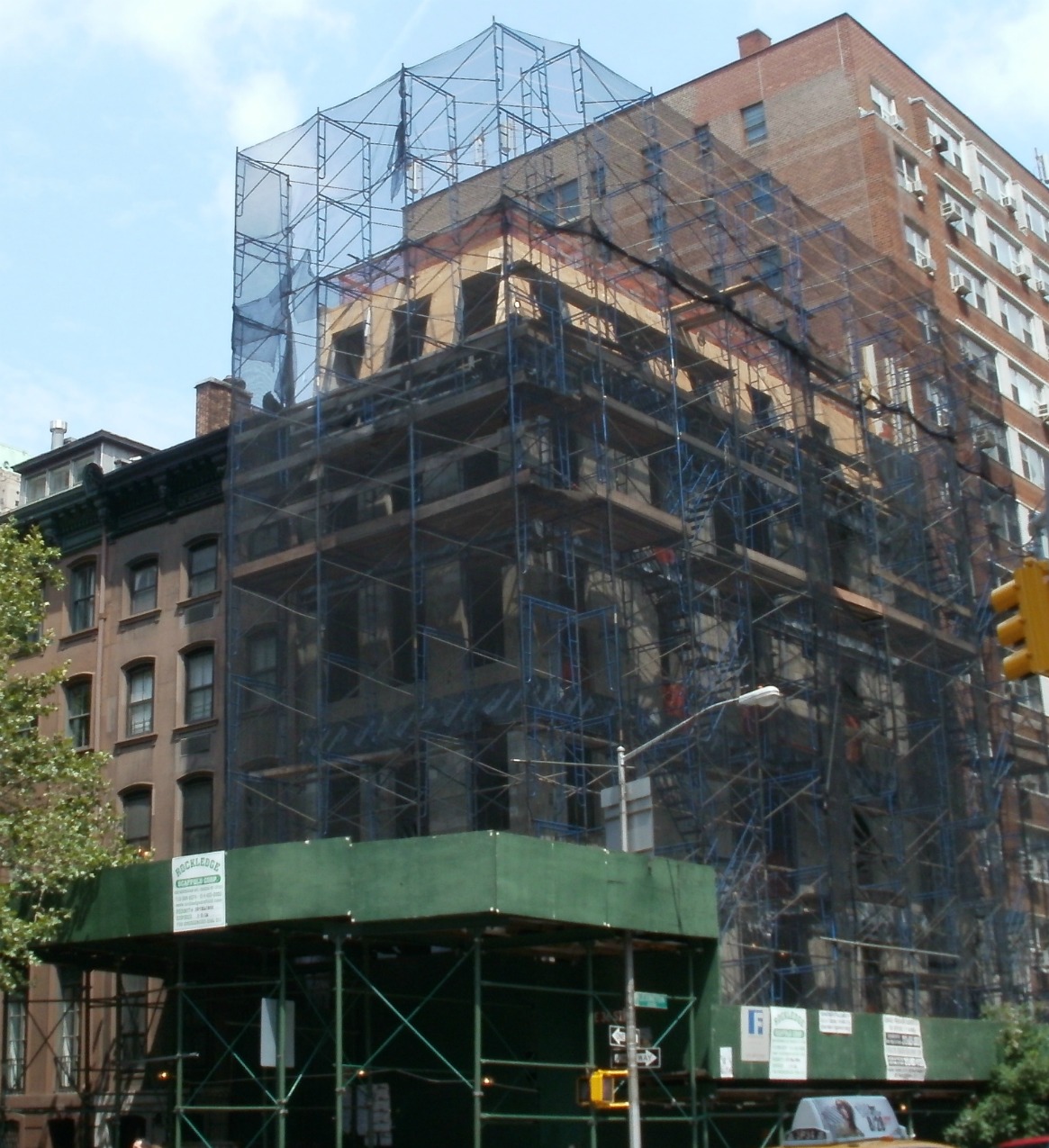
Renovation completed (almost)
Last time I took a photo of this building it was covered with scaffolding.
Near Herald Square, this stretch of Broadway has seen the renovation and restoration of many old buildings...sometimes turned into condo units.
Lots of renovation going on in Lower Midtown and downtown, often on relatively newer buildings. From article in the New York Times:
535 Madison Avenue to invest in the building’s first major upgrades in more than two decades. That the wager, at a cost of more than $5 million, was made in 2009 at the depths of the market only made it riskier.
But with lobby, elevator and electrical renovations now complete at the 37-story office tower, the building’s owners say the bet is already paying off. Since last year, more than half of the 200,000 square feet UBS vacated has been leased, with much of the common space spruced up just as the Manhattan office leasing market begins to show signs of improvement.
“We’re absolutely ecstatic with the way tenants have responded to it,” said Alfred Bradshaw, the executive vice president of the Park Tower Group, which owns and manages the building at Madison and 54th Street. “The response, both from the tenants and the prospective tenants and all the people in the real estate industry, has really been universally positive.” The Park Tower Group and the few other landlords who sank substantial sums into renovations during the economic downturn are now beginning to see results in the form of higher rents and a renewed interest from tenants, the owners said. (Park Tower is asking $75 to $125 per square foot.)
As rents fell across the city in the downturn, some owners who were unwilling or unable to invest in new construction focused instead on refurbishing their properties. Among the buildings renovated from 2007 through 2009 were 535 Madison Avenue, 545 Madison Avenue, the boutique office building 681 Fifth Avenue and the Empire State Building.
“Think about the foresight it took for some of these guys to say, ‘Now is the time to go in and fix this because when we come out of this we want to be the best positioned as the go-to product,’ ” said Jonathan Serko, a vice chairman of Cushman & Wakefield who advised the owners of 1385 Broadway on renovations that began in late 2008. “And obviously, for the ones who stuck with the strategy, it’s all worked out according to plan.”
Near Herald Square, this stretch of Broadway has seen the renovation and restoration of many old buildings...sometimes turned into condo units.
Lots of renovation going on in Lower Midtown and downtown, often on relatively newer buildings. From article in the New York Times:
535 Madison Avenue to invest in the building’s first major upgrades in more than two decades. That the wager, at a cost of more than $5 million, was made in 2009 at the depths of the market only made it riskier.
Michelle V. Agins/The New York Times
The office building at 535 Madison Avenue, center, is among those renovated during the downturn.
“We’re absolutely ecstatic with the way tenants have responded to it,” said Alfred Bradshaw, the executive vice president of the Park Tower Group, which owns and manages the building at Madison and 54th Street. “The response, both from the tenants and the prospective tenants and all the people in the real estate industry, has really been universally positive.” The Park Tower Group and the few other landlords who sank substantial sums into renovations during the economic downturn are now beginning to see results in the form of higher rents and a renewed interest from tenants, the owners said. (Park Tower is asking $75 to $125 per square foot.)
As rents fell across the city in the downturn, some owners who were unwilling or unable to invest in new construction focused instead on refurbishing their properties. Among the buildings renovated from 2007 through 2009 were 535 Madison Avenue, 545 Madison Avenue, the boutique office building 681 Fifth Avenue and the Empire State Building.
“Think about the foresight it took for some of these guys to say, ‘Now is the time to go in and fix this because when we come out of this we want to be the best positioned as the go-to product,’ ” said Jonathan Serko, a vice chairman of Cushman & Wakefield who advised the owners of 1385 Broadway on renovations that began in late 2008. “And obviously, for the ones who stuck with the strategy, it’s all worked out according to plan.”
Pre-Schools etc.
Robber stamps, anyone?
Who uses rubber stamps anymore, anyway? If you do, let me know...
Rest of store with sign is more up to date.
Used to have a friend, many years ago, who had a collection of different kinds of rubber stamps...
He got them to go with his big rolltop desk that he was very proud of. He loved all the little drawers and old fashioned aspects....
Rest of store with sign is more up to date.
Used to have a friend, many years ago, who had a collection of different kinds of rubber stamps...
He got them to go with his big rolltop desk that he was very proud of. He loved all the little drawers and old fashioned aspects....
Monday, August 8, 2011
Correction on Sikhs
Just a correction on one of my postings about the Sikh Center in Midtown:
A reader writes:
I'm a Sikh and sometimes it surprises me to see my people thriving in the most unlikely places. One correction, if I may, to your description of Sikhs as an Indian sect. Sikhism actually the world's 5th largest religion, founded in the 1400's by Guru Nanak.
Doodads, Costume Jewelry, etc.
This is the kind of store you see in Midtown that sells weird and novelty knicknacks, doodads and assorted "chachkeys."
From the internet== NY Magazine:
New Stuff
Photographs by Davies + Starr; Courtesy of Banana Republic (necklace)
Trolling for Vintage
DIGGING OUT THE GOOD STUFF
If you’d rather rummage through boxes at a thrift store than buy new, there are ways to make sure your piece won’t fall apart in a week. Eva Weiss, co-owner of vintage boutique Beauty Crisis, explains.
Heft says a lot. Generally, the older the piece, the heavier it will be. Twenties-era pieces were made of more substantial “pot metals” like brass and steel. After World War II, designers started to use aluminum and plastics.
Look for a name on the back of the settings. Signed pieces from well-known designers like Miriam Haskell, Hattie Carnegie, and Sarah Coventry will be better assembled than no-names. Check the back of the clasps or the balls of the rhinestones.
Learn your clasps. Many older pieces used simple hooklike C-clasps, but those came undone easily and fell out of use. Around the sixties, clasps started to get sturdier, more like the lobster-claw forms common today.
Grime should not be a deterrent. Take it to a watch cleaner—typically cheaper than jewelry specialists. You can also clean it at home with light steel wool. Buff off any surface tarnish (gently; these metals are often patinaed), or swab it with a Q-tip moistened with rubbing alcohol.
Prime Hunting Ground
Stores and fleas with excellent track records.
Housing Works
157 E. 23rd St., nr. Third Ave.; 212-529-5955
Housing Works is reliable for big designer pieces from the seventies and eighties. Saturdays are best, since the store puts out its finest stuff after close on Friday to attract weekend browsers.
St. Nicholas of Tolentine
80-22 Parsons Blvd., nr. Union Pkwy., Jamaica; 718-591-1815
If you can’t make it out to this parish flea market by two o’clock on the weekends, don’t bother. Crowds flock here for unusual finds like nautical- or animal-inspired bracelets or necklaces from the twenties through the eighties.
Church of the Resurrection
85-09 118th St., nr. Lefferts Blvd., Kew Gardens; 718-847-2649
Tables and tables of earrings, necklaces, and rings for as little as 50 cents. This is a great resource for budget gifts. The church affiliation yields an unusually high selection of crosses. The next sale is October 18 and 19.
Italian Charities of America
83-20 Queens Blvd., nr. Van Loon St., Elmhurst; 718-478-3100
Hit and miss: Sometimes there’s a jewelry-store owner unloading a trove; other times, it’s a jumble of junk. There’s a good chance you’ll find a few hefty necklaces from the twenties and thirties. Next flea market: September 27.
From the internet== NY Magazine:
Big Fakers
Huge costume jewelry is on the march. Delicate chains and tiny gems have been batted aside by beefy assemblages of glass, plastic, and metal. The best of the new stuff, where and how to buy vintage, and why a “fake” necklace costs $500.
- By Aja Mangum
- Published Aug 3, 2008
|
|
|
|
|
|
Trolling for Vintage
DIGGING OUT THE GOOD STUFF
If you’d rather rummage through boxes at a thrift store than buy new, there are ways to make sure your piece won’t fall apart in a week. Eva Weiss, co-owner of vintage boutique Beauty Crisis, explains.
Heft says a lot. Generally, the older the piece, the heavier it will be. Twenties-era pieces were made of more substantial “pot metals” like brass and steel. After World War II, designers started to use aluminum and plastics.
Look for a name on the back of the settings. Signed pieces from well-known designers like Miriam Haskell, Hattie Carnegie, and Sarah Coventry will be better assembled than no-names. Check the back of the clasps or the balls of the rhinestones.
Learn your clasps. Many older pieces used simple hooklike C-clasps, but those came undone easily and fell out of use. Around the sixties, clasps started to get sturdier, more like the lobster-claw forms common today.
Grime should not be a deterrent. Take it to a watch cleaner—typically cheaper than jewelry specialists. You can also clean it at home with light steel wool. Buff off any surface tarnish (gently; these metals are often patinaed), or swab it with a Q-tip moistened with rubbing alcohol.
Prime Hunting Ground
Stores and fleas with excellent track records.
Housing Works
157 E. 23rd St., nr. Third Ave.; 212-529-5955
Housing Works is reliable for big designer pieces from the seventies and eighties. Saturdays are best, since the store puts out its finest stuff after close on Friday to attract weekend browsers.
St. Nicholas of Tolentine
80-22 Parsons Blvd., nr. Union Pkwy., Jamaica; 718-591-1815
If you can’t make it out to this parish flea market by two o’clock on the weekends, don’t bother. Crowds flock here for unusual finds like nautical- or animal-inspired bracelets or necklaces from the twenties through the eighties.
Church of the Resurrection
85-09 118th St., nr. Lefferts Blvd., Kew Gardens; 718-847-2649
Tables and tables of earrings, necklaces, and rings for as little as 50 cents. This is a great resource for budget gifts. The church affiliation yields an unusually high selection of crosses. The next sale is October 18 and 19.
Italian Charities of America
83-20 Queens Blvd., nr. Van Loon St., Elmhurst; 718-478-3100
Hit and miss: Sometimes there’s a jewelry-store owner unloading a trove; other times, it’s a jumble of junk. There’s a good chance you’ll find a few hefty necklaces from the twenties and thirties. Next flea market: September 27.
Sunday, August 7, 2011
The Mustard Seed
The Mustard Seed sounds like the name of a secret society or something...
I remember vaguely some Buddhist teaching involving death and a mustard seed.
From internet--seems to be associated with AA:
Searching for a meeting?
Register for InTheRooms.com now to get exclusive free access to Daily Meditations, Speaker Tapes, and over 143,000 people in recovery who are willing to share their experience, strength and hope with YOU.
Learn More About InTheRooms.com
I remember vaguely some Buddhist teaching involving death and a mustard seed.
From internet--seems to be associated with AA:
Searching for a meeting?
Get REAL recovery online now!
Register for InTheRooms.com now to get exclusive free access to Daily Meditations, Speaker Tapes, and over 143,000 people in recovery who are willing to share their experience, strength and hope with YOU.Learn More About InTheRooms.com
The Maltese Consulate
Besides being home to the Maltese Falcon, I don't know much about Malta except that it is in the Mediterrenean and is supposed to have a great climate.
From Wikipedia again:
Malta (
i/ˈmɔːltə/), officially known as the Republic of Malta (Maltese: Repubblika ta' Malta), is a Southern European country consisting of an archipelago situated in the centre of the Mediterranean, 93 km south of Sicily and 288 km east of Tunisia, with the Strait of Gibraltar 1,826 km to the west and Alexandria 1,510 km to the east.[7]
Malta covers just over 300 km² in land area, making it one of the world's smallest and most densely populated countries.[8][9][10] Its de facto capital is Valletta and the largest town is Birkirkara. The main island is made up of many small towns, which together form one Larger Urban Zone (LUZ) with a population of 368,250 (majority of the population of the country) according to Eurostat.[11] The country has two official languages – Maltese and English – with Maltese being considered the national language.
Throughout history, Malta's location has given it great strategic importance,[12] and a sequence of powers including the Phoenicians, Greeks, Romans, Normans, Sicilians, Knights of St John, French and the British ruled the islands. Malta gained independence from the United Kingdom in 1964 and became a republic in 1974, whilst retaining membership in the Commonwealth of Nations. It is a member of the United Nations (since 1964) and a member of the European Union (since 2004). Malta is also party to the Schengen Agreement (since 2007)[13] and member of the eurozone (since 2008).
Malta has a long Christian legacy and is an Apostolic See. According to the Acts of the Apostles in the Bible,[14] St. Paul was shipwrecked on "Melite", as the Greeks called the island, and ministered there.[15] Catholicism continues to be the official and dominant religion in Malta.[16][17]
Malta is internationally renowned as a tourist resort, with numerous recreational areas and historical monuments, including nine UNESCO World Heritage Sites,[18] most prominently the Megalithic Temples which are some of the oldest free-standing structures in the world.[19][20][21]
From Wikipedia again:
Malta (
Malta covers just over 300 km² in land area, making it one of the world's smallest and most densely populated countries.[8][9][10] Its de facto capital is Valletta and the largest town is Birkirkara. The main island is made up of many small towns, which together form one Larger Urban Zone (LUZ) with a population of 368,250 (majority of the population of the country) according to Eurostat.[11] The country has two official languages – Maltese and English – with Maltese being considered the national language.
Throughout history, Malta's location has given it great strategic importance,[12] and a sequence of powers including the Phoenicians, Greeks, Romans, Normans, Sicilians, Knights of St John, French and the British ruled the islands. Malta gained independence from the United Kingdom in 1964 and became a republic in 1974, whilst retaining membership in the Commonwealth of Nations. It is a member of the United Nations (since 1964) and a member of the European Union (since 2004). Malta is also party to the Schengen Agreement (since 2007)[13] and member of the eurozone (since 2008).
Malta has a long Christian legacy and is an Apostolic See. According to the Acts of the Apostles in the Bible,[14] St. Paul was shipwrecked on "Melite", as the Greeks called the island, and ministered there.[15] Catholicism continues to be the official and dominant religion in Malta.[16][17]
Malta is internationally renowned as a tourist resort, with numerous recreational areas and historical monuments, including nine UNESCO World Heritage Sites,[18] most prominently the Megalithic Temples which are some of the oldest free-standing structures in the world.[19][20][21]
Namibian Consulate
Namibian Consulate is getting overhaul in Murray Hill.
OK, just where and what the hell is Namibia anyway. From Wikipedia:
Namibia, officially the Republic of Namibia (Afrikaans: Republiek van Namibië, German: Republik Namibia), is a country in southern Africa whose western border is the Atlantic Ocean. It shares land borders with Angola and Zambia to the north, Botswana to the east and South Africa to the south and east. It gained independence from South Africa on 21 March 1990, following the Namibian War of Independence. Its capital and largest city is Windhoek. Namibia is a member state of the United Nations (UN), the Southern African Development Community (SADC), the African Union (AU), and the Commonwealth of Nations.
The dry lands of Namibia were inhabited since early times by Bushmen, Damara, and Namaqua, and since about the 14th century AD by immigrating Bantu who came with the Bantu expansion. It became a German Imperial protectorate in 1884 and remained a German colony until the end of World War I. In 1920, the League of Nations mandated the country to South Africa, which imposed its laws and, from 1948, its apartheid policy.
In 1966, uprisings and demands by African leaders led the UN to assume direct responsibility over the territory. It recognized the South West Africa People’s Organization (SWAPO) as the official representative of the Namibian people in 1973. Namibia, however, remained under South African administration during this time. Following internal violence, South Africa installed an interim administration in Namibia in 1985. Namibia obtained full independence from South Africa in 1990, with the exception of Walvis Bay and the Penguin Islands, which remained under South African control until 1994.
Namibia has a population of 2.1 million people and a stable multi-party parliamentary democracy. Agriculture, herding, tourism and the mining industry – including mining for gem diamonds, uranium, gold, silver, and base metals form the backbone of Namibia's economy. After Mongolia it is the second least densely populated country in the world. Approximately half the population live below the international poverty line, and the nation has suffered heavily from the effects of HIV/AIDS, with 15% of the adult population infected with HIV in 2007.
OK, just where and what the hell is Namibia anyway. From Wikipedia:
Namibia, officially the Republic of Namibia (Afrikaans: Republiek van Namibië, German: Republik Namibia), is a country in southern Africa whose western border is the Atlantic Ocean. It shares land borders with Angola and Zambia to the north, Botswana to the east and South Africa to the south and east. It gained independence from South Africa on 21 March 1990, following the Namibian War of Independence. Its capital and largest city is Windhoek. Namibia is a member state of the United Nations (UN), the Southern African Development Community (SADC), the African Union (AU), and the Commonwealth of Nations.
The dry lands of Namibia were inhabited since early times by Bushmen, Damara, and Namaqua, and since about the 14th century AD by immigrating Bantu who came with the Bantu expansion. It became a German Imperial protectorate in 1884 and remained a German colony until the end of World War I. In 1920, the League of Nations mandated the country to South Africa, which imposed its laws and, from 1948, its apartheid policy.
In 1966, uprisings and demands by African leaders led the UN to assume direct responsibility over the territory. It recognized the South West Africa People’s Organization (SWAPO) as the official representative of the Namibian people in 1973. Namibia, however, remained under South African administration during this time. Following internal violence, South Africa installed an interim administration in Namibia in 1985. Namibia obtained full independence from South Africa in 1990, with the exception of Walvis Bay and the Penguin Islands, which remained under South African control until 1994.
Namibia has a population of 2.1 million people and a stable multi-party parliamentary democracy. Agriculture, herding, tourism and the mining industry – including mining for gem diamonds, uranium, gold, silver, and base metals form the backbone of Namibia's economy. After Mongolia it is the second least densely populated country in the world. Approximately half the population live below the international poverty line, and the nation has suffered heavily from the effects of HIV/AIDS, with 15% of the adult population infected with HIV in 2007.
Tuesday, August 2, 2011
Murray Hill building ornaments
Some neighborhoods in NY have all these handsome old houses, many with distinctive ornamentation...
Wonder when this house dates from. Probably the 1860's.
Internet on Murray Hill:
In mid-century the rich, temporarily, and the upper middle class more permanently filled the brownstone row houses that filled Murray Hill's streets, the Brick Presbyterian Church followed its congregation; selling its site facing City Hall Park, it rebuilt in 1857 closer to its congregation, on the smoothed brow of Murray Hill, at Fifth Avenue and 37th Street.[14] But when J. P. Morgan built his conservative brownstone free-standing mansion in 1882 on Madison Avenue at 36th Street, which is today a part of The Morgan Library & Museum, it was considered a fashionable but slightly old-fashioned address,[15] as the rich were filling Fifth Avenue with palaces as far as Central Park. Instead stylish merchandising was changing the neighborhood; Madison Square Park, at this time considered a part of Murray Hill, was bordered by the fashionable ladies' shops of the day on Fifth Avenue.
The community is also home to the CUNY Graduate Center which share the landmark former B. Altman Building with the New York Public Library Science, Industry and Business Library or SIBL and Oxford University Press. The neighborhood is also home to Stern College for Women of Yeshiva University, The Morgan Library & Museum and Scandinavia House - The Nordic Center in America, The Mexican Cultural Institute of New York and a historically notable private institution, the Union League Club of New York. On January 29, 2008, the Whitney Museum of American Art branch gallery at what had been the Philip Morris headquarters opposite Grand Central Terminal closed after a 25-year run. For around fifty years the neighborhood has been home to National Review, the conservative journal of opinion founded by William F. Buckley, Jr., most of that time at 150 East 35th Street, currently at 215 Lexington Avenue at 33rd Street. 150 East 35th Street was purchased by Yeshiva University.
Wonder when this house dates from. Probably the 1860's.
Internet on Murray Hill:
Nineteenth century
During the 19th century, this neighborhood was "uptown" with the city ending with the reservoir at Fifth Avenue and 42nd Street covering what today is the New York Public Library and Bryant Park. To the north was for the most part farmland. In the bitter winter of 1808 during the embargo that closed New York harbor, an innovative work relief program kept out-of-work dock workers busy reducing the height of Murray Hill;[10] between twenty and forty feet were sliced off its summit and used for fill.[11] In 1833 the railroad cut was begun, to carry the New York and Harlem Rail Road through Murray Hill; the route under the most prominent obstacle in its right-of-way was opened 1 May 1834;[12] then the locomotives, which had met the horse-cars that ran through the city's streets at the station at 27th Street, could pass the reduced hill; by an act of 1850 the city pemitted to roof over the cut for the passage of steam locomotives. This Park Avenue Tunnel, enlarged and relined, is devoted to automobile traffic since 1937.[13]In mid-century the rich, temporarily, and the upper middle class more permanently filled the brownstone row houses that filled Murray Hill's streets, the Brick Presbyterian Church followed its congregation; selling its site facing City Hall Park, it rebuilt in 1857 closer to its congregation, on the smoothed brow of Murray Hill, at Fifth Avenue and 37th Street.[14] But when J. P. Morgan built his conservative brownstone free-standing mansion in 1882 on Madison Avenue at 36th Street, which is today a part of The Morgan Library & Museum, it was considered a fashionable but slightly old-fashioned address,[15] as the rich were filling Fifth Avenue with palaces as far as Central Park. Instead stylish merchandising was changing the neighborhood; Madison Square Park, at this time considered a part of Murray Hill, was bordered by the fashionable ladies' shops of the day on Fifth Avenue.
[edit] Twentieth century
For much of the 20th century, the neighborhood was a quiet and rather formal place, with many wealthy older residents. Since the late 1990s, many upper-class young professionals in their twenties and thirties have begun to move into the area.[16] On weekends, the raucous restaurant-and-bar scene along Third Avenue, beyond the traditional eastern limits of Murray Hill, particularly reflects this change.The community is also home to the CUNY Graduate Center which share the landmark former B. Altman Building with the New York Public Library Science, Industry and Business Library or SIBL and Oxford University Press. The neighborhood is also home to Stern College for Women of Yeshiva University, The Morgan Library & Museum and Scandinavia House - The Nordic Center in America, The Mexican Cultural Institute of New York and a historically notable private institution, the Union League Club of New York. On January 29, 2008, the Whitney Museum of American Art branch gallery at what had been the Philip Morris headquarters opposite Grand Central Terminal closed after a 25-year run. For around fifty years the neighborhood has been home to National Review, the conservative journal of opinion founded by William F. Buckley, Jr., most of that time at 150 East 35th Street, currently at 215 Lexington Avenue at 33rd Street. 150 East 35th Street was purchased by Yeshiva University.
Twenty-first century
Though housing in the neighborhood is slightly cheaper than in fashionable nearby parts of Manhattan, prices for apartments here rose a great deal during the boom of the late 1990s and early 2000s—as much as 500 percent in a decade.Smoker skulking in doorway
Guy smokes in doorway away from sidewalk and in shade...looks like something from a movie.
They have banned smoking just about everywhere in New York City, which I guess is a good thing,
but having once been a nicotine addict, I sympathize with those who are still hooked.
About NYC laws (this is from last May):
Smokers in New York City looking to light up in most public places will not be able to without paying a price after an outdoor citywide smoking ban takes effect Monday.
The law, which Mayor Michael Bloomberg signed in February after it was passed by the New York City Council, will make smoking illegal in New York City's 1,700 parks and on the city's 14 miles of public beaches. Smoking will also be prohibited in pedestrian plazas like Times Square.
They have banned smoking just about everywhere in New York City, which I guess is a good thing,
but having once been a nicotine addict, I sympathize with those who are still hooked.
About NYC laws (this is from last May):
Smokers in New York City looking to light up in most public places will not be able to without paying a price after an outdoor citywide smoking ban takes effect Monday.
The law, which Mayor Michael Bloomberg signed in February after it was passed by the New York City Council, will make smoking illegal in New York City's 1,700 parks and on the city's 14 miles of public beaches. Smoking will also be prohibited in pedestrian plazas like Times Square.
Monday, August 1, 2011
Walk In Medical Help
First walk-in medical clinic I have ever seen in NYC.
Maybe they already have them in other places.
From internet:(their posting)
New York City Walk in Clinic
MedRite Urgent Care Center is the 21st century solution to urgent and routine medical care in New York City. Working families, busy schedules, and an ever changing work environment often demands flexible hours and convenient medical solutions. MedRite offers walk-in and same-day urgent care treatment for most minor and serious non-fatal injuries and illnesses as well as preventative and occupational medical services.
Our mission is to provide compassionate quality urgent care and preventative medical services to the NYC community. Our courteous staff is dedicated to providing the highest quality care possible in a timely and economic fashion. Our modern, clean, and safe facility creates a comfortable and pleasant environment.
What’s the difference between an urgent care center and emergency room care? The Medrite team of medical professionals treats all urgent non-life threatening conditions. That includes injuries, like lacerations, sprang ankles, and broken bones, as well as illnesses like flus, migraines, and bladder infections. We also provide a wide variety of well patient services like physicals, employment screenings, insurance certifications, and complete well woman care.
We offer medical services when you need them, but we never rush our patients. Our doctors and medical professionals will take their time to explain treatments and provide information and educational literature. We participate with most major insurance carriers.
New York City Walk in Clinic

MedRite Urgent Care Center is the 21st century solution to urgent and routine medical care in New York City. Working families, busy schedules, and an ever changing work environment often demands flexible hours and convenient medical solutions. MedRite offers walk-in and same-day urgent care treatment for most minor and serious non-fatal injuries and illnesses as well as preventative and occupational medical services.
Our mission is to provide compassionate quality urgent care and preventative medical services to the NYC community. Our courteous staff is dedicated to providing the highest quality care possible in a timely and economic fashion. Our modern, clean, and safe facility creates a comfortable and pleasant environment.
What’s the difference between an urgent care center and emergency room care? The Medrite team of medical professionals treats all urgent non-life threatening conditions. That includes injuries, like lacerations, sprang ankles, and broken bones, as well as illnesses like flus, migraines, and bladder infections. We also provide a wide variety of well patient services like physicals, employment screenings, insurance certifications, and complete well woman care.
We offer medical services when you need them, but we never rush our patients. Our doctors and medical professionals will take their time to explain treatments and provide information and educational literature. We participate with most major insurance carriers.
Koch Bridge-- or so they say
The Queensboro Bridge, which is also known colloquially as the 59th Street Bridge ( Simon and Garfunkel song from long ago--"Feelin' Groovy") has been renamed to honor ex mayor Ed Koch.
From Wikipedia-- too long to quote anything, I just refer you to the article about Koch
http://en.wikipedia.org/wiki/Ed_Koch
Caricatures on wall of Palm restaurant
Caricatures of --who knows who they are- owners or regulars of the restaurant-- is a very dated thing in NYC...
Last saw this back in the late 1980's.... there was a bar that had all these framed caricatures of regulars from the early 1950's I would say up on all its walls.
Old hairstyles and peculiar faces....it was really something. Then whole block was ripped down for skyscraper.
Last saw this back in the late 1980's.... there was a bar that had all these framed caricatures of regulars from the early 1950's I would say up on all its walls.
Old hairstyles and peculiar faces....it was really something. Then whole block was ripped down for skyscraper.
Sunday, July 31, 2011
Shoe stores and sneakers
Big shoe store on Seventh Avenue reminds me of factory outlet at some suburban mall.
Is it true that popular Nike sneakers are made with child labor? To check the internet:
Nike is one of the largest athletic shoe brands in the world. While the company sells millions of shoes and pieces of clothing each year, Nike does not produce any of these products. Instead, the company contracts with manufacturing facilities located throughout the world. Nearly 800,000 people work in these factories, located primarily in Asia. Since the 1990s, the company has been criticized for the working conditions and low wages at these factories, with many critics accusing the company of profiting from sweatshop labor. While Nike has made efforts to improve conditions, many rights groups still push for higher wages and greater change.
Is it true that popular Nike sneakers are made with child labor? To check the internet:
Nike is one of the largest athletic shoe brands in the world. While the company sells millions of shoes and pieces of clothing each year, Nike does not produce any of these products. Instead, the company contracts with manufacturing facilities located throughout the world. Nearly 800,000 people work in these factories, located primarily in Asia. Since the 1990s, the company has been criticized for the working conditions and low wages at these factories, with many critics accusing the company of profiting from sweatshop labor. While Nike has made efforts to improve conditions, many rights groups still push for higher wages and greater change.
Saturday, July 30, 2011
Tunnel closing and traffic jam on 2nd Avenue
Unannounced closing of Midtown Tunnel on a Saturday causes of course a massive traffic jam.
These unannounced street closings etc. are commonplace in Manhattan and must be a real headache to tourists especially.
Same thing happens with subway trains...some changes on weekends are announced, others aren't.
These unannounced street closings etc. are commonplace in Manhattan and must be a real headache to tourists especially.
Same thing happens with subway trains...some changes on weekends are announced, others aren't.
Cheap lamps
For safety's sake, I would never buy one of these extreme discount shop cheap lamps...
Know some of my neighbors have them, though!
What is Buncee?
Good question: what the hell is Buncee?
Tried internet:
Buncee Pro is a social publishing platform designed exclusively for the iPad that enables you to creatively express yourself using your own photos and text. You can share your creation by saving it to your photo library, posting it to your favorite social networking sites, or emailing it to friends, family or co-workers.
Tried internet:
Buncee Pro is a social publishing platform designed exclusively for the iPad that enables you to creatively express yourself using your own photos and text. You can share your creation by saving it to your photo library, posting it to your favorite social networking sites, or emailing it to friends, family or co-workers.
Friday, July 29, 2011
Constant upkeep
All the cornices and stonework etc. require a lot of upkeep all over New York City.
Many buildings built before World War I had really fancy cornices. These started crumbling back in the 1970's as I remember and a lot of buildings had them removed completely, which drastically altered the appearance of the buildings.
From internet article on this topic:
Most New Yorkers are too jaded and too hurried to look up at the often stunning architecture that surrounds them. But to some, like Mr. Bess, who do, every building with a top denuded of pressed tin, copper, cast-iron, stone, terra-cotta or even wood cornices and ornamentation stands out like a disfigured part of the urban landscape.
Many of those naked tops are the unintended consequence of Local Law 10, passed less than a year after Grace Gold, a Barnard student, was struck and killed by a falling piece of masonry at 115th Street and Broadway 25 years ago last month, and of its even more stringent successor, Local Law 11, passed in 1998.
The law, which requires that exterior walls and projecting ornamentation be inspected for safety by an engineer every five years, applies to the 12,000 city buildings - 60 percent of them in Manhattan - that are taller than six stories. Preservationists say the laws have contributed to the attitude that old buildings are inherently dangerous and should be stripped of decoration as a preventive measure rather than take a chance that a piece of masonry or cornice will fall off. As a result, ornamentation may be removed independently of the facade-inspection law, as was the case with the building on Strivers Row.
The neighborhoods most affected are often long-neglected jewels like Harlem and Fort Greene, Brooklyn, where the architecture is beautiful but ill-maintained, and where building owners are more likely to comply with safety requirements by taking the cheapest route instead of the most aesthetically pleasing one.
It is hard to miss the evidence of destruction wrought in the name of safety. Lintels have been shaved off windows, leaving behind a flattened shadow of the former ornament. Apartment buildings have been capped by ribbons of "ghosting," layers of bare brick or stucco parging where massive overhanging cornices once hung like beetled brows. Such ghostings can be seen along Columbus Avenue in Manhattan Valley. Buildings have been scalped on nearly every block of Lenox Avenue in Harlem.
Many buildings built before World War I had really fancy cornices. These started crumbling back in the 1970's as I remember and a lot of buildings had them removed completely, which drastically altered the appearance of the buildings.
From internet article on this topic:
Most New Yorkers are too jaded and too hurried to look up at the often stunning architecture that surrounds them. But to some, like Mr. Bess, who do, every building with a top denuded of pressed tin, copper, cast-iron, stone, terra-cotta or even wood cornices and ornamentation stands out like a disfigured part of the urban landscape.
Many of those naked tops are the unintended consequence of Local Law 10, passed less than a year after Grace Gold, a Barnard student, was struck and killed by a falling piece of masonry at 115th Street and Broadway 25 years ago last month, and of its even more stringent successor, Local Law 11, passed in 1998.
The law, which requires that exterior walls and projecting ornamentation be inspected for safety by an engineer every five years, applies to the 12,000 city buildings - 60 percent of them in Manhattan - that are taller than six stories. Preservationists say the laws have contributed to the attitude that old buildings are inherently dangerous and should be stripped of decoration as a preventive measure rather than take a chance that a piece of masonry or cornice will fall off. As a result, ornamentation may be removed independently of the facade-inspection law, as was the case with the building on Strivers Row.
The neighborhoods most affected are often long-neglected jewels like Harlem and Fort Greene, Brooklyn, where the architecture is beautiful but ill-maintained, and where building owners are more likely to comply with safety requirements by taking the cheapest route instead of the most aesthetically pleasing one.
It is hard to miss the evidence of destruction wrought in the name of safety. Lintels have been shaved off windows, leaving behind a flattened shadow of the former ornament. Apartment buildings have been capped by ribbons of "ghosting," layers of bare brick or stucco parging where massive overhanging cornices once hung like beetled brows. Such ghostings can be seen along Columbus Avenue in Manhattan Valley. Buildings have been scalped on nearly every block of Lenox Avenue in Harlem.
Steamy day in the Jungle of Cities
New York on a hot and very humid day feels like a jungle....seems apt to see people behind all this foliage in Herald Square.
Start 'em young
Local school wants kids to start chess early...
Internet reference on chess (Wikipedia):
The history of chess spans some 1500 years. The earliest predecessors of the game originated in India, before the 6th century AD. From India, the game spread to Persia. When the Arabs conquered Persia, chess was taken up by the Muslim world and subsequently spread to Southern Europe. In Europe, chess evolved into its current form in the 15th century. In the second half of the 19th century, modern chess tournament play began, and the first world Chess Championship was held in 1886. The 20th century saw great leaps forward in chess theory and the establishment of the World Chess Federation (FIDE). Developments in the 21st century include use of computers for analysis, which originated in the 1970s with the first programmed chess games on the market. Online gaming appeared in the mid 1990's.
Internet reference on chess (Wikipedia):
The history of chess spans some 1500 years. The earliest predecessors of the game originated in India, before the 6th century AD. From India, the game spread to Persia. When the Arabs conquered Persia, chess was taken up by the Muslim world and subsequently spread to Southern Europe. In Europe, chess evolved into its current form in the 15th century. In the second half of the 19th century, modern chess tournament play began, and the first world Chess Championship was held in 1886. The 20th century saw great leaps forward in chess theory and the establishment of the World Chess Federation (FIDE). Developments in the 21st century include use of computers for analysis, which originated in the 1970s with the first programmed chess games on the market. Online gaming appeared in the mid 1990's.
Checker cab reference, Hertz and rental cars
Checker cab reference reminds me of story I heard on the BBC that the rental car business was started by a guy named Hertz who originally had a fleet of cabs...
People originally thought rental car idea was silly and would be a flop.
Let me see if I can find an internet reference:
While the exact origins of the first renting company are lost in the mists of the past, many hold the belief that the first rental company was started by a man named Joe Saunders. His rather small operation started with the Model T Ford, a car that brought automobile transport to the masses. It is believed that Saunders would rent his cars to customers and would charge ten cents a mile for their use. Charges were calculated with the aid of a mileage tracking device. A rather appealing story is that the first renter was a travelling salesman who used Saunders' car to impress a local girl he was taking out for dinner. Whether any truth is in this story is unknown, but it does add an attractive human element to the history of the rental car.
Saunders experienced large levels of success for his company, perhaps becoming the first rental magnate. By 1925 Saunders had depots in twenty one states across America. The success was short lived however, the Great Depression, a complete collapse of the economy in the United States, led to Saunders' operation struggling to find business. Eventually, rather sadly Saunders went bankrupt shortly after.
Saunders however was not the only entrepreneur with the foresight to spot an opportunity in the market. Another American, Walter Jacobs also started a car rental firm renting Model T cars to customers. Jacobs also experienced success although he sold his business to the larger Yellow Cab Company, owned by John Hertz. In turn Hertz was bought out by the automobile giant General Motors, the investment provided by GM ensured the survival of Hertz's company. Today Hertz is still in existence and the largest car hire company in the world, it distinctive yellow signage recognisable in countries around the globe.
After the Second World War the industry as a whole experienced a boom time. This was due to the close relationship between the growth in air travel and rental companies. Airlines were increasingly being used for business purposes and hence hire cars were widely being used by these businessmen once they had disembarked from the plane. Hertz were well ahead of the game at this stage, having the foresight to place a rental desk and depot in Chicago's Midway Airport in 1932. Hertz was not the only one however, Warren Avis, another entrepreneur almost entirely based his operations within airports anticipating the growth of air travel; mainly due to Avis' experience as an army pilot during the war years. Today Avis is another giant of the rental industry, owning other major industry players such as Budget.
People originally thought rental car idea was silly and would be a flop.
Let me see if I can find an internet reference:
While the exact origins of the first renting company are lost in the mists of the past, many hold the belief that the first rental company was started by a man named Joe Saunders. His rather small operation started with the Model T Ford, a car that brought automobile transport to the masses. It is believed that Saunders would rent his cars to customers and would charge ten cents a mile for their use. Charges were calculated with the aid of a mileage tracking device. A rather appealing story is that the first renter was a travelling salesman who used Saunders' car to impress a local girl he was taking out for dinner. Whether any truth is in this story is unknown, but it does add an attractive human element to the history of the rental car.
Saunders experienced large levels of success for his company, perhaps becoming the first rental magnate. By 1925 Saunders had depots in twenty one states across America. The success was short lived however, the Great Depression, a complete collapse of the economy in the United States, led to Saunders' operation struggling to find business. Eventually, rather sadly Saunders went bankrupt shortly after.
Saunders however was not the only entrepreneur with the foresight to spot an opportunity in the market. Another American, Walter Jacobs also started a car rental firm renting Model T cars to customers. Jacobs also experienced success although he sold his business to the larger Yellow Cab Company, owned by John Hertz. In turn Hertz was bought out by the automobile giant General Motors, the investment provided by GM ensured the survival of Hertz's company. Today Hertz is still in existence and the largest car hire company in the world, it distinctive yellow signage recognisable in countries around the globe.
After the Second World War the industry as a whole experienced a boom time. This was due to the close relationship between the growth in air travel and rental companies. Airlines were increasingly being used for business purposes and hence hire cars were widely being used by these businessmen once they had disembarked from the plane. Hertz were well ahead of the game at this stage, having the foresight to place a rental desk and depot in Chicago's Midway Airport in 1932. Hertz was not the only one however, Warren Avis, another entrepreneur almost entirely based his operations within airports anticipating the growth of air travel; mainly due to Avis' experience as an army pilot during the war years. Today Avis is another giant of the rental industry, owning other major industry players such as Budget.
Wednesday, July 27, 2011
Red Garage Door
For some reason I don't understand,
there are a number of small buildings with their own garages
on a street near to where I live.
Internet article from New York Times in 2008 talks about this:
MILLIONS of New Yorkers compress their lives into small spaces and yearn for things that their friends in the suburbs don’t think twice about: an extra bedroom, a patch of grass, a little distance between themselves and the neighbors.
A recent check of real estate Web sites turned up about a dozen listings for town houses with private garage space in Manhattan and Brooklyn, ranging in price from $1.195 million, for a brownstone in Crown Heights, to $18.75 million for a restored carriage house in Greenwich Village. "I can’t imagine any greater luxury than a garage,” said Kirk Henckels, a Stribling & Associates broker. ”It’s not the square footage in Manhattan that counts. It’s the amenities.”
Town houses with existing garages and curb cuts on the sidewalk command a premium when the houses are resold. That is partly because getting approval from the city to create a new curb cut involves navigating a thicket of building regulations and approvals.
The Department of Buildings has approved only 54 new curb cuts in Manhattan so far in 2008, and only 57 curb cuts in all of 2007.
Jonathan Miller, chief executive of Miller Samuel Inc., the real estate research company, estimates that a garage adds about 5 percent to the price of a town house in Manhattan. Brokers say that in some neighborhoods, that number can reach 20 to 25 percent.
Enrico Cinzano, an heir to the Cinzano spirit and wine fortune, has owned his six-bedroom town house at 40 West 10th Street for 16 years and is offering it for sale at $18.75 million.
“In my experience, above and beyond the rarity of having the garage with a curb cut, the garage door affords privacy and security,” Mr. Cinzano said in an e-mail message.
His broker, Michael Pellegrino of Sotheby’s International Realty, said the garage added at least $1 million in value to the property.
The carriage houses that the wealthiest New Yorkers had at the turn of the last century were the forerunners of the town-house garage, which sprouted in the 1910s as cars became common for the very wealthy.
there are a number of small buildings with their own garages
on a street near to where I live.
Internet article from New York Times in 2008 talks about this:
MILLIONS of New Yorkers compress their lives into small spaces and yearn for things that their friends in the suburbs don’t think twice about: an extra bedroom, a patch of grass, a little distance between themselves and the neighbors.
Circle the block five times looking for a place to park, and another wish can be added to the list: a private garage.
A recent check of real estate Web sites turned up about a dozen listings for town houses with private garage space in Manhattan and Brooklyn, ranging in price from $1.195 million, for a brownstone in Crown Heights, to $18.75 million for a restored carriage house in Greenwich Village. "I can’t imagine any greater luxury than a garage,” said Kirk Henckels, a Stribling & Associates broker. ”It’s not the square footage in Manhattan that counts. It’s the amenities.”
Town houses with existing garages and curb cuts on the sidewalk command a premium when the houses are resold. That is partly because getting approval from the city to create a new curb cut involves navigating a thicket of building regulations and approvals.
The Department of Buildings has approved only 54 new curb cuts in Manhattan so far in 2008, and only 57 curb cuts in all of 2007.
Jonathan Miller, chief executive of Miller Samuel Inc., the real estate research company, estimates that a garage adds about 5 percent to the price of a town house in Manhattan. Brokers say that in some neighborhoods, that number can reach 20 to 25 percent.
Enrico Cinzano, an heir to the Cinzano spirit and wine fortune, has owned his six-bedroom town house at 40 West 10th Street for 16 years and is offering it for sale at $18.75 million.
“In my experience, above and beyond the rarity of having the garage with a curb cut, the garage door affords privacy and security,” Mr. Cinzano said in an e-mail message.
His broker, Michael Pellegrino of Sotheby’s International Realty, said the garage added at least $1 million in value to the property.
The carriage houses that the wealthiest New Yorkers had at the turn of the last century were the forerunners of the town-house garage, which sprouted in the 1910s as cars became common for the very wealthy.
Buildings Crowding In
Buildings with such variegated rooftops make for some interesting contrasts in Midtown.
Notice too how residential buildings are wedged in between commercial ones.
About the congestion on this streets, this was recently posted by the Mayor's Office:
Mayor Michael R. Bloomberg, Deputy Mayor for Operations Stephen Goldsmith, Department of Transportation Commissioner Janette Sadik-Khan, Administrator of the Federal Highway Administration Victor Mendez and Department of Information Technology and Telecommunications Commissioner Carole Post today unveiled a new, technology-based traffic management system that allows City traffic engineers to monitor and respond to Midtown Manhattan traffic conditions in real time, improving traffic flow on the city’s most congested streets. The system, called Midtown in Motion, includes 100 microwave sensors, 32 traffic video cameras and E-ZPass readers at 23 intersections to measure traffic volumes, congestion and record vehicle travel times in the approximately 110-square block area bound by Second to Sixth Avenues and 42nd to 57th streets. The combined data is transmitted wirelessly to the City’s Traffic Management Center in Long Island City, allowing engineers to quickly identify congestion choke points as they occur and remotely adjust Midtown traffic signal patterns to clear traffic jams. Department of Transportation engineers are using recently upgraded traffic signal control systems to adjust the traffic lights. The real-time traffic flow information will be made available to motorists and to app developers for use on PDAs and smart phones. The wireless system is made possible through the use of the New York City Wireless Network (NYCWiN) – a wireless network developed and managed by the Department of Information Technology and Telecommunications. Using technology to reduce greenhouse gas emissions and air pollution caused by traffic congestion is one of the priorities of the City’s PlaNYC sustainability agenda. The Mayor made the announcement at the City’s Traffic Management Center in Long Island City, Queens.
Notice too how residential buildings are wedged in between commercial ones.
About the congestion on this streets, this was recently posted by the Mayor's Office:
Mayor Michael R. Bloomberg, Deputy Mayor for Operations Stephen Goldsmith, Department of Transportation Commissioner Janette Sadik-Khan, Administrator of the Federal Highway Administration Victor Mendez and Department of Information Technology and Telecommunications Commissioner Carole Post today unveiled a new, technology-based traffic management system that allows City traffic engineers to monitor and respond to Midtown Manhattan traffic conditions in real time, improving traffic flow on the city’s most congested streets. The system, called Midtown in Motion, includes 100 microwave sensors, 32 traffic video cameras and E-ZPass readers at 23 intersections to measure traffic volumes, congestion and record vehicle travel times in the approximately 110-square block area bound by Second to Sixth Avenues and 42nd to 57th streets. The combined data is transmitted wirelessly to the City’s Traffic Management Center in Long Island City, allowing engineers to quickly identify congestion choke points as they occur and remotely adjust Midtown traffic signal patterns to clear traffic jams. Department of Transportation engineers are using recently upgraded traffic signal control systems to adjust the traffic lights. The real-time traffic flow information will be made available to motorists and to app developers for use on PDAs and smart phones. The wireless system is made possible through the use of the New York City Wireless Network (NYCWiN) – a wireless network developed and managed by the Department of Information Technology and Telecommunications. Using technology to reduce greenhouse gas emissions and air pollution caused by traffic congestion is one of the priorities of the City’s PlaNYC sustainability agenda. The Mayor made the announcement at the City’s Traffic Management Center in Long Island City, Queens.
Subscribe to:
Posts (Atom)