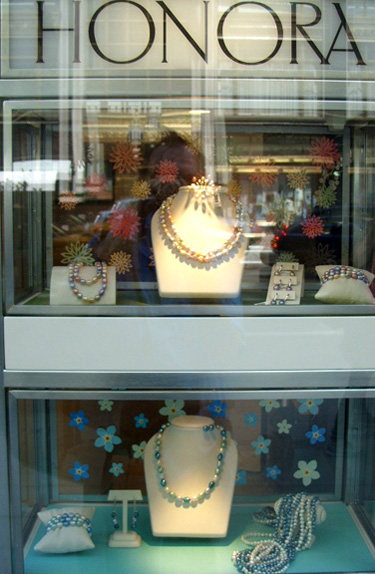
Since I failed to get a shot of Tiffany's store in Midtown, thought I would say something about Louis Comfort Tiffany, the famous designer ( especially associated with Art Nouveau) who did so much work in stained glass...
His father was a successful businessman. Louis attended a number of schools include a military school and studied with artists in New York and Paris.
To quote Wikipedia about his early career:
Tiffany started out as a painter, but became interested in glassmaking from about 1875 and worked at several glasshouses in Brooklyn between then and 1878. In 1879, he joined with Candace Wheeler, Samuel Colman and Lockwood de Forest to form Louis Comfort Tiffany and Associated American Artists. Tiffany's leadership and talent, as well as his father's money and connections, led this business to thrive.
In 1881 Tiffany did the interior design of the Mark Twain House in Hartford, Connecticut, which still remains, but the new firm's most notable work came in 1882 when President Chester Alan Arthur refused to move into the White House until it had been redecorated. He commissioned Tiffany, who had begun to make a name for himself in New York society for the firm's interior design work, to redo the state rooms, which Arthur found charmless. Tiffany worked on the East Room, the Blue Room, the Red Room, the State Dining Room and the Entrance Hall, refurnishing, repainting in decorative patterns, installing newly designed mantelpieces, changing to wallpaper with dense patterns and, of course, adding Tiffany glass to gaslight fixtures, windows and adding the opalescent floor to ceiling glass screen in the Entrance Hall.[4][5][6]
A desire to concentrate on art in glass led to the breakup of the firm in 1885 when Tiffany chose to establish his own glassmaking firm that same year. The first Tiffany Glass Company was incorporated December 1, 1885 and in 1902 became known as the Tiffany Studios.
In the beginning of his career, Tiffany used cheap jelly jars and bottles because they had the mineral impurities that finer glass lacked. When he was unable to convince fine glassmakers to leave the impurities in, he began making his own glass. Tiffany used opalescent glass in a variety of colors and textures to create a unique style of stained glass. This can be contrasted with the method of painting in enamels or glass paint on colorless glass that had been the dominant method of creating stained glass for hundred of years in Europe. (The First Presbyterian Church building of 1905 in Pittsburgh, Pennsylvania is unique in that it uses Tiffany windows that partially make use of painted glass.) Use of the colored glass itself to create stained glass pictures was motivated by the ideals of the Arts and Crafts movement and its leader William Morris in England. Fellow artists and glassmakers Oliver Kimberly and Frank Duffner, founders of the Duffner and Kimberly Company and John La Farge were Tiffany's chief competitors in this new American style of stained glass. Tiffany, Duffner and Kimberly, along with La Farge, had learned their craft at the same glasshouses in Brooklyn in the late 1870s.
In 1893, Tiffany built a new factory called the Stourbridge Glass Company, later called Tiffany Glass Furnaces, which was located in Corona, Queens, New York. In 1893, his company also introduced the term Favrile in conjunction with his first production of blown glass at his new glass factory. Some early examples of his lamps were exhibited in the 1893 World's Fair in Chicago. At the Exposition Universelle (1900) in Paris, he won a gold medal with his stained glass windows The Four Seasons.
Of course, Tiffany is also associated with fine jewelry. To quote Wikipedia again
It appears that Louis Comfort Tiffany waited until after his father’s death (
Charles Lewis Tiffany) in 1902 before beginning to create jewelry. On March 22, 1902 Tiffany was approved to become a member of Tiffany & Co.’s Board of Directors, afterwards becoming vice-president and art director. This motion gave Tiffany the ability to make executive choices, without being under the shadow of his father any longer Tiffany was able to focus his creative energies on his jewelry.
[1] Tiffany began to dabble with jewelry designs in 1902 at
Tiffany Furnaces, with the intent of showing his pieces as part of Tiffany & Co.’s display at the
St. Louis Exposition. It was the perfect venue for him to show his range of talent in a variety of mediums. All the jewelry Tiffany made during this time was stamped with “Louis C. Tiffany,” along with “Artist.”
[2] Unfortunately there are no day books or ledgers that survived to help provide information on how Tiffany went about his jewelry prior to 1907, however his exhibit at the St. Louis Exposition provides some knowledge of his ventures.
[3]Inspiration For many of the pieces that Tiffany produced during this time, his focus gravitated towards flower-like inspirations. The nature theme was also a current motif that occurred in many of his other works. He also produced some pieces based on Etruscan prototypes.[3]
Motifs such as wild carrots, dandelions, birds and blackberries were quite common. The scarab theme was also used quite frequently as a decorative motive in his jewelry and desktop items.[4] It is noted that many of the pieces took on a very chunky appearance, reminiscent of the jewelry worn by the Celts. His work was very different from the airy, fluttery look of the Art Nouveau.[5] Tiffany’s jewelry can be categorized into two main areas of influence, naturalism and historicism, but after further investigation it is apparent that he had many other influences, some being quite unidentifiable.[6] How does he use colour and pattern?
Most of Tiffany’s work has a lot of pattern, and looks busy but his use of colour makes his work stand out from everyone else’s. He uses mostly different tones of greens, blues and yellows in his glass work and lamps.
 I could not get anywhere near the Puerto Rican Day Parade...